











Introduction
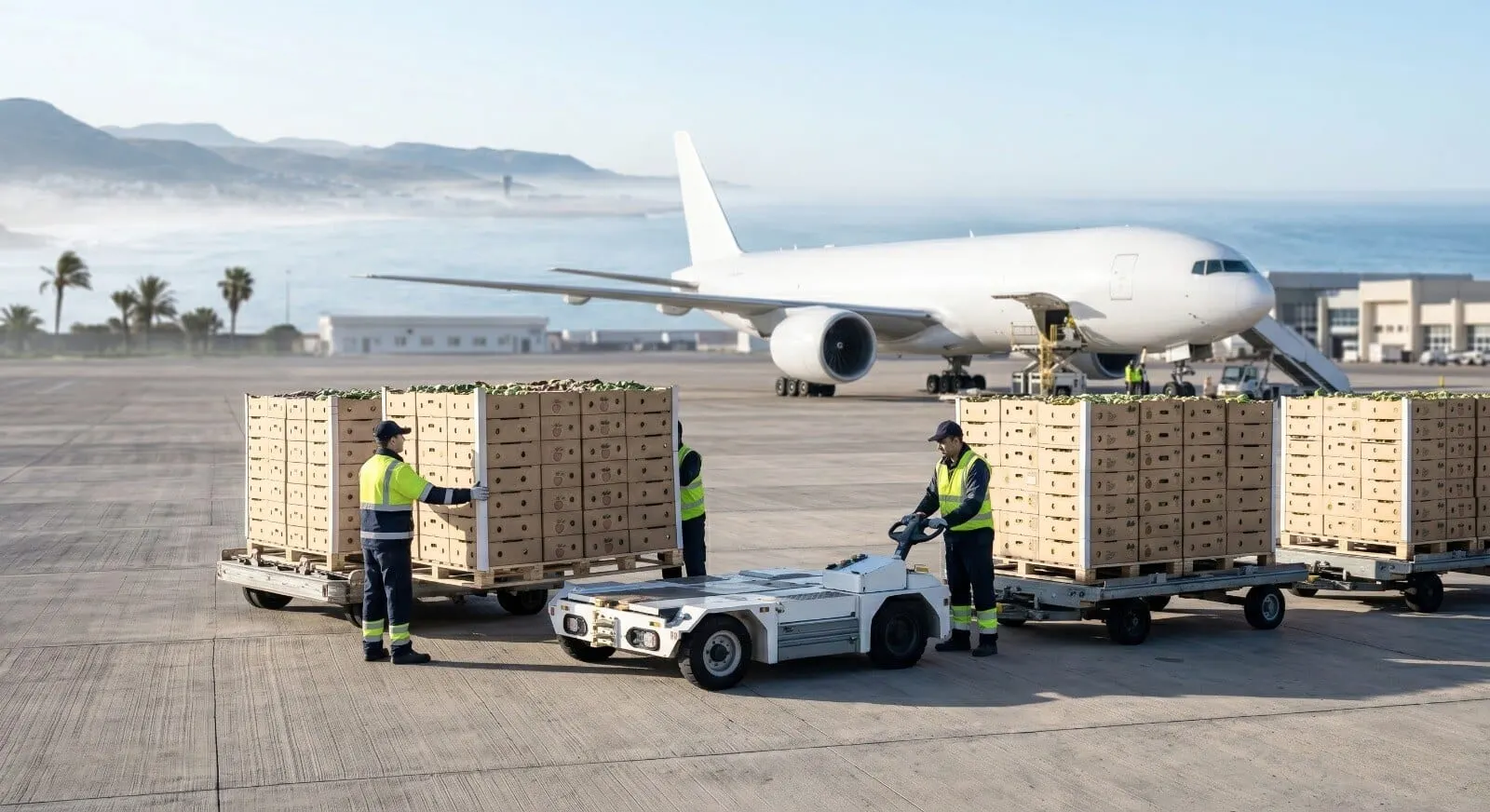
Air transport in Morocco plays a role disproportionate to its share of freight volumes. By weight, air freight is a small fraction of Morocco’s total cargo movement — the maritime and road sectors dominate in tonnage. But air transport is the critical enabler for Morocco’s highest-value industries: aerospace components on just-in-time schedules, pharmaceutical shipments requiring GDP cold chain compliance, fresh strawberries for premium European supermarkets, and fast-fashion samples connecting Moroccan manufacturers with EU buyers.
In 2025, Morocco’s aviation sector crossed a significant threshold: 36.3 million passengers, an 11% increase over 2024 — described by Airports of Morocco as “a structural turning point for air transport in Africa.” [1] The same infrastructure expansion supporting passenger growth directly increases Morocco’s air freight capacity and reliability.
1. Morocco’s Airport Network: The Four Airports That Matter for Cargo
| Airport | IATA | 2025 Traffic | Cargo Role | Key Note |
|---|---|---|---|---|
| Casablanca Mohammed V | CMN | 11M+ passengers | Primary hub; 150,000 t/yr capacity; Terminal 3 = cargo exclusively | 50 airlines; 96+ destinations; 4th-busiest in Africa |
| Agadir Al Massira | AGA | 10% national traffic | Air gateway for Souss-Massa fresh produce (strawberries, tomatoes) | 45–60 min from major packhouses; Airport 2030 modernisation |
| Tangier Ibn Battouta | TNG | +17% growth 2025 | Secondary aerospace cargo — Airbus/Boeing supply chain parts | Proximity to Tanger Med Free Zone industrial zones |
| Marrakesh Menara | RAK | 10M+ passengers | Primarily passenger; limited cargo — fashion samples, luxury goods | Airport 2030 modernisation contract awarded to Jet Contractors |
The 2025 passenger milestone matters for cargo shippers for a structural reason: belly cargo capacity on passenger aircraft is the primary source of air freight capacity on most Morocco-Europe routes. A 10.8% passenger growth year translates to proportionally more belly cargo capacity — more weekly frequencies, more competitive rates — on lanes like Casablanca-Paris, Agadir-London, and Tangier-Madrid. [1]
2. Which Industries Use Air Freight in Morocco — and Why
| Industry | Key Cargo | Why Air | Key Company / Contract |
|---|---|---|---|
| Aerospace | Precision parts, components | JIT schedules; no delay tolerance; high value per kg | CEVA Logistics: 3-yr Morocco–France contract renewed June 2025 |
| Premium Fresh Produce | Strawberries, asparagus, tomatoes | Shelf life too short for maritime; premium EU buyers justify cost | Souss-Massa to Paris CDG / London LHR via AGA or CMN |
| Pharmaceuticals | APIs, finished doses, vaccines | GDP cold chain required; high value; regulatory compliance | Sanofi, Cooper Pharma; 2–8°C temperature control |
| Automotive (urgent) | Line-stop prevention parts | EUR 20,000+/hr production line cost > air freight cost | Renault/Stellantis: emergency parts Tangier ↔ France |
| Fashion & Textiles | Samples, fast replenishments | Buyer decision cycle faster than sea transit allows | Decathlon, Asos, Boohoo: typically under 500 kg |
| Electronics | High-value components | High value-to-weight ratio justifies air premium | Morocco's growing electronics assembly sector |
“Airport 2030 emphasises infrastructure adaptation, stronger air connectivity, supporting not only passenger travel but also air cargo and regional trade flows, contributing to a more efficient African supply chain.”
— Airports of Morocco / Logistics Business Africa, January 2026
3. Air Freight Transit Times and Costs: Morocco 2026 Benchmarks
Flight times from Casablanca CMN
| Route | Flight Time | Door-to-Door (cargo) | Key Carriers |
|---|---|---|---|
| Casablanca → Paris CDG | 3h 30min | 18–36 hours | Royal Air Maroc, Air France, Iberia |
| Casablanca → Madrid | 2h 30min | 16–28 hours | Royal Air Maroc, Iberia, Ryanair (belly) |
| Casablanca → Frankfurt | 3h 45min | 20–36 hours | Royal Air Maroc, Lufthansa |
| Casablanca → London LHR | 3h 30min | 20–36 hours | Royal Air Maroc, British Airways |
| Casablanca → Dubai | 6h 45min | 24–48 hours | Royal Air Maroc, Emirates |
| Casablanca → Dakar | 3h 00min | 24–48 hours | Royal Air Maroc, Air Senegal |
| Agadir → London LGW | 3h 45min | 24–42 hours | Royal Air Maroc, easyJet (belly) |
Air freight cost benchmarks — Morocco to Europe (2026 indicative)
| Cargo Type | Indicative Cost | Operational Note |
|---|---|---|
| General cargo (CMN → Paris CDG) | EUR 1.80–3.50 per kg | Minimum charge EUR 80–120 per shipment |
| Perishables / temperature-controlled (CMN → EU) | EUR 3.00–6.00 per kg | Requires pre-booked ULD and priority handling |
| Pharmaceuticals GDP (CMN → EU) | EUR 4.00–8.00 per kg | Specialist handling; continuous temperature records |
| Aerospace components (CMN / TNG → Paris / Toulouse) | EUR 2.50–5.00 per kg | Time-definite, door-to-door, typically under standing forwarder agreement |
| Fashion / textiles (under 500 kg, CMN → EU) | EUR 2.00–4.00 per kg | Express courier competitive for under 30 kg |
Air vs. maritime vs. road: when to choose air
| Factor | Air Freight | Maritime (FCL) | Road (Morocco-Spain) |
|---|---|---|---|
| Door-to-door transit | 18–48 hours | 5–7 days (Agadir–Rotterdam) | 18–28 hours |
| Cost per kg | EUR 1.80–8.00 | EUR 0.02–0.08 | EUR 0.03–0.15 |
| Minimum viable shipment | Any weight; min charge ~EUR 100 | LCL 1 CBM; FCL full container | Full truck typically 24 tonnes |
| Temperature control | Available (ULD, active reefer) | Reefer container (excellent) | Reefer truck (excellent, real-time) |
| Ideal cargo | High value, urgent, perishable, <500 kg | Bulk, ambient, non-urgent | Produce, automotive, FMCG |
| Carbon footprint | Highest per tonne-km | Lowest per tonne-km | Moderate |
4. Morocco’s Airports 2030 Strategy: USD 2.8 Billion in Investment
The U.S. ITA Morocco Infrastructure Guide 2025 confirms approximately USD 2.8 billion in airport investment. [3]
What Airports 2030 means for cargo shippers
Every passenger terminal expansion in Morocco translates directly to more belly cargo capacity on Morocco–Europe routes. A CMN terminal handling 35 million passengers annually — versus today’s 15 million — serves roughly twice as many weekly aircraft movements. For cargo shippers, this means more available space, more frequent services, and more competitive air freight rates on the Casablanca–Paris, Casablanca–Madrid, and Casablanca–Frankfurt lanes through the late 2020s.
5. Air Freight Documentation in Morocco
6. Digital Integration: Connecting Air Freight to the Full Supply Chain
Air freight’s speed advantage is only realised when the upstream and downstream road legs are equally efficient. A cargo that flies from Casablanca to Paris CDG in 3.5 hours and waits two days for road delivery to Lyon has not used its speed. Equally, a cargo delayed on the road leg from a Casablanca packhouse to the airport misses its flight and the time advantage is lost.
FreshTrack tracks the road legs that bookend every air freight shipment. For a pharmaceutical shipment from a Casablanca laboratory to a Paris hospital: the temperature-controlled road leg from lab to CMN cargo terminal is tracked in real time, with automated alerts if temperature deviates from the 2–8°C GDP requirement. At the destination, the road leg from CDG cargo to the hospital is also tracked and documented.
The same monitoring applies to premium fresh produce — a blueberry shipment, for example, is tracked against a 1°C target with an acceptable range of 0–2°C, with alerts triggered the moment the cold chain drifts outside that window.
The air leg is managed by the airline — FreshTrack provides the complete multimodal picture that no single carrier system can offer, a capability that extends beyond Morocco’s traditional European lanes to growing air freight corridors with the Middle East, China, and Montreal. This visibility depends on a tracker being fitted to the pallet: shipments equipped with one are monitored end-to-end on the road legs, while those without cannot be tracked.
Structured for Google People Also Ask and AI Mode. All figures sourced.
Frequently asked questions
What is the main airport for air freight in Morocco?
Mohammed V International Airport (CMN) in Casablanca — 150,000 tonnes cargo capacity per year; Terminal 3 exclusively for freight; 50 airlines; 96+ destinations; 11M+ passengers in 2025; 4th-busiest in Africa. [1,6]
How much cargo does Morocco's aviation sector handle?
CMN designed for 150,000 tonnes/year cargo capacity. [6] Morocco's airports collectively handled 36.3 million passengers in 2025 (+10.8%). ONDA/Airports of Morocco revenue: MAD 5.4B in 2024 (from MAD 3.3B in 2021). Operating profit MAD 1.9B. [7]
What is Morocco's Airports 2030 strategy?
USD 2.8B in airport investment: new CMN terminal (15M to 35M passengers/year, by 2029); new Casablanca airport; Rabat-Sale, Fez, Agadir, Marrakesh expansions. [3] Every passenger terminal expansion proportionally increases belly cargo capacity on Morocco–Europe routes.
Which industries use air freight in Morocco?
Aerospace (CEVA 3-yr Morocco–France contract, June 2025); premium fresh produce (strawberries, asparagus from Souss-Massa); pharmaceuticals (GDP cold chain); automotive parts (line-stop prevention for Renault and Stellantis); fashion samples (Decathlon, Asos, Boohoo). [8]
How long does air freight from Morocco to Europe take?
Casablanca to Paris CDG: 3h 30min flight; 18–36 hours door-to-door. Casablanca to Madrid: 2h 30min flight; 16–28 hours door-to-door. For urgent pharma or aerospace with pre-arranged customs, 18–24 hours achievable on the Casablanca–Paris lane.
What is the cost of air freight from Morocco?
2026 indicative: general cargo EUR 1.80–3.50/kg; temperature-controlled perishables EUR 3.00–6.00/kg; GDP pharmaceuticals EUR 4.00–8.00/kg. Minimum charge EUR 80–120 per shipment. Air freight is 20–50x more expensive per kg than maritime FCL — justified only for high-value, urgent, or perishable cargo.
Does Morocco have direct air cargo services to Africa?
Yes. Casablanca Mohammed V serves as Morocco's primary hub for Sub-Saharan Africa, with Royal Air Maroc connecting to Dakar, Abidjan, Bamako, Nairobi, and other key African cities. Airports 2030 explicitly targets stronger African air connectivity as a pillar of Morocco's role as 'a strategic platform for African trade.' [1]
References
All statistics traceable to primary or authoritative secondary sources.
© 2026 FreshTrack · freshtrack.ma/en · All statistics verified as of May 2026.
- Airports of Morocco (formerly ONDA). 36.3M passengers 2025 (+10.8%); Casablanca 11M+; Marrakesh 10M+; Rabat +26%; Tangier +17%. Via Logistics Business Africa, January 2026.
- Wikipedia. Airports of Morocco (ONDA). Official rebranding 2025; management of all public airports.
- U.S. ITA. Morocco Infrastructure Guide 2025. USD 2.8B airport programme; CMN new terminal; Rabat, Fez, Agadir, Marrakesh projects.
- European Commission — DG Trade. EU-Morocco Association Agreement — EUR.1 certificates.
- ONSSA. Phytosanitary certification for Moroccan agricultural air freight exports.
- CRI Casablanca-Settat. Mohammed V Airport: 14M passenger capacity; 150,000 tonnes cargo/year; 2 cargo terminals; 50 airlines; 96+ destinations.
- Morocco World News. ONDA revenue MAD 3.3B (2021) to MAD 5.4B (2024); operating profit MAD 1.9B. October 2025.
- Mordor Intelligence. Morocco Freight and Logistics Market 2026–2030. CEVA 3-yr Morocco–France aeronautics contract, June 2025.
- Wikipedia. Mohammed V International Airport. New terminal: 15M to 35M passengers/year by 2029.
- Royal Air Maroc. Fleet and network; Sub-Saharan Africa routes; cargo services.
- Casablanca-Airport.com. CMN: 33% of Morocco flights; Terminal 3 for cargo; 96+ destinations.
- World Bank. LPI 2023. Digitalisation reduces port delays by up to 70%.
- EU. Regulation (EU) 2017/625 on official controls — BIP procedures for third-country agri-food air freight.