
Proactive Detection of Logistics Anomalies: What Your TMS Will Never See
KEY POINTS
Introduction: when your TMS’s silence is what costs you
In international logistics, your TMS does its job with discipline: it plans, executes, documents. It tells you where your container is, which shipping line operates the leg, what the theoretical ETD and ETA are. That is its natural scope — and it honours it.
But real logistics is governed by another reality: the unexpected. Port congestion, unannounced blank sailings, missed cut-offs, silent temperature drift inside a refrigerated container — these events show up in your TMS only when it is too late to act.
Proactive detection of logistics anomalies has become the competitive advantage most supply chain leaders underestimate — until they measure the cost of its absence on their invoices.
01 — What your TMS sees — and what it does not
A TMS is built for execution. It does not correlate vessel AIS positions with real-time port data. It does not flag that an unannounced blank sailing will push your ETD by 5 days. It does not detect that congestion in Rotterdam has just triggered your demurrage free-time window.
| What the TMS sees | TMS limitation | What FreshTrack detects |
|---|---|---|
| → Theoretical ETA/ETD | Static status, manually updated | Real ETA gaps vs. plan in real time |
| → Documentary status | No predictive analysis | Imminent demurrage risk (D−3) |
| → Carrier & booking | Siloed per carrier | Unnotified route deviations |
| → Contractual costs | No real-time cost estimate | Cold chain temperature incidents |
| → Post-incident reporting | Confirmed after the fact | Blank sailings anticipated before confirmation |
| → — | No congestion alert | Port congestion & transit time impact |
This information asymmetry is the difference between steering in real time and discovering incidents on your invoices — often several weeks after they have generated their cost.
What you do not see, you cannot measure. What you do not measure, you cannot reduce. The lack of logistics visibility does not stay inside the operational perimeter — it directly impacts your organisation's financial performance.
02 — The missing layer: predictive intelligence
Logistics is no longer just a transport question — it is an information question. In an environment where decisions are made in seconds and where every hour of immobilisation generates a cost, the ability to anticipate the unexpected becomes the primary source of competitiveness.
Why fragmented data kills performance
The proliferation of channels — emails, phone calls, carrier portals, scattered files — dilutes critical information. Your teams spend a substantial share of their time consolidating data rather than making decisions. The result: reactive trade-offs, taken too late, on incomplete information.
The principle of proactive detection
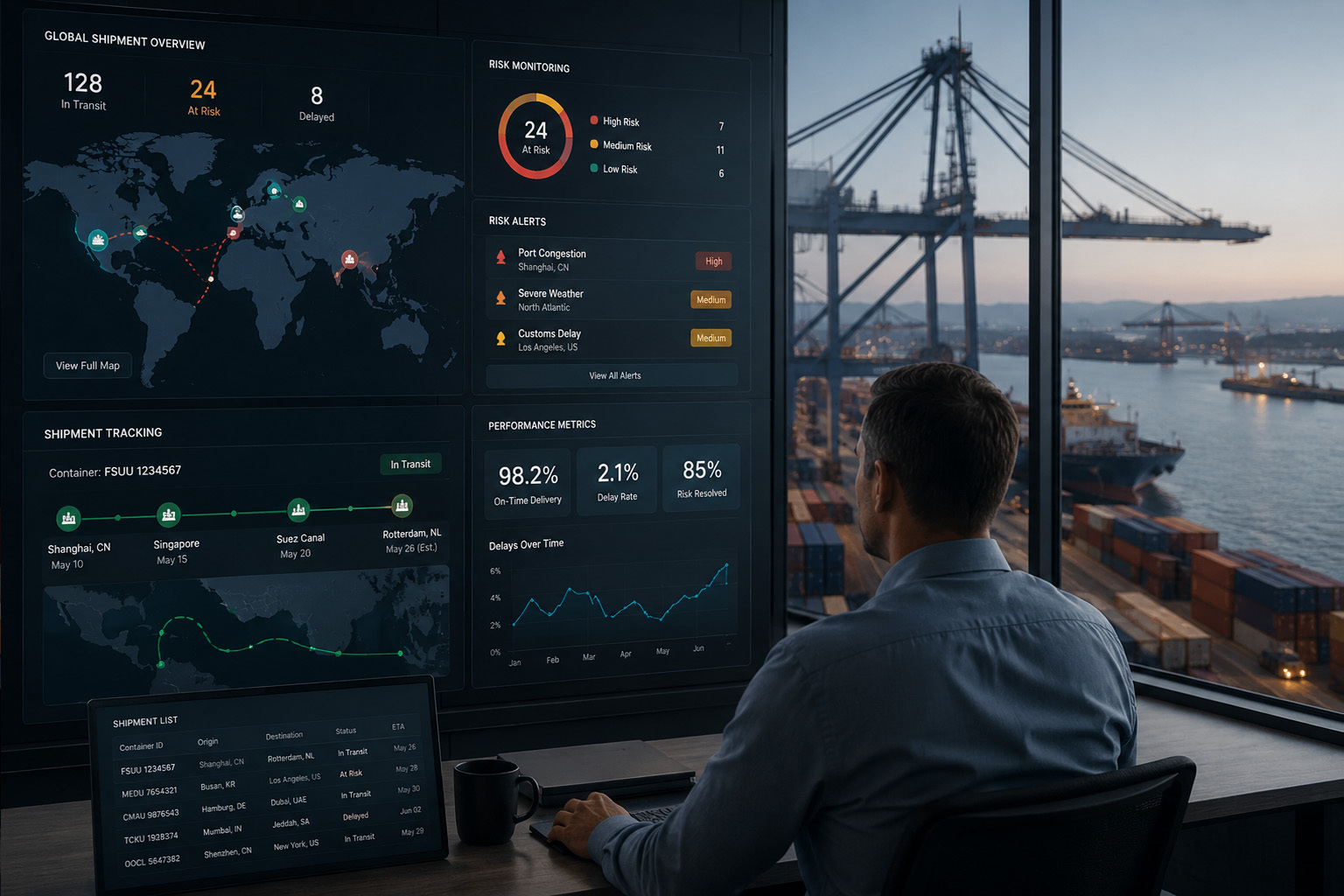
FreshTrack continuously analyses several simultaneous data streams — vessel AIS positions, port data, weather conditions, historical performance per route and per carrier — to correlate weak signals that the human eye cannot detect alone.
An alert reaches you before demurrage starts ticking, before the container deviates from its route, before a cold chain break compromises your goods. The action window stays open.
03 — TMS vs FreshTrack: an objective comparison
FreshTrack is not a replacement TMS — it is a strategic layer that grafts onto your existing system to bring what it structurally lacks: the ability to see what is about to happen before it occurs.
| Capability | Classic TMS | FreshTrack |
|---|---|---|
| Real-time position tracking | Partial | Complete & multi-source |
| Anomaly detection | Reactive only | Proactive — before the incident |
| Demurrage & detention alerts | No | Yes — D−3 anticipation |
| Route risk analysis | No | AI recommendations |
| Cold chain temperature tracking | No | Real-time alerts |
| Intelligent logistics assistant | No | Continuous analysis |
| Financial impact of incidents | No | Quantified per shipment |
| Carrier performance benchmark | Limited | Consolidated data |
The data is the same in both configurations. The only variable: the ability to anticipate.
04 — The four pillars of FreshTrack proactive detection
FreshTrack’s detection architecture rests on four distinct capabilities which, combined, constitute a complete steering system — not a tracking tool, but a preventive action system.
Multi-source consolidation
All your shipping lines, ports and partners aggregated in real time inside a single interface — zero fragmentation, zero informational blind spot.
Contextualised proactive alerts
Each alert is prioritised by estimated financial impact and accompanied by available action options — before the incident materialises.
Route risk analysis
Every routing decision informed by real historical data — performance, reliability and actual cost per carrier, route and season.
AI logistics assistant
Continuous analysis of your flows, suggested corrective actions, identification of recurring anomaly patterns so root causes can be addressed.
05 — The real financial impact of logistics invisibility
Demurrage and detention fees are the most striking illustration of the cost of invisibility. These charges, billed as soon as the free-time window granted by the shipping line is exceeded, can amount to several hundred euros per container per day — without any signal being raised in your TMS.
The hidden costs of informational standstill
Beyond demurrage, lack of visibility generates an ecosystem of diffuse costs that silently erodes commercial margin: late-delivery penalties at destination, cold chain product losses, suboptimal purchasing decisions due to unreliable ETAs, manual handling cost of carrier claims.
| Hidden cost category | Mechanism | Typical impact |
|---|---|---|
| Demurrage & detention | Port free-time exceeded without anticipation | $75–300 / container / day depending on port and carrier (Freightos & Drewry, 2024) |
| Emergency rerouting overcost | Action window closed = express solution | Significant overcost vs. planned rate (varies by route and mode) |
| Distributor SLA penalties | Delay confirmed before contacting provider | Variable per distributor contract (check commercial agreement) |
| Cold chain losses | Undetected deterioration in transit | Partial to total loss |
| Reduced insurance reimbursement rate | Incomplete incident documentation | Potential reduction (varies by policy and documentation) |
Conclusion: visibility is not an option — it is margin protection
Your TMS does not disappear — it continues doing what it was designed for. But in a world where global supply chains absorb ever-more-frequent shocks, the ability to anticipate has become the most valuable logistics competency.
FreshTrack is not yet another tool in your stack. It is the intelligence layer that turns your logistics data into a durable competitive advantage — by giving you a head start on every incident, every overcost, every risk.
The question is no longer whether your operations generate hidden costs. The question is how much they really amount to — and how long you can afford to keep not seeing them.
What you don't see today is already costing you. It's time to see.
Free logistics diagnostic
Request your personalised 30-minute logistics diagnostic
Free, no strings attached. Together we will identify your supply chain blind spots and their real cost on your margin.
FAQ — Frequently asked questions
What is the difference between a TMS and a visibility solution like FreshTrack?
A TMS plans and executes transport: contract management, bookings, documents and basic tracking. It operates in passive mode and waits for manual updates from carriers. FreshTrack is a visibility and predictive intelligence layer on top of the TMS: it proactively detects anomalies by correlating multi-source data in real time, anticipates overcosts and provides action recommendations before incidents materialise. The two tools are complementary — FreshTrack does not replace your TMS, it brings what your TMS structurally cannot have.
How does FreshTrack detect logistics anomalies in real time?
FreshTrack continuously aggregates multi-source data: vessel AIS positions, port data, historical performance per carrier and route, congestion information, weather conditions. An analytics engine correlates these signals to identify emerging anomalies — route deviations, demurrage risk, temperature incidents — and triggers proactive alerts with classified risk level and available action options.
Is FreshTrack compatible with all shipping lines?
Yes. FreshTrack is connected to the main global shipping lines — CMA CGM, Maersk, MSC and many others — and integrates with their real-time data feeds. The platform centralises this information into a single dashboard, removing the need for your teams to consult several portals in parallel.
What concrete gains does proactive detection bring on demurrage?
FreshTrack generates proactive alerts as soon as a free-time overrun risk is identified — before fees start ticking. This anticipation allows teams to trigger corrective actions inside the window where they are still effective.
Is FreshTrack suited to exporting SMEs or only to large groups?
FreshTrack offers two tiers: Solution Horizon (free) for a consolidated view of maritime schedules, and Solution Navigator, the full steering and risk-management platform, priced based on shipment volume. FreshTrack supports exporting SMEs as well as large groups, on both dry and reefer flows, regardless of sector.
How does FreshTrack integrate with the existing information system?
FreshTrack runs in the browser, no heavy install required. For companies with an existing ERP or TMS, API connectors enable smooth integration into the existing IT ecosystem. The FreshTrack team supports each rollout with a structured onboarding to guarantee fast adoption and measurable ROI within the first weeks.
References & Sources
- Drewry Supply Chain Advisors — Demurrage & Detention Benchmark Report (via Container xChange), 2023 — https://www.drewry.co.uk/supply-chain-advisors/supply-chain-expertise/demurrage-detention
- Container xChange — Demurrage & Detention Annual Benchmark Report, 2023 — https://www.container-xchange.com/blog/demurrage-detention/
- Gartner — Market Guide for Real-Time Transportation Visibility Platforms, 2024 — https://www.gartner.com/en/supply-chain/insights/real-time-transportation-visibility-platforms
- Alphaliner — Vessel Schedule Reliability Tracker, Q1 2025 — https://www.alphaliner.com
- McKinsey & Company — Risk, resilience, and rebalancing in global value chains, 2020 — https://www.mckinsey.com/capabilities/operations/our-insights/risk-resilience-and-rebalancing-in-global-value-chains
- Tanger Med Port Authority — Performance Report & Throughput Data, 2024 — https://www.tangermed.ma/en/tanger-med-port/
- Freightos — What is Demurrage: Meaning, Charges & Detention (updated 2024-2025) — https://www.freightos.com/freight-resources/demurrage-meaning-fees-and-charges/