
Strait of Hormuz Closed: What the Decade's Biggest Logistics Crisis Costs Your Supply Chain
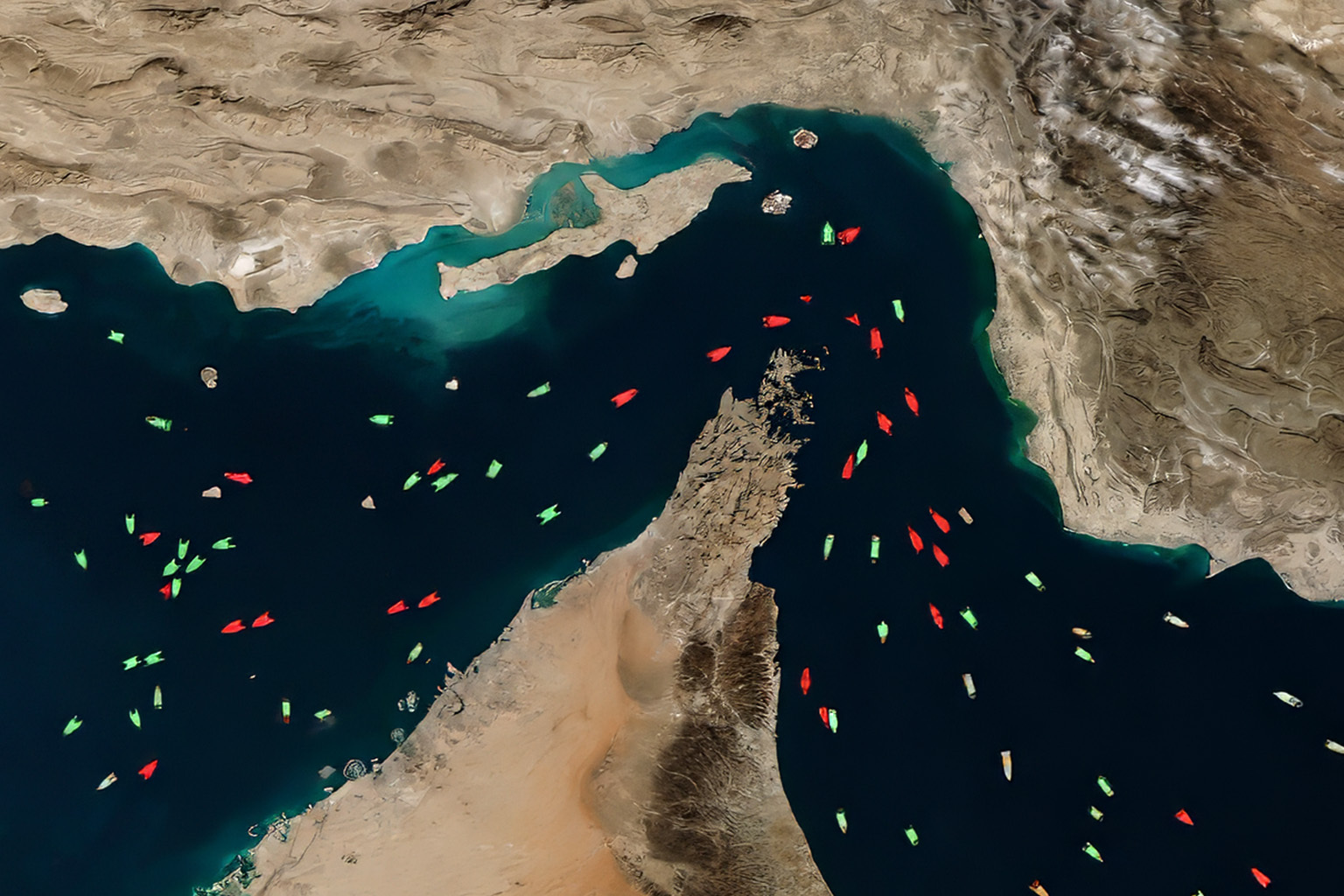
Active crisis alert — May 2026
Strait of Hormuz: situation still volatile despite fragile de-escalation signals.
KEY POINTS — 30S READ
Introduction: when geopolitics shuts off the world’s tap
On April 18, 2026, Iran re-closed the Strait of Hormuz for the second time in a week, citing American violations of the ceasefire in force. The day before, Iran’s Foreign Minister had announced that the Strait was “fully open”. Crude had dropped 10% in a few hours. This reversal, occurring on a Saturday to avoid immediate market impact, captures with precision the logistics environment Moroccan exporters operate in today: volatile, unpredictable, and financially brutal.
Since February 28, 2026 — the date of the American-Israeli strikes on Iran under Operation Epic Fury — the Strait of Hormuz has been the theatre of the worst maritime crisis since the Tanker War of the 1980s. For supply chain directors, logistics managers and CFOs handling export flows from Morocco, this article poses a direct question: is your organisation equipped to navigate a world where maritime routes close in 48 hours?
01 — Timeline of an unprecedented crisis
To grasp the operational impact, you first need to grasp the speed at which this crisis materialised. The following events unfolded in under 50 days.
| Date | Event |
|---|---|
| Feb 28, 2026 | Operation Epic Fury: American-Israeli strikes on Iran. The IRGC announces closure of the Strait. War-risk insurance premiums quadruple in 72 hours. |
| Mar 2, 2026 | The IRGC officially confirms the closure. Maersk and Hapag-Lloyd suspend Middle East routes. No tanker broadcasts an AIS signal in the strait. |
| Mar 4, 2026 | Brent crosses $90/barrel. 230 loaded tankers stuck in the Gulf. Pakistan and Bangladesh facing LNG supply emergencies. |
| Mar 10, 2026 | UNCTAD publishes its assessment: traffic down 95%, global growth revised down. Urea up 50% since the start of the crisis. |
| Mar 15, 2026 | Trump demands NATO and China help reopen the Strait. China responds by blocking the South China Sea. |
| Apr 8, 2026 | Temporary ceasefire. Iran announces a reopening but imposes passage fees of over $1 million per vessel. |
| Apr 17, 2026 | Iran announces the Strait is "fully open". Crude drops 10% in hours. The announcement is quickly contradicted. |
| Apr 18, 2026 | Iran re-closes the Strait, citing the continued US naval blockade. Gunboat fire on a tanker confirmed by UKMTO. The crisis resumes. |
| Apr 20, 2026 | Maritime traffic remains near zero. The Iranian Parliament considers a law imposing tolls on "non-hostile" vessels. Situation volatile. |
| May 4, 2026 | Trump launches Operation Project Freedom: a US naval mission escorting merchant vessels out of the Persian Gulf. The IRGC calls the operation a "violation of the ceasefire". Fire exchanges between US and Iranian forces in the Strait push Brent to $114.44/barrel (+6% in a single day, Al Jazeera). According to the IMO, 20,000 sailors remain stranded on roughly 2,000 vessels in the Strait. |
| May 6, 2026 | Trump suspends Operation Project Freedom citing "great progress" toward a possible deal. The IRGC states that safe transit through the Strait will be "ensured" once US threats stop, while requiring new procedures whose substance remains unspecified (Al Jazeera, May 6, 2026). Pakistan announces it is mediating between Washington and Tehran. |
| May 8, 2026 | Today: Brent at ~$101/barrel, up after new US-Iran fire exchanges (CNBC). Pakistan-Iran-US negotiations continue; Islamabad "hopes for an agreement at the earliest". Shipping operators warn that traffic restart will be slow, even with an agreement, with shipowners requiring a "stable, predictable and durable situation" (NBC News). Status: active negotiations, fragile ceasefire. |
In 50 days, the Strait of Hormuz went from vital corridor to war zone. Logistics organisations without real-time visibility discovered their incidents on their invoices.
02 — The numbers redrawing the global risk map
To measure the real impact of the Strait closure on your supply chain, you first need to understand what this 34-kilometre corridor represents in the global economy.
of global seaborne crude oil flows
Kpler, 2026
drop in vessel traffic since March
UNCTAD, March 2026
Brent crossed in April ($/barrel)
Reuters, Apr. 2026
War-risk insurance premiums multiplied
Congress.gov, 2026
What these numbers don’t say directly: the impact is not limited to oil and LNG. As documented by the World Economic Forum, the crisis affects a far broader spectrum of commodities and inputs. The Strait of Hormuz is not only the jugular vein of global energy — it is also the jugular vein of agriculture, chemical industry and batteries.
| Commodity / flow | Share transiting Hormuz | April 2026 crisis impact |
|---|---|---|
| Crude oil | 31% of global seaborne flows | Brent >$100/barrel, Asia supply disruption |
| LNG | 20% of global exports | Pakistan/Bangladesh: risk of electricity demand destruction |
| Fertilisers / Urea | 25-35% of global exports | Urea +50%; 2026 harvests compromised in North America |
| Sulphur (OCP feedstock) | ~50% of seaborne trade | Pressure on Moroccan phosphate output — OCP impact |
| Methanol (plastics) | ~33% of global trade | Higher packaging costs; Chinese ports under stock pressure |
| Aluminium (UAE) | 21% of 2025 US imports | Metal market tensions; impact on agri-export packaging |
| TOTAL MOROCCO EXPOSURE | Direct double exposure | Freight + inputs + fertilisers + insurance + energy markets |
03 — Moroccan exposure: a low-visibility double vulnerability
Morocco does not route its exports through the Strait of Hormuz. Its main maritime routes — to Europe, the United States, Asia — go through the Strait of Gibraltar, Tanger Med, the Atlantic and Mediterranean lines. For a Moroccan supply chain director, it is tempting to view the Hormuz crisis as distant.
This reading is a strategic mistake. Morocco’s exposure is double, structural, and already materialising in balance sheets.
Vector 1 — The cost contagion across all maritime routes
The closure of Hormuz does not only slow down Gulf routes — it redistributes pressure across every global maritime corridor. Shipowners that suspended their Persian Gulf lines redeploy capacity on other routes, including the Atlantic and Mediterranean lines your shipments use. War risk premiums spread. Insurers recalibrate. ETAs turn volatile market-wide.
In concrete terms: Moroccan sovereign bond yields have already moved from 5.5% to nearly 6% in early April 2026 (Morocco World News). Maritime freight costs on Morocco-Europe lines have come under significant pressure, with operators passing on the broad rise in insurance premiums and fuel costs.
Vector 2 — The input shock: sulphur, OCP, and the agricultural domino effect
This is the least visible vector — and the most structurally significant for the Moroccan economy. ISS African Futures and Kpler have documented it with precision: nearly 50% of the global sulphur trade transits the Strait of Hormuz, primarily from the United Arab Emirates and Saudi Arabia.
Sulphur is the critical input for sulphuric acid production, itself essential to manufacturing phosphate fertilisers — OCP Group’s core business. When sulphur supply contracts, Moroccan phosphate output cannot be scaled, even though reserves are abundant and internal logistics intact.
The consequence: a reduction in the global supply of Morocco-sourced phosphate fertilisers, in a context where fertiliser prices have already risen 50% since the start of the crisis (Feb 2026, UNCTAD). For Moroccan agri-food exporters, this translates into higher upstream agricultural production costs, even though their shipments have never come near the Persian Gulf.
Rise in global fertiliser prices since February 2026
UNCTAD, March 2026
Of global seaborne sulphur transiting Hormuz
ISS/Kpler, 2026
Moroccan sovereign bond yields (April 2026)
MWN, April 2026
Morocco does not export through Hormuz. But Hormuz exports its consequences all the way to Morocco. That is the systemic nature of modern geopolitical crises: they have no logistics borders.
04 — Six perspectives on the same crisis: impact by your position in the chain
The Hormuz crisis does not wear the same face depending on where you stand in the supply chain. Here is how it concretely materialises for six operational profiles.
Moroccan agri-food exporter
Your ETAs are wrong. Your insurance costs have exploded.
Shipping lines are recalibrating their global rotations in response to capacity withdrawal from the Gulf. Your ETAs on Europe and Asia lines are less reliable than usual. War premiums are expanding their geographical perimeter. Every SLA contract you signed with a European distributor is potentially at risk.
Logistics operator / freight forwarder
Your clients are calling. You don't have the answers.
Route and ETA uncertainty multiplies update requests. Without consolidated visibility, your teams manually piece together fragmented information from multiple portals, at the expense of service quality and customer relationship. You endure the crisis instead of steering it.
Shipping line
Your routes need to be rewritten. Your customers absorb your adjustments.
Shipowners that suspended Persian Gulf services are repositioning vessels on other corridors, disrupting frequencies and capacity on Atlantic and Mediterranean lines. For your shipper clients, this translates into rarer space, higher rates, and unanticipated rotation changes.
Marine insurer
Your 72-hour cancellation-clause policies are being exercised.
War risk policies carry 72-hour cancellation clauses in case of conflict. In an environment of opening-closing-reopening of the Strait, each cycle triggers a tariff recalibration. Premiums have multiplied 4 to 5 times. For shippers, this translates into insurance costs impossible to plan beyond 48 hours.
Farmer / agri-food cooperative
Your inputs cost more. Your competitiveness is affected.
Pressure on sulphur directly impacts the availability and price of phosphate fertilisers, of which Morocco is both a global producer and a significant domestic consumer. Higher fertiliser costs at agricultural production, in a context of high export logistics costs, systemically compress margins.
CFO / executive leadership
Your operational risk exposure has never been so visible.
The Hormuz crisis has made visible something balance sheets normally don't show: strategic dependence on global maritime corridors. For companies without a dedicated logistics risk management layer, exposure is maximal. For those equipped, the crisis is a resilience test — not a catastrophe.
05 — In geopolitical crisis, risk management changes nature
In normal conditions, logistics risk management protects against operational incidents — demurrage, delays, mis-assigned containers. In geopolitical crisis conditions, it becomes something more fundamental: the ability to maintain visibility and reactivity in an environment where the fundamentals change in 48 hours.
What the Hormuz crisis reveals about passive tools
In a stable market, a classic TMS “works” within the limits of its passivity. Detection delays are costly but manageable. In an environment where a maritime route can be closed in 48 hours, where ETAs are recalibrated daily, and where insurance premiums shift over 72 hours, a passive system does not manage the unexpected — it endures it.
- A container stuck in a Gulf port awaiting transshipment to Europe generated no alert in any TMS — until the carrier manually updated the status.
- Maritime rotation changes triggered by the crisis were not notified in real time to shippers. ETAs were already obsolete by the time they were consulted.
- Rerouting trade-offs — switching from a Maersk route to an alternative — required hours of manual information consolidation that some organisations no longer had time to do.
The Hormuz crisis does not create new logistics risks. It reveals those that were already there, silently — in every hour lost manually consolidating information that your organisation accepted as inevitable.
06 — What your organisation must do now: the crisis protocol
In active geopolitical crisis, retrospective preparation does not exist. What exists is the ability to react fast with reliable data. Here is the protocol the best-equipped organisations are applying today.
| Priority | Action to take |
|---|---|
| Immediate | Map all shipments in progress and their transshipment routes |
| 24-48h | Identify shipments at demurrage risk in the next 7 days |
| This week | Verify the status of war-risk insurance policies on all active routes |
| This week | Proactively communicate with customers on revised ETAs before they notice |
| This month | Benchmark performance of alternative shipping lines |
| ABSOLUTE PRIORITY | Audit your organisation's detection and reactivity capacity in the face of maritime disruption |
FAQ — Frequently asked questions
Does the Strait of Hormuz directly impact Moroccan exports to Europe?
Not directly via transit — Morocco-Europe routes do not pass through Hormuz. But the impact is indirect and structural: broad rise in global maritime insurance costs, pressure on fleet capacity redistributed from the Gulf to other corridors, rise in fertiliser costs via sulphur pressure, and ETA instability across the entire container transport market. The impact is systemic, not direct.
What are the alternatives to Hormuz routes for regional exporters?
For Gulf countries, alternatives include Saudi Arabia's IPSA pipeline to the port of Yanbu on the Red Sea, the UAE-Fujairah pipeline (limited capacity), and land routes via Turkey. For Moroccan exporters, whose routes do not transit Hormuz, vigilance must focus on contagion effects: higher rates on Atlantic and Mediterranean corridors due to fleet repositioning, and monitoring of agricultural input prices.
Will the crisis last? What scenario should we anticipate?
The situation as of May 8, 2026 is the following: a fragile ceasefire is in force, but fire exchanges between American and Iranian forces in the Strait occurred on May 4 and 5, keeping oil markets under high tension (Brent at ~$101-114/barrel depending on the day). Operation Project Freedom — the US naval escort mission — was launched on May 4 and suspended on May 6 after diplomatic "progress". Pakistan is actively mediating between Washington and Tehran. Iran has signalled that transit will be "ensured" once US threats lift, but without specifying new procedures. Shipping operators warn that even after an agreement, traffic restart will be gradual, with shipowners requiring a "stable, predictable and durable situation" before resuming operations (NBC News, May 7, 2026). For supply chains, the operational lesson remains unchanged: crises of this kind last longer than anticipated and their effects propagate well beyond their apparent geographical perimeter. The IMF has revised its baseline projection on a mid-2026 de-escalation — a hypothesis that the May events tend to call into question.
How do I calculate my organisation's financial exposure to this crisis?
Exposure has four components: (1) higher freight costs on your active routes, linked to capacity redistribution; (2) higher maritime insurance premiums on cargo in transit; (3) the cost of undetected incidents — demurrage, unanticipated delays, SLA penalties; (4) the impact of fertiliser and input costs if you are upstream of the agricultural chain.
Conclusion: geopolitics as a revealer
The Strait of Hormuz crisis is exceptional in its scale. It is not in its nature. Major geopolitical disruptions — the Red Sea crisis in 2024, the war in Ukraine in 2022, the pandemic in 2020 — have each demonstrated that global maritime corridors are vulnerable and that supply chains not equipped to detect and react in real time pay the full price of every shock.
What the Hormuz crisis reveals to every supply chain director, every CFO, every logistics manager is a simple equivalence: the quality of your detection system is proportional to your capacity to survive the next crisis.
Hormuz will not close forever. But the next disruption — whether it comes from another geopolitical zone, an extreme weather event, or a supply chain failure — will arrive. The question is not if. The question is how fast your organisation sees it — and whether it will still have time to act.
What you don't see today is already costing you. It's time to see.
Crisis logistics diagnostic
Audit your supply chain's exposure to the Hormuz crisis
30 minutes, free, no strings attached. Together we map your at-risk routes, your exposure to insurance premiums and your operational blind spots.
Sources & References
- UNCTAD — Strait of Hormuz disruptions: Implications for global trade and development, March 2026 — https://unctad.org/publication/strait-hormuz-disruptions-implications-global-trade-and-development
- UNCTAD — Hormuz disruption deepens global economic strain, April 2026 — https://unctad.org/news/hormuz-disruption-deepens-global-economic-strain-across-trade-prices-and-finance
- CNBC — The Strait of Hormuz is facing a blockade. These countries will be most impacted, March 2026 — https://www.cnbc.com/2026/03/03/strait-of-hormuz-closure-which-countries-will-be-hit-the-most.html
- CNBC — How Strait of Hormuz closure can become tipping point for global economy, March 2026 — https://www.cnbc.com/2026/03/11/strait-of-hormuz-closure-shipping-economy-oil.html
- World Economic Forum — Beyond oil: 9 commodities impacted by the Strait of Hormuz crisis, April 2026 — https://www.weforum.org/stories/2026/04/beyond-oil-lng-commodities-impacted-closure-hormuz-strait/
- Kpler — The Strait of Hormuz blockade: what it means for grain and food security, March 2026 — https://www.kpler.com/blog/the-strait-of-hormuz-blockade-what-it-means-for-grain-and-food-security
- ISS African Futures — Hormuz exposes Africa’s fertiliser structural risk, 2026 — https://futures.issafrica.org/blog/2026/Hormuz-exposes-Africas-fertiliser-structural-risk
- Morocco World News — Morocco Faces Rising Economic Pressure as Middle East War Drives Regional Slowdown, April 2026 — https://www.moroccoworldnews.com/2026/04/287604
- CNN — Live updates: Ceasefire deadline looms as Iran closes Strait of Hormuz, April 19, 2026 — https://www.cnn.com/2026/04/18/world/live-news/iran-war-trump-israel
- Congress.gov / CRS — Iran Conflict and the Strait of Hormuz: Impacts on Oil, Gas, and Other Commodities, March 2026 — https://www.congress.gov/crs-product/R45281
- Al Jazeera — Iran says Strait of Hormuz passage to be ensured after US pauses operation, May 6, 2026 — https://www.aljazeera.com/news/2026/5/6/french-container-ship-struck-in-latest-escalation-at-strait-of-hormuz
- Al Jazeera — Oil prices surge as violence flares in Strait of Hormuz, May 5, 2026 — https://www.aljazeera.com/economy/2026/5/5/oil-prices-surge-as-violence-flares-in-strait-of-hormuz
- CNBC — Oil prices today: U.S.-Iran fire exchange rattles fragile Hormuz ceasefire, May 8, 2026 — https://www.cnbc.com/2026/05/08/oil-prices-today-wti-brent-us-iran-fire-war-hormuz-ceasefire.html
- NBC News — Why the Strait of Hormuz will take a long time to reboot, May 7, 2026 — https://www.nbcnews.com/world/iran/strait-hormuz-will-take-long-time-reboot-rcna343817
- NPR — Pakistan says it’s hopeful a U.S.-Iran deal can happen soon, May 7, 2026 — https://www.npr.org/2026/05/06/nx-s1-5813497/iran-war-strait-hormuz-updates