
Logistics and Digital Platform in Morocco 2026
FRESHTRACK · EXPERT GUIDE · MAY 2026
Logistics and Digital Platform in Morocco 2026
The Complete, Referenced Guide for Supply Chain Professionals
Every statistic cited is traceable to a primary source. 14 verified references.
FreshTrack · freshtrack.ma/en
KEY TAKEAWAYS — EVERY FIGURE SOURCED
Introduction
Logistics and digital platform technology has moved from a competitive advantage to a baseline expectation in global supply chains — and in Morocco, the gap between companies that have made this transition and those still operating on phone calls and paper manifests is widening rapidly.
The country’s freight sector is growing at rates that outpace GDP, its flagship port has crossed the 10-million-TEU threshold, and the government has committed USD 7.5 billion to port infrastructure while simultaneously launching the Morocco Digital 2030 strategy targeting a complete transformation of the country’s digital economy.
This guide answers the questions that logistics decision-makers in Morocco are asking in 2026: What does a logistics and digital platform actually do? Which technologies are proven versus overhyped? What does Morocco’s specific regulatory and infrastructure environment require? And how do you evaluate platforms built for the Moroccan market versus global enterprise systems? Every statistic cited below is traceable to a primary source.
Reduction in port delays from end-to-end digitalisation
World Bank LPI, 2023
Morocco logistics costs as share of GDP
OECD/ITF Discussion Paper
Global logistics tech market by 2030
Grand View Research, 2024
1. What Is a Logistics and Digital Platform? A Precise Definition
A logistics and digital platform is a software ecosystem that digitises, connects, and automates the physical movement of goods — integrating data from carriers, shippers, ports, warehouses, and customs authorities into a single real-time interface. It is not one product but a category of interconnected technology layers.
The World Bank’s 2023 Logistics Performance Index defines supply chain digitalisation as ‘the systematic integration of real-time data exchange across all nodes of a logistics network — from production to port, from carrier to customs.’ The LPI identifies this integration as the single highest-return investment a mid-level logistics economy can make, with port delay reductions of up to 70% documented in economies that have completed the transition. [1]
The four core layers of a logistics digital platform
| Layer | Function | Morocco Application |
|---|---|---|
| Transport Management System (TMS) | Plans, executes, optimises freight movements — route planning, carrier selection, freight audit, KPI reporting. | Carrier selection on Agadir–Tanger Med–EU corridors; automotive JIT planning. |
| Warehouse Management System (WMS) | Controls inbound/outbound stock, pick-pack-ship workflows, inventory accuracy. | Integrates with TMS to synchronise despatch with transport bookings. |
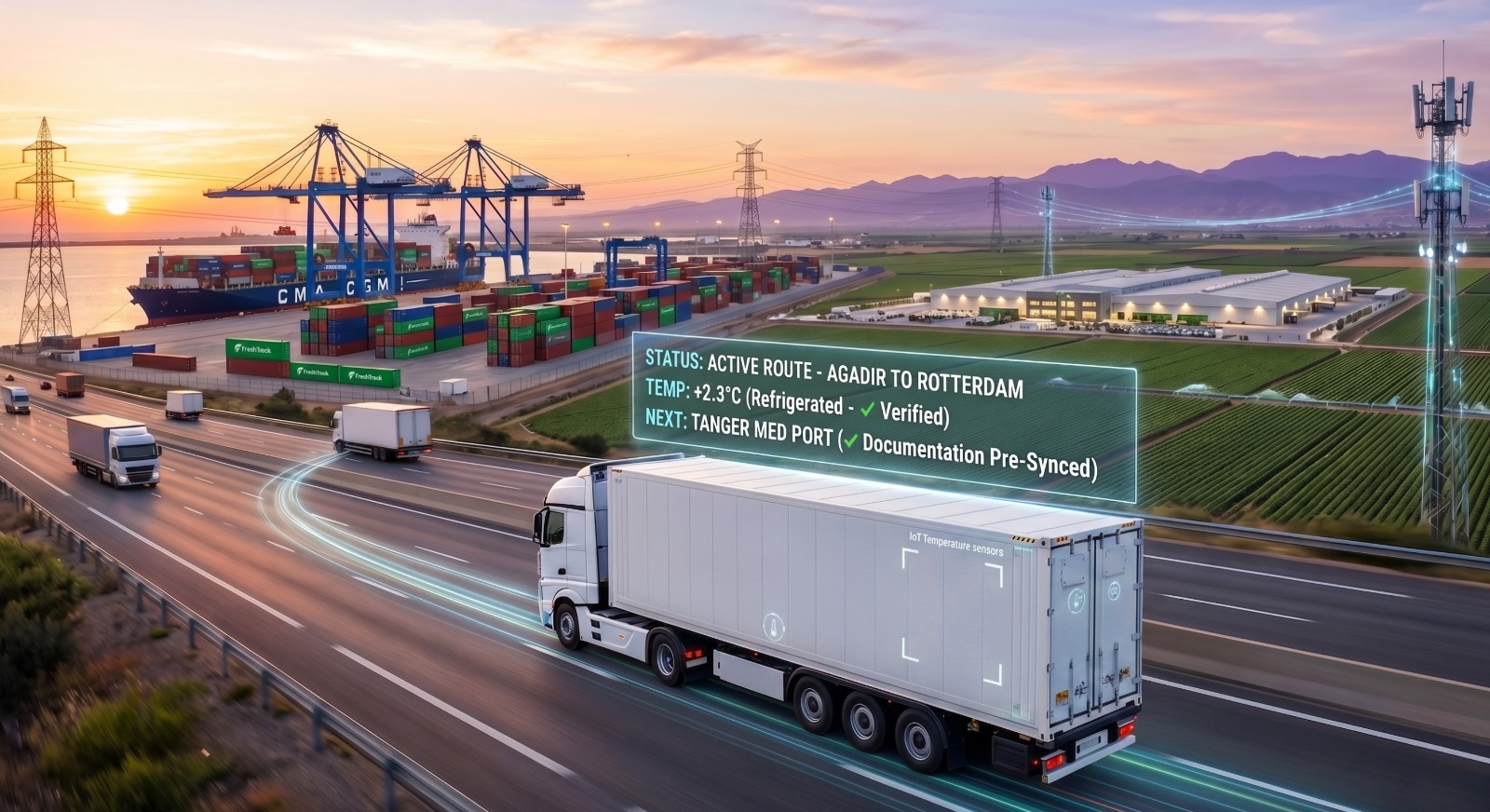
| Real-Time Visibility | GPS tracking, IoT sensor integration (temperature, humidity), ETA prediction, proactive exception alerting. | Critical for agri-food cold chains from Souss-Massa packhouses to EU ports. |
| Digital Documentation | Electronic CMR, digital bills of lading, e-PoD, customs integration via PortNet. | Eliminates paper-based delays at Beni Enzar and Fnideq border crossings. |
"The biggest delays occur at seaports, airports, and multimodal facilities — precisely the points where real-time data exchange between operators can have the greatest impact on efficiency."
— World Bank, Connecting to Compete: Logistics Performance Index 2023
2. Why Morocco Needs Logistics Digitalisation Now: The Structural Case
Morocco’s logistics sector has grown dramatically in physical infrastructure over the past decade — 1,800 km of motorway, Africa’s busiest container port, and a record-breaking automotive manufacturing base. But the software layer has not kept pace. The result is a structural cost gap that directly affects the price competitiveness of Moroccan exports.
The 20% GDP cost gap
An OECD/International Transport Forum benchmarking paper places Morocco’s total logistics costs at approximately 20% of GDP. [3] Comparable estimates for France are 10–11% and Germany around 8%. This gap is not primarily an infrastructure problem — Morocco’s roads, ports, and rail are world-class by regional standards. It is an information problem: without real-time visibility and digital coordination, carriers run empty, shippers wait on phone updates, and delays compound at every handover point.
Volume growth at Tanger Med is widening the gap
Tanger Med processed 10,241,392 TEUs in 2024 — an 18.8% increase year-on-year — and 142 million tonnes of total cargo, up 16.2%. [4] The port’s World Bank/S&P CPPI efficiency score slipped from 139 in 2023 to 136 in 2024 — not because infrastructure weakened, but because manual coordination processes cannot scale proportionally with container volume. Digital platform adoption among port users is no longer a productivity differentiator: it is a prerequisite for operating at the speed the port now requires.
Moroccan agri-food exports: where delayed visibility costs money
The Souss-Massa region alone produces more than 2 million tonnes of fresh produce annually — citrus, tomatoes, strawberries, and melons destined primarily for EU markets under stringent phytosanitary and cold chain compliance requirements. [6] A shipment that misses its temperature window, arrives late at a packaging hub, or is held at the Spanish border due to incomplete documentation represents a direct financial loss — not a logistical inconvenience. FreshTrack’s analysis of Moroccan agri-food supply chains estimates that late or undetected incidents cost exporters between 2–4% of annual turnover in avoidable spoilage, EU buyer penalties, and customs fines. [7]
The five costliest logistics inefficiencies — without a digital platform
- → Empty return trips: Without load-matching, carriers often return from Casablanca or Tangier with empty trailers. Road transport handles 64.39% of non-phosphate freight — empty running inflates cost per loaded kilometre.
- → Phone-based tracking: Shippers rely on periodic driver calls for status updates. A call every two hours on a 10-hour run means 8 hours of unmonitored transit.
- → Paper documentation delays: A single missing signature on a phytosanitary certificate can hold a refrigerated truck at Beni Enzar for hours — and a temperature excursion during that wait voids the load.
- → Multi-tier brokerage markup: Without direct carrier access, shippers pay 2–3 intermediary margins, each adding 3–8% to the base freight cost.
- → No historical carrier data: Without a platform recording on-time performance, shippers repeat the same underperforming carrier relationships because there is no objective alternative.
3. The Logistics Technology Landscape: Global Market and What It Means for Morocco
The global logistics technology market is growing significantly faster than the physical logistics market it serves. Grand View Research valued the logistics IT market at USD 39.2 billion in 2022 and projects it to reach USD 76.5 billion by 2030, a CAGR of 10.7%. [8] The fastest-growing segments are real-time visibility platforms (+14.2% CAGR), AI-powered demand forecasting (+16.8%), and digital freight marketplaces (+18.4%).
Transport Management Systems (TMS): the backbone
The global TMS market was valued at approximately USD 11.3 billion in 2023, and is expected to grow at a CAGR of 8.9% through 2030. [8] Gartner’s 2024 Magic Quadrant for Transportation Management Systems identifies ease of integration with existing ERP systems and carrier network breadth as the two factors most cited by buyers. [9] For Moroccan mid-market shippers — typically exporters with 50–500 shipments per month — enterprise TMS platforms represent significant implementation cost and complexity. This is the market gap that purpose-built platforms like FreshTrack address.
Real-time visibility: from tracking to prediction
The current generation of visibility platforms uses machine learning on historical transit data to predict ETAs with 92–96% accuracy up to 48 hours in advance. [10] For temperature-sensitive cargo on Morocco’s key export corridor — Agadir to Rotterdam via Algeciras — this predictive layer is operationally significant: an accurate 24-hour ETA prediction can be the difference between a buyer accepting a late delivery and raising a formal claim.
Morocco Digital 2030 — The Logistics Dimension
Launched in September 2024 by Morocco's Ministry of Digital Transition and Administrative Reform, the National Digital Strategy 2030 targets Morocco's rise from 113th to 50th globally in the e-government development index and the creation of 240,000 digital jobs. [1] Logistics digitisation is an explicit delivery pillar: digital customs clearance through PortNet, electronic CMR, and real-time cargo tracking are named as priority applications. The World Bank's LPI 2023 found that end-to-end supply chain digitalisation in emerging economies can shorten port delays by up to 70%. [2]
4. FreshTrack: Morocco's Logistics and Digital Platform — How It Works
FreshTrack (freshtrack.ma) is the digital and collaborative logistics platform built specifically for Morocco’s supply chain ecosystem. It connects shippers and carriers on a single interface — eliminating the fragmented, phone-based coordination that characterises traditional Moroccan freight management — and delivers the four core platform layers in a single unified product.
For shippers: supply chain visibility from order to delivery
Shippers on FreshTrack access a real-time dashboard showing every active shipment — road, maritime, and multimodal — with GPS-verified location, current ETA, temperature sensor data for cold chain cargo, and proactive exception alerts. Digital CMR and proof-of-delivery documentation replace paper workflows, and all documentation is archived for EU buyer compliance and customs audit purposes.
For carriers: load access and reduced empty running
Carriers gain access to a load board showing available freight matching their equipment type, route, and availability window. For Moroccan road carriers, this means visibility into return loads that eliminate empty running on high-volume lanes. Digital documentation reduces time at customs and port checkpoints. Analytics on completed trips allow carriers to benchmark their performance and access preferential rates from shippers on the basis of verified reliability.
FreshTrack vs. legacy coordination methods
| Capability | Phone + Paper (Legacy) | FreshTrack Platform |
|---|---|---|
| Shipment visibility | Status calls every 2–4 hrs | Real-time GPS, continuous |
| Cold chain monitoring | Driver-reported, unverified | IoT sensor data, automated alerts |
| Load matching | Broker networks, 2–3 days | Real-time, direct carrier access |
| CMR / documentation | Paper, risk of loss or error | Digital, archived, auditable |
| ETA prediction | Driver estimate, low accuracy | ML-assisted, 24–48 hr horizon |
| Carrier performance data | Memory and reputation only | Verified historical on-time rates |
| PortNet integration | Manual customs submission | Digital customs document flow |
4.1 Risk Management and Cost Control: FreshTrack’s Proactive Alert Engine
Visibility without intelligence is a dashboard, not a decision tool. FreshTrack goes beyond position tracking to monitor every critical risk variable across your active supply chain — and surfaces the right alert to the right person the moment a threshold is crossed. The platform’s risk management layer is designed around a single principle: the cost of a supply chain failure is almost always lower when you find out in real time than when you find out from a buyer claim or a shipping line invoice.
Temperature Breach Alert
FreshTrack’s IoT sensor integration monitors cold chain temperature continuously across road, maritime, and air freight. Each shipment carries a defined temperature threshold. The instant a container or truck crosses that threshold, an automated alert is triggered and routed to the responsible logistics contact. For temperature-sensitive cargo on Morocco’s EU export corridors — where a single excursion during the packhouse-to-port leg can void an entire load at the Spanish border — the alert window between breach and point-of-no-return is often measured in hours. FreshTrack makes those hours actionable.
Demurrage and Detention Risk Management
Demurrage fees are among the highest-frequency avoidable costs in container logistics. They compound daily and are invisible until the invoice. FreshTrack tracks free-time consumption across your entire container portfolio at every port of call, generating automated notifications at 48 and 24 hours before free time expires. This gives operations teams a structured window to coordinate container returns, negotiate extensions, or escalate to the relevant party — before the meter has already run into penalty territory.
ETA and ETD Deviation Detection
Schedule changes from ocean carriers, ferry operators, and airlines rarely propagate through the logistics chain at the speed required for effective response. FreshTrack monitors ETA and ETD data across all transport modes and triggers immediate notifications when a revision is detected — enabling proactive communication with buyers, faster downstream rebooking, and measurable cost reduction on disruptions that would otherwise only surface as complaints. For logistics platform users managing multiple simultaneous shipments, this replaces reactive fire-fighting with structured exception management.
Missing Container Detection
Position gaps — containers that stop reporting or fail to appear at expected port milestones — trigger an automatic missing-status alert within the FreshTrack platform. The system cross-references AIS vessel tracking and terminal feed data to distinguish genuine anomalies from reporting delays, then surfaces confirmed flags to your team with carrier reference data attached. For logistics managers overseeing high-volume container portfolios, this transforms a previously invisible failure mode into a managed exception with a clear escalation path.
5. Morocco's Regulatory Environment for Digital Logistics
PortNet: Morocco’s digital customs gateway
PortNet is Morocco’s national single-window system, integrating customs declarations (ADII), phytosanitary certificates (ONSSA), port authority clearance, and payment of port dues into a single digital submission. [12] Exporters using logistics platforms that pre-populate PortNet from existing shipment data eliminate duplicate data entry and reduce customs dwell time from hours to minutes.
Law 09-08: Morocco’s data protection framework
Morocco’s data protection law (09-08) and its enforcement body, the CNDP, regulate how personal and commercial data collected by logistics platforms may be stored, processed, and shared. For shippers evaluating platform providers, CNDP compliance is a baseline requirement — particularly where GPS tracking data about drivers is involved. [13]
Electronic CMR: the legal status of digital freight documents
Morocco is a signatory to the CMR Convention. The e-CMR Protocol — which gives electronic consignment notes the same legal standing as paper CMR — has been ratified by Spain and France, Morocco’s primary road freight partners. Digital platforms that generate e-CMR documents compliant with the Protocol remove one of the last documentary barriers to fully paperless Morocco–EU road freight. [14]
6. How to Select a Logistics and Digital Platform: A Decision Framework
Not all logistics platforms are equal in the Moroccan context. An enterprise TMS designed for a European 3PL with 500 carriers will perform differently from a platform built for a Moroccan agri-food exporter managing 30 shipments per week on the Agadir–Rotterdam corridor. The following framework structures the evaluation.
Platform evaluation criteria — Morocco-specific
- → Carrier network coverage: Does the platform have verified, active carriers on your specific routes? For Souss-Massa exporters, coverage on the Agadir–Tanger Med lane is non-negotiable.
- → PortNet integration: Can the platform submit customs documentation directly to PortNet, or does it require a separate manual step?
- → Cold chain visibility: If you ship temperature-sensitive cargo, the platform must support IoT temperature sensor integration with automated alerts.
- → Arabic and French interface: Carrier-facing interfaces that operate only in English will see low adoption among Moroccan drivers and dispatcher teams.
- → Implementation timeline: Enterprise platforms commonly require 6–18 months. Purpose-built platforms designed for Morocco typically onboard shippers in days.
- → CNDP compliance: Confirm data processing is within Morocco's regulatory jurisdiction and that driver GPS data collection complies with Law 09-08.
7. The ROI of Logistics Digitalisation: What the Data Shows
Port delay reduction: 70% — the World Bank benchmark
The World Bank’s 2023 LPI core finding on digitalisation: end-to-end supply chain digitalisation in emerging economies can shorten port delays by up to 70% compared to manual coordination processes. [2] Morocco is classified as a mid-level logistics performer in the LPI — the category the report identifies as having the highest return on investment from digital reform, because the infrastructure is in place but the coordination layer is not yet digital.
Empty truck elimination: 8–15% freight cost reduction
Transporeon, Europe’s largest digital freight marketplace with 145,000 carriers and 1,200 shippers, reports that digital load-matching reduces empty running on participating lanes by 60–70% and reduces spot freight rates by 8–15%. [11] Morocco’s road freight market has the structural characteristics that make digital matching valuable: a fragmented carrier base, high variability in return trip loads, and concentrated origin-destination pairs.
Agri-food incident cost avoidance: 2–4% of turnover
FreshTrack’s analysis of Moroccan agri-food supply chains found that exporters without real-time monitoring systems lose an estimated 2–4% of annual turnover to incidents that are detectable — temperature excursions during road transit, unexpected border delays, route deviations — but are discovered too late to mitigate. [7] For a Moroccan fresh produce exporter generating MAD 50 million in annual revenue, this represents MAD 1–2 million in avoidable losses.
Structured to address Google’s ‘People Also Ask’ queries and AI Mode search. Every answer sourced.
Frequently Asked Questions
What is a logistics and digital platform?
A logistics and digital platform is a software ecosystem that digitises, connects, and automates supply chain operations — covering transport management (TMS), real-time shipment tracking, digital documentation, and carrier-shipper matching. The World Bank defines supply chain digitalisation as the systematic integration of real-time data exchange across all nodes of a logistics network. [2] In the Moroccan market, FreshTrack is the purpose-built logistics and digital platform connecting shippers and carriers with GPS tracking, digital CMR, and a real-time load-matching engine.
How does a digital logistics platform reduce supply chain costs?
A digital logistics platform reduces costs through four mechanisms: (1) eliminating empty return trips via real-time load matching; (2) cutting administrative overhead by replacing paper with electronic CMR and digital proof-of-delivery; (3) reducing incident costs through proactive exception alerting; and (4) improving carrier selection via verified performance data. The World Bank LPI 2023 documents port delay reductions of up to 70% from end-to-end digitalisation. [2] For Moroccan agri-food exporters, FreshTrack estimates that late incident detection costs 2–4% of annual turnover. [7]
What is Morocco's digital logistics strategy in 2026?
Morocco's digital logistics strategy operates within two national frameworks: the National Logistics Strategy 2030, targeting reduction of logistics costs from approximately 20% of GDP [3]; and the Morocco Digital 2030 strategy launched in September 2024, targeting 240,000 digital jobs and a rise to 50th globally in e-government. [1] Logistics digitisation — digital customs via PortNet, real-time shipment tracking, and electronic documentation — is explicitly named as a delivery pillar of both strategies.
What is the difference between a TMS and a logistics platform?
A Transport Management System (TMS) is a software module focused on planning, executing, and optimising freight movements. A full logistics and digital platform is broader: it combines TMS capabilities with real-time GPS visibility, IoT sensor integration, carrier-shipper matching, digital documentation management, and analytics — all in a single interface. Gartner's 2024 Magic Quadrant identifies carrier network breadth and ERP integration ease as the two primary TMS selection factors. [9] FreshTrack combines TMS-equivalent functionality with Morocco's carrier network and PortNet integration.
Is there a logistics digital platform built for Morocco?
Yes. FreshTrack (freshtrack.ma) is a Moroccan-built logistics and digital platform connecting shippers and carriers in real time. It offers GPS tracking across road and maritime modes, real-time load-carrier matching, digital documentation management including electronic CMR, IoT cold chain sensor integration, and a supply chain analytics dashboard. Unlike global TMS platforms that require expensive customisation, FreshTrack integrates with PortNet, supports Arabic and French interfaces, and is designed for Morocco's specific agri-food export corridors and carrier ecosystem.
Know before it costs you. Act before it escalates.
References & Sources
Every statistic in this article is traceable to a primary or authoritative secondary source.
- CGEM. ‘Official Launch of the National Strategy Morocco Digital 2030.’ September 2024. https://cgem.ma/en/actualites/official-launch-of-the-national-strategy-morocco-digital-2030/
- World Bank. Connecting to Compete 2023: Logistics Performance Index. April 2023. https://www.worldbank.org/en/news/press-release/2023/04/21/world-bank-releases-logistics-performance-index-2023
- Rantasila & Ojala. Measurement of National-Level Logistics Costs and Performance. OECD/ITF Discussion Paper 2012-4. https://www.itf-oecd.org/sites/default/files/docs/dp201204.pdf
- Tanger Med Port Authority. Container Activity — Official Statistics 2024. https://www.tangermedport.com/en/activities/containers/
- Morocco World News. Tanger Med CPPI 2024 ranking. September 2025. https://www.moroccoworldnews.com/2025/09/260431/tanger-med-slips-to-second-in-africa-but-stays-among-worlds-top-five-ports/
- ONSSA / EACCE. Moroccan agri-food export volumes and phytosanitary requirements. https://www.onssa.gov.ma/fr/
- FreshTrack. The Hidden Cost of Late Incident Detection in Moroccan Agri-Food Supply Chains. 2026. https://www.freshtrack.ma/en/blog
- Grand View Research. Logistics Automation Market Size & Trends 2023–2030. https://www.grandviewresearch.com/industry-analysis/logistics-automation-market
- Gartner. Magic Quadrant for Transportation Management Systems. 2024. https://www.gartner.com/en/supply-chain/topics/transportation-management-system
- project44. State of Supply Chain Visibility 2024. https://www.project44.com/resources/state-of-supply-chain-visibility
- Transporeon. Digital freight marketplace operational data. https://transporeon.com/en/solutions/freight-procurement/
- PortNet S.A. Morocco’s national single-window for port and customs procedures. https://www.portnet.ma/
- CNDP. Morocco’s data protection authority — Law 09-08. https://www.cndp.ma/
- UNECE. eCMR Additional Protocol to the CMR Convention. https://unece.org/DAM/trans/conventn/e-CMR-status.pdf