
Moroccan Logistics in 2026: The Complete, Referenced Guide
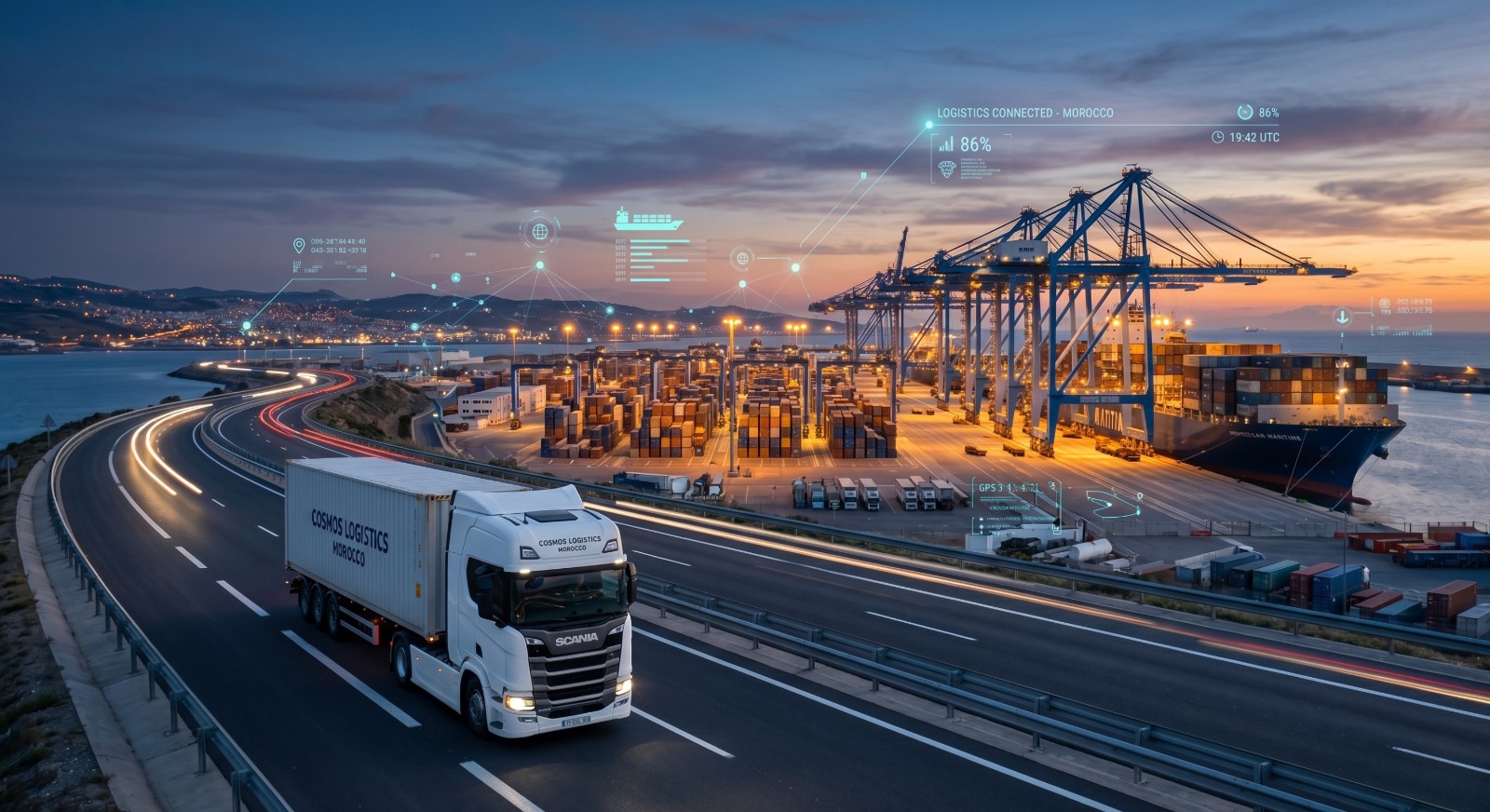
FreshTrack · Market Guide · June 2026
Moroccan Logistics in 2026
The Complete, Referenced Guide to Morocco's Freight & Transport Sector. Every figure sourced, from Tanger Med's official port data to World Bank research. A guide for executives, investors and supply chain professionals, with 16 verified references.
KEY TAKEAWAYS — EVERY FIGURE SOURCED
Introduction
Moroccan logistics stands at a pivotal moment. The country that once depended on imported logistics services has, in two decades, built Africa’s largest container port, a 1,800-kilometre motorway network, and an automotive manufacturing base producing more than half a million vehicles a year. Morocco’s northern coast sits approximately 14 km from Spain across the Strait of Gibraltar — one of the world’s busiest maritime passages — and the country has secured free trade agreements with the European Union, the United States, and Turkey that give Moroccan-origin goods preferential access to markets of over 2.5 billion consumers. [1]
This guide covers every dimension of Moroccan logistics that matters to decision-makers: the market size and growth trajectory, all four transport modes in detail, government strategy and investment commitments, the digital transformation underway, the structural challenges the sector faces, and where the opportunities lie through 2030. Every statistic is cited. Where credible sources disagree — as they do on market size — we present both figures and explain the difference.
Editorial note on market size figures
Morocco's logistics market size is estimated differently depending on scope and methodology. Mordor Intelligence (2025) places it at USD 13.80 billion; Research & Markets (2025) at USD 23.97 billion. Both are commercial research reports, not official government statistics. We cite both precisely so readers can assess the evidence themselves rather than accept a single cherry-picked number.
Market size range, 2026
Mordor Intelligence & Research & Markets, 2025
Tanger Med throughput, 2024
Tanger Med Port Authority — official data
Vehicles produced, Morocco 2024
OICA / CEIC Data (record high)
1. Why Moroccan Logistics Matters: Geography & Strategic Position
Morocco’s logistics significance begins with a map. Its northern coastline lies approximately 14 km from Spain — the narrowest point of the Strait of Gibraltar — placing it at the junction of the Atlantic Ocean and Mediterranean Sea, through which a significant share of global seaborne trade passes daily. [3] This geography is the foundational reason why Tanger Med was built, why global automotive manufacturers chose Morocco for export-oriented assembly, and why Morocco consistently ranks as the primary FDI destination in North Africa.
From Tanger Med, the port of Rotterdam is approximately three days by sea; the Chinese port of Ningbo around 20 days; and the East Coast of the United States around 10 to 14 days. [3] Morocco has signed free trade agreements with the EU, the United States (since 2006), and Turkey. According to AMDIE, these agreements collectively give Moroccan-origin goods preferential access to a consumer market of over 2.5 billion people. [1]
Morocco's principal freight corridors
- → Morocco–Spain/EU (highest volume): Automotive parts, fresh produce, textiles. Road via Tanger Med ferry + container shipping. 516,000 trucks processed at Tanger Med in 2024. [4]
- → Morocco–Sub-Saharan Africa: Consumer goods, construction materials, phosphate derivatives. Growing via the Atlantic Highway and new maritime routes.
- → Casablanca–Tangier domestic corridor: Morocco's highest-volume inland route (~350 km), serving automotive, FMCG, and retail between the two largest economic poles.
- → Agadir–Casablanca (perishables): Temperature-controlled trucks carry fresh citrus, tomatoes, and berries from the Souss-Massa agricultural region to Casablanca processing and export hubs.
- → Khouribga–Jorf Lasfar (phosphate): OCP Group's 235 km slurry pipeline transports phosphate from Morocco's largest mine to its processing complex — one of the world's longest gravity-powered industrial pipelines. [10]
2. Moroccan Logistics Market Size & Growth Drivers
Two major commercial research houses have published estimates for Morocco’s freight and logistics market, and their figures differ materially — which deserves a clear explanation before either is cited in a business context.
Mordor Intelligence (2025) estimates the market at USD 13.80 billion in 2026, forecast to grow to USD 16.32 billion by 2030 at a CAGR of 3.41%. [5] Research & Markets (2025) estimates a broader scope at USD 23.97 billion, projecting USD 32.24 billion by 2030 at a CAGR of 6.11%. [6] The gap reflects different methodological boundaries — what services are included, what base data is used — rather than a factual dispute. Both directional conclusions are consistent: the Moroccan logistics sector is growing at rates that outpace overall GDP.
Automotive manufacturing
Record production and supplier density drive complex freight flows.
Morocco produced a record 559,645 motor vehicles in 2024, according to OICA data tracked by CEIC Data. [7] AMDIE confirms Morocco now hosts 270 automotive suppliers across six regions, up from just 35 in 2000, with proximity to European markets enabling 1-day trucking access to Spain, France, and Italy. [8] In H1 2025, vehicle production grew a further 36% year-on-year, exceeding 350,000 units. [8]
Phosphate industry
A distinct high-volume segment of Morocco's freight market.
Morocco holds 68% of the world's known phosphate rock reserves per the U.S. Geological Survey (January 2025), as cited by OCP Group on its official website. [9] OCP employs nearly 17,000 people and generated revenues of USD 9.76 billion in 2024. [10]
Port infrastructure investment
The 2030 National Port Strategy anchors long-term capacity growth.
Morocco's 2030 National Port Strategy commits USD 7.5 billion to the upgrade and expansion of 27 commercial ports, confirmed by the U.S. International Trade Administration. [11] Major projects include Nador West Med and the Dakhla Atlantic Port.
E-commerce
Revenue growth creates last-mile and micro-fulfillment demand.
Morocco's e-commerce revenue grew from USD 1.21 billion in 2022 to USD 1.38 billion in 2023 and was projected to reach USD 1.61 billion in 2024. [6]
Rail expansion
A major plan extends high-speed connectivity and train capacity.
In April 2025, Morocco approved a USD 10 billion rail plan adding a 430-kilometre high-speed line linking Kenitra, Rabat, Casablanca, and Marrakesh, with 168 trains procured for USD 3.1 billion. [5]
3. Morocco's Four Transport Modes: Verified Data
| Mode | Share / Volume | 2024 Key Data | Source |
|---|---|---|---|
| Road | 64.39% non-phosphate | 1,800 km motorway; 516,000 trucks via Tanger Med | Mordor Intelligence 2025 / Tanger Med Port Authority |
| Maritime | 10.24M TEU | 10,241,392 TEUs (+18.8% YoY); 180+ ports, 70 countries; 17th globally | Tanger Med Port Authority, official 2024 |
| Air Freight | <2% by volume | Critical for aerospace & pharma; CEVA renewed 3-yr Morocco–France contract Jun 2025 | Mordor Intelligence company intelligence, 2025 |
| Rail | 400K TEU/year cap. | Tanger Med rail terminal; phosphate & automotive primary flows; USD 10B expansion approved Apr 2025 | Tanger Med Port Authority; Mordor Intelligence 2025 |
Road Transport: Morocco’s Logistics Backbone
Road transport handles 64.39% of all non-phosphate freight in Morocco, according to Mordor Intelligence’s 2025 market report. [5] The network stretches 1,800 kilometres, with a government commitment to reach 3,000 km by 2030. Tanger Med processed 516,000 trucks in 2024 — up 8.1% year-on-year — and announced a USD 500 million truck terminal expansion in July 2025 to double capacity to one million trucks annually. [4]
A structural cost challenge for road operators: diesel reached 11.26 MAD per litre in June 2025, confirmed by Mordor Intelligence’s sector tracking, [5] following the phase-out of government fuel subsidies. This squeezes carrier margins and accelerates interest in digital load-matching platforms that reduce empty-running kilometres.
Maritime Freight: Tanger Med in Official Numbers
The following data is drawn directly from Tanger Med Port Authority’s official 2024 activity statistics: [2]
Tanger Med 2024 — Official Port Authority Statistics
- → Container throughput: 10,241,392 TEUs — an 18.8% increase over 2023.
- → Global volume ranking: 17th globally by throughput volume (World Bank / S&P CPPI 2024). [16]
- → CPPI efficiency ranking: 5th globally in operational efficiency (World Bank / S&P Container Port Performance Index 2024). [16]
- → Total cargo throughput: 142 million tonnes — up 16.2% year-on-year.
- → Truck crossings: 516,000 — up 8.1% year-on-year.
- → Maritime connections: 180+ ports across 70 countries, served by Maersk, CMA CGM, Hapag-Lloyd, MSC.
- → Rail container capacity: 400,000 TEUs/year at the on-port rail terminal.
Rail: Strategic Role and USD 10 Billion Expansion
Morocco’s rail network focuses on two high-volume commodity flows: phosphate (from the Khouribga region to processing and export ports) and automotive exports from the Renault and Stellantis plants. The Tanger Med rail terminal has an annual capacity of 400,000 TEUs. [2] In April 2025, Morocco approved a USD 10 billion rail expansion plan — a 430-kilometre high-speed line linking Kenitra, Rabat, Casablanca, and Marrakesh, with 168 trains procured for USD 3.1 billion. [5]
Air Freight: Small Volume, Strategic Importance
Air freight represents a small fraction of Morocco’s total freight by weight, but serves industries where speed and product integrity outweigh cost. Morocco’s aerospace sector — supplying Airbus and Boeing through industrial zones near Casablanca and Tangier — relies on precision parts logistics under just-in-time schedules. CEVA Logistics renewed a three-year contract in June 2025 to manage aeronautics parts movements between Morocco and France. [12]
4. Morocco's National Logistics Strategy 2030: What the Government Has Committed
Morocco’s logistics sector operates within an explicit government framework. The National Logistics Strategy 2030 sets measurable targets and investment commitments that shape the competitive environment for every operator in the market.
National Logistics Strategy 2030 — Verified Commitments
- → USD 7.5 billion in port investment across 27 commercial ports via the National Port Strategy, managed by the National Ports Agency (ANP). [11]
- → 36,000 new jobs targeted in the logistics sector. [6]
- → Highway expansion from 1,800 km to 3,000 km by 2030. [5]
- → Nador West Med: 600-hectare industrial-logistics zone. EBRD approved EUR 110 million in December 2024. [5]
- → Dakhla Atlantic Port: USD 1.7 billion; Phase 1 expected to open by 2030; designed to give landlocked Sahel nations Atlantic deepwater access. [11]
- → Logistics cost reduction: Morocco's logistics costs are estimated at approximately 20% of GDP in an OECD/ITF academic paper [13] — the Strategy explicitly targets reducing this figure.
Digital Morocco 2030 — The Logistics Dimension
Launched in September 2024 by the Ministry of Digital Transition and Administrative Reform, the National Digital Strategy 2030 targets Morocco's rise from 113th to 50th globally in the e-government development index and the creation of 240,000 digital jobs. [14] Logistics digitisation — digital customs clearance, real-time shipment tracking, electronic documentation — is a direct application area. The World Bank's LPI 2023 found that end-to-end supply chain digitalisation in emerging economies can shorten port delays by up to 70%. [15]
5. The Digital Transformation of Moroccan Logistics
The World Bank’s 2023 Logistics Performance Index — the most rigorous global benchmarking tool for trade logistics, covering 139 countries — found that end-to-end supply chain digitalisation in emerging economies can shorten port delays by up to 70% compared to manual processes. [15] Morocco is classified as a mid-level logistics performer in the LPI framework — a category the report identifies as having the highest potential return on investment from digital reform.
"The biggest delays occur at seaports, airports, and multimodal facilities — precisely the points where real-time data exchange between operators can have the greatest impact on efficiency."
— World Bank, Connecting to Compete: Logistics Performance Index 2023
Traditional Moroccan logistics has operated through fragmented networks of brokers, freight forwarders, and independent carriers, with coordination managed largely by telephone. This model creates three chronic inefficiencies: opacity (shippers cannot track cargo in real time), idle capacity (carriers run with empty loads), and administrative friction (manual documentation causes delays at ports and border crossings).
FreshTrack: Morocco’s Digital Logistics Platform
FreshTrack is a collaborative supply chain visibility and risk management platform connecting all actors of the logistics ecosystem. It connects all supply chain actors on a single interface — enabling real-time GPS tracking across road, maritime, and air transport modes, instant capacity matching between load owners and carriers, digital documentation, and analytics dashboards that give logistics managers a complete view of their freight portfolio.
What a digital logistics platform changes in Morocco
- → Real-time GPS tracking: Every truck, container, or shipment visible from any device — eliminating phone-based status chasing.
- → Instant capacity matching: Shippers post loads; carriers respond in real time. Reduces empty-running and lowers cost per shipment.
- → Digital documentation: All shipment-related documentation managed electronically, reducing any type of delays.
- → Multimodal orchestration: Road, maritime, and air legs tracked on a single dashboard — eliminating the information gaps that characterise cross-modal supply chains.
- → Analytics: Historical transit times, carrier reliability scores, and route cost data — enabling evidence-based logistics procurement decisions.
6. The Real Challenges in Moroccan Logistics
A credible analysis of Moroccan logistics must document its structural obstacles with the same rigour applied to its opportunities.
High logistics costs relative to GDP
The cost gap directly affects export competitiveness.
An OECD/International Transport Forum academic working paper notes that historical estimates place logistics costs at around 20% of GDP, although more recent official nationwide measurements remain limited. [13] Comparable estimates for France are around 10–11% and Germany around 8%.
Fuel cost volatility
Diesel pressure accelerates interest in optimisation.
Diesel reached 11.26 MAD per litre in June 2025 following the phase-out of government fuel subsidies, as confirmed by Mordor Intelligence. [5] Operators handling 85% of non-phosphate freight face direct margin pressure.
Skills gap and workforce capacity
The 36,000-job target makes training a policy priority.
Research & Markets identifies a persistent shortage of trained logistics professionals — from supply chain coordinators and customs specialists to qualified drivers and cold-chain technicians — as a constraint on sector growth. [6]
Regulatory and customs complexity
Cross-border logistics into sub-Saharan Africa remains demanding.
The U.S. ITA's Morocco Infrastructure guide identifies regulatory complexity — particularly for cross-border logistics into sub-Saharan Africa — as a persistent operational challenge. [11] Despite PortNet improvements, some corridor documentation remains multi-step and time-consuming.
Port efficiency under record volume pressure
Record throughput can strain turnaround times.
Tanger Med's World Bank/S&P CPPI score slipped from 139 in 2023 to 136 in 2024. The analysis attributes the decline not to weakening capacity but to the pressure of handling record-breaking throughput. [16]
7. The Opportunities in Moroccan Logistics: 2026–2030
Logistics platform digitalisation
The highest-leverage intervention for mid-performing systems.
The World Bank's LPI 2023 identifies digitalisation as the single highest-leverage intervention available to mid-performing logistics systems. [15] Morocco's National Digital Strategy 2030 provides policy tailwind for logistics digitisation investment. [14]
Cold chain and agri-food export logistics
Traceability and temperature control become commercial necessities.
Morocco is one of Africa's major exporters of fresh citrus, tomatoes, and berries to European markets. Temperature-controlled logistics infrastructure remains underdeveloped relative to export volumes.
Africa gateway infrastructure
Dakhla Atlantic Port opens a new Sahel access route.
The Dakhla Atlantic Port — projected to open Phase 1 by 2030 — will give landlocked Sahel nations their first direct access to deepwater Atlantic shipping lanes. [11]
Automotive supply chain services
Specialised logistics demand is growing faster than the wider market.
With 559,645 vehicles produced in 2024 and H1 2025 production up 36% year-on-year, [8] inbound components logistics, finished vehicle rail-and-port movements, and warranty reverse flows all require specialised capability.
Phosphate and energy-transition logistics
Phosphate reserves gain strategic value in EV supply chains.
Morocco holds 68% of the world's known phosphate reserves (USGS, January 2025). [9] Beyond fertilisers, phosphate is an input for lithium iron phosphate (LFP) batteries — a growing segment of EV supply chains.
8. How to Choose a Logistics Partner in Morocco
Evaluation checklist — Moroccan logistics partners
- → Network coverage: Does the provider serve your specific origin-destination pairs, including cross-border routes into Spain/EU or sub-Saharan Africa?
- → Real-time tracking: Can you see your shipment's GPS position and status at any moment without calling a dispatcher?
- → Risk management and cost control.
- → Multimodal competence: Can they manage road, maritime, and air legs — ideally on a single platform with a unified tracking view?
- → Customs expertise: Do they handle Moroccan customs documentation and PortNet clearance in-house, or subcontract it?
- → Cold chain certification: For agri-food: IFS and ONSSA compliance. For pharmaceuticals: GDP (Good Distribution Practice).
- → Digital integration: Can they connect to your ERP or TMS via API for automated booking and tracking data exchange?
- → Financial stability: In a market with fuel volatility and ongoing consolidation, partner financial health matters for service continuity.
Frequently Asked Questions about Moroccan Logistics
What is the size of the Moroccan logistics market in 2026?
Market research estimates vary by scope. Mordor Intelligence (2025) estimates the Morocco freight and logistics market at USD 13.80 billion, growing to USD 16.32 billion by 2030 at a CAGR of 3.41%. [5] Research & Markets (2025) estimates a broader scope at USD 23.97 billion, projecting USD 32.24 billion by 2030 at a CAGR of 6.11%. [6] Both are commercial research reports. There is no single official government-published annual figure for the full logistics market.
What are the main transport modes in Morocco for freight?
Morocco's main freight modes are: road (64.39% of non-phosphate freight via 1,800 km of motorway — Mordor Intelligence, 2025 [5]); maritime (Tanger Med handled 10,241,392 TEUs in 2024, up 18.8% — Tanger Med Port Authority, official data [2]); rail (400,000 TEU/year capacity at Tanger Med, primarily serving phosphate and automotive [2]); and air freight, which is small by weight but critical for aerospace and pharmaceutical cargo.
Why is Morocco a logistics hub between Europe and Africa?
Three factors combine. Geography: Morocco's northern coast is approximately 14 km from Spain at the Strait of Gibraltar. [3] Infrastructure: Tanger Med connects to 180 ports in 70 countries and handled over 10 million TEUs in 2024, ranking 17th globally. [2] Trade agreements: Free trade agreements with the EU, USA, and Turkey give Moroccan-origin goods access to over 2.5 billion consumers. [1]
What is Morocco's National Logistics Strategy 2030?
Morocco's National Logistics Strategy 2030 commits to: reducing logistics costs as a share of GDP; creating 36,000 new jobs in the sector; cutting CO2 emissions from freight; and investing USD 7.5 billion across 27 commercial ports (U.S. International Trade Administration, 2025 [11]). It also targets highway expansion to 3,000 km and supply chain digitisation. Key port projects: Nador West Med and the Dakhla Atlantic Port.
How much did Tanger Med port handle in 2024?
Per official Tanger Med Port Authority statistics: 10,241,392 TEUs in container throughput (up 18.8%); 142 million tonnes total cargo (up 16.2%); 516,000 trucks (up 8.1%). [2] The port ranked 17th globally by volume and 5th in the World Bank/S&P CPPI efficiency index for 2024. [16]
How can a digital logistics platform improve supply chains in Morocco?
The World Bank's LPI 2023 found that supply chain digitalisation in emerging economies can shorten port delays by up to 70% vs. manual processes. [15] A platform like FreshTrack addresses Morocco's core inefficiencies — opacity, idle capacity, documentation delays — through real-time GPS tracking, digital load-matching, and electronic documentation management across road, maritime, and air modes.
What percentage of the world's phosphate reserves does Morocco hold?
According to the U.S. Geological Survey (January 2025), cited by OCP Group on its official website, Morocco holds approximately 68% of the world's known phosphate rock reserves. [9] OCP generated revenues of USD 9.76 billion in 2024, employs nearly 17,000 people in Morocco, and operates a 235 km slurry pipeline between Khouribga and Jorf Lasfar — one of the world's longest gravity-powered industrial pipelines. [10]
Moroccan logistics is no longer a support function. It is strategic infrastructure for growth, resilience and export competitiveness.
Morocco logistics visibility
Turn fragmented freight data into a single operational view
FreshTrack connects shippers, carriers and logistics partners across road, maritime and air flows, with real-time tracking, risk visibility and decision-ready analytics.
References & Sources
Every statistic in this article is traceable to a primary or authoritative secondary source. All links verified as of May 2026. Where figures come from commercial research reports (not official government statistics), this is stated explicitly.
- AMDIE (Moroccan Agency for Investment and Export Development). Free trade agreement market access data and automotive supplier count. Via: Yabiladi, November 2025. https://en.yabiladi.com/articles/details/180459/morocco-s-automotive-industry-from-early.html
- Tanger Med Port Authority. Container Activity — Official Statistics 2024. https://www.tangermedport.com/en/activities/containers/
- Tanger Med Special Agency. Ports & Logistics — Port overview, transit times, and global connectivity. https://www.tangermed.ma/en/ports-and-logistics/port/
- Morocco World News. Tanger Med Port Launches $500 Million Expansion of Truck Terminal to Double Capacity. July 2025. https://www.moroccoworldnews.com/2025/07/228937/tanger-med-port-launches-500-million-expansion-of-truck-terminal-to-double-capacity
- Mordor Intelligence. Morocco Freight And Logistics Market Size & Share Analysis — Growth Trends & Forecasts 2026–2030. https://www.mordorintelligence.com/industry-reports/morocco-freight-and-logistics-market
- Research & Markets. Morocco Freight And Logistics — Market Share Analysis, Industry Trends & Statistics, Growth Forecasts 2026–2030. https://www.researchandmarkets.com/reports/5530044/morocco-freight-and-logistics-market-share
- International Organisation of Motor Vehicle Manufacturers (OICA), data via CEIC Data. Morocco Motor Vehicle Production: 559,645 units in 2024 — all-time record. https://www.ceicdata.com/en/indicator/morocco/motor-vehicle-production
- AMDIE data cited in Yabiladi. Morocco’s Automotive Industry. November 2025. 270 suppliers; H1 2025 production +36%. https://en.yabiladi.com/articles/details/180459/morocco-s-automotive-industry-from-early.html
- U.S. Geological Survey (USGS), January 2025. Morocco holds 68% of world known phosphate reserves. Cited by OCP Group. https://www.ocpgroup.ma/en/what-we-do/what-phosphate
- OCP Group. Corporate data: 2024 revenues USD 9.76 billion; ~17,000 employees; 235 km Khouribga–Jorf Lasfar slurry pipeline. https://www.ocpgroup.ma/en
- U.S. International Trade Administration. Morocco — Infrastructure. Country Commercial Guide, 2025. USD 7.5B National Port Strategy; Dakhla USD 1.7B; Nador West Med. https://www.trade.gov/country-commercial-guides/morocco-infrastructure
- Mordor Intelligence. Top Morocco Freight And Logistics Companies. CEVA 3-year contract renewal Morocco–France, June 2025. https://www.mordorintelligence.com/industry-reports/morocco-freight-and-logistics-market/companies
- Rantasila, K. & Ojala, L. Measurement of National-Level Logistics Costs and Performance. OECD/ITF Discussion Paper 2012-4. Morocco logistics costs at ~20% of GDP. https://www.itf-oecd.org/sites/default/files/docs/dp201204.pdf
- CGEM. Official Launch of the National Strategy Morocco Digital 2030. September 2024. 240,000 digital jobs; target: rank 50th globally in e-government. https://cgem.ma/en/actualites/official-launch-of-the-national-strategy-morocco-digital-2030/
- World Bank. Connecting to Compete 2023: Trade Logistics in an Uncertain Global Economy — Logistics Performance Index. April 2023. https://www.worldbank.org/en/news/press-release/2023/04/21/world-bank-releases-logistics-performance-index-2023
- Morocco World News. Tanger Med Slips to Second in Africa but Stays Among World’s Top Five Ports. September 2025. World Bank/S&P CPPI 2024: 5th globally (score 136), 17th by volume. https://www.moroccoworldnews.com/2025/09/260431/tanger-med-slips-to-second-in-africa-but-stays-among-worlds-top-five-ports/
© 2026 FreshTrack · freshtrack.ma · Informational purposes only. All statistics cited are traceable to primary sources as verified in May 2026.