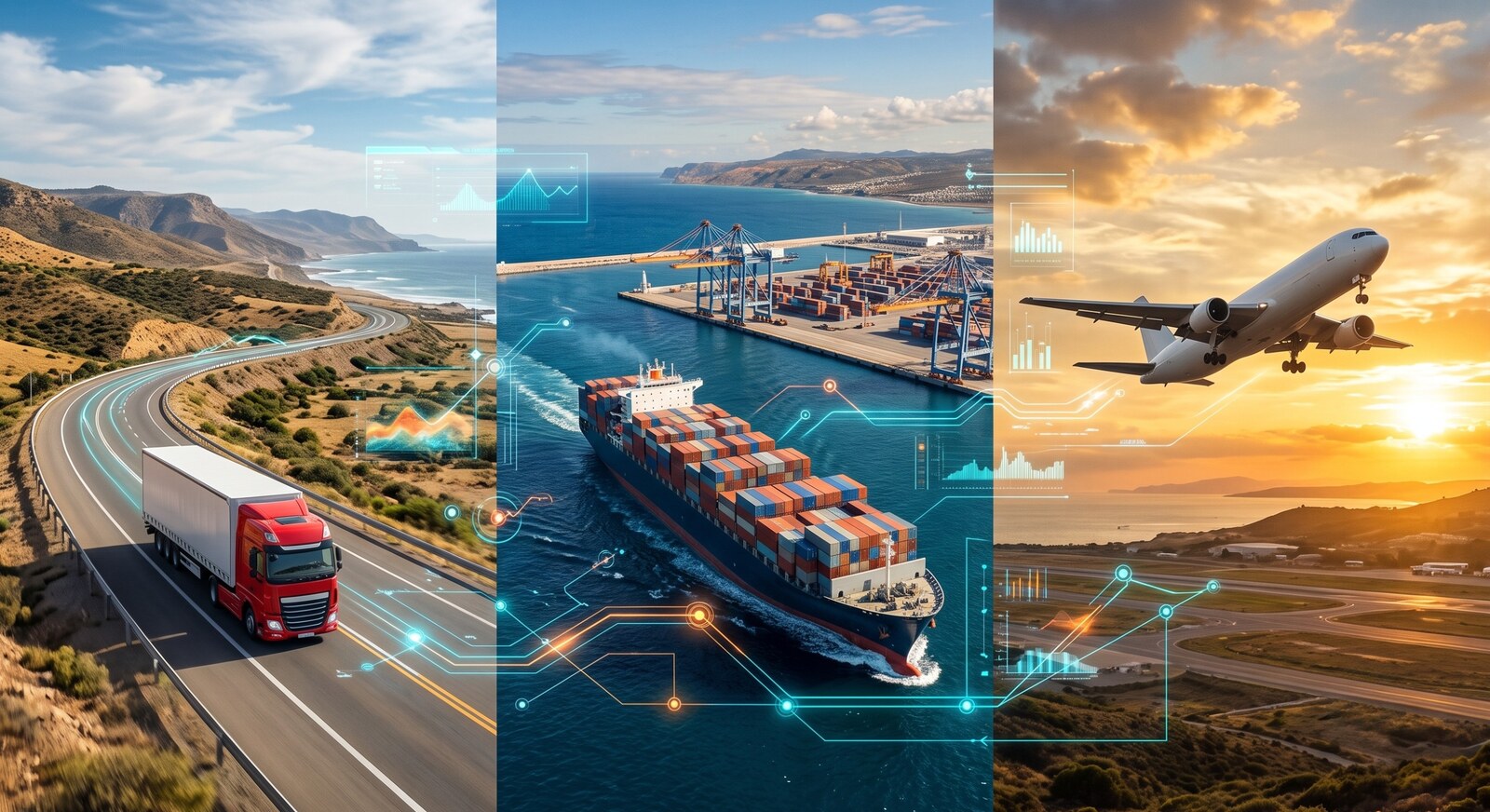
Multimodal Orchestration: Managing Road, Maritime and Air on One Dashboard
KEY POINTS
Introduction: the fragmentation tax
A Moroccan agri-food exporter ships frozen strawberries to France. The journey starts by truck from the Souss-Massa region to Tanger Med port. It crosses the Mediterranean on a container vessel. It arrives at a French port, clears customs, and is loaded onto a refrigerated truck for final delivery to a Parisian distribution centre.
Three modes. Four carriers. Three different tracking portals. Zero consolidated visibility.
This is the reality for every multimodal shipment in 2026: a patchwork of disconnected systems, each providing a partial view of a journey that demands a unified one. The result is a fragmentation tax — measured in hours of manual coordination, undetected anomalies, and preventable costs — that most logistics teams have normalised as “just how it works.”
It does not have to work that way.
01 — What Multimodal Orchestration Actually Means
Beyond “tracking” — toward command
Multimodal tracking shows you where a shipment is.
Multimodal orchestration tells you whether it will arrive on time, what risks are emerging, and what action you can still take — across road, maritime, and air, on a single interface.
| Capability | Multimodal Tracking | Multimodal Orchestration |
|---|---|---|
| Scope | Location and status | Location + risk + action |
| Data sources | Carrier-provided updates | Multi-source: AIS, GPS, IoT, port data, weather |
| Alert mechanism | Passive — you check | Active — system alerts you |
| Risk detection | None | Predictive, per shipment |
| Action recommendations | None | Contextualised, time-sensitive |
| Financial impact | Not quantified | Quantified per anomaly |
Why “one dashboard” is not enough — you need one intelligence layer
Most logistics platforms claim to offer “one dashboard.” But consolidation without intelligence is just a prettier version of fragmentation.
If your dashboard consolidates data but does not interpret it — if it shows you a green indicator when a shipment is actually drifting off schedule — you have solved the interface problem while the intelligence problem remains.
True multimodal orchestration means:
- Single source of truth — all modes, all carriers, all data consolidated in real time
- Contextualised alerts — anomalies detected and classified by severity and financial impact
- Action-ready intelligence — not just “what happened” but “what can you still do”
02 — The Four Dimensions of Multimodal Complexity
Multimodal logistics introduces complexity that single-mode tracking cannot address. Understanding these four dimensions is the foundation for building an effective orchestration system.
Data format fragmentation
Road carriers report via GPS pings and driver apps. Maritime lines use AIS vessel tracking and container-level updates. Air cargo operates on AWB milestones and airport handling systems. Orchestration requires automated ingestion and normalisation of multi-format data into a unified structure.
Temporal misalignment
A truck may update every 15 minutes, a vessel every 6 hours, and an air cargo system only at airport handling milestones. Orchestration cross-references data across temporal resolutions to maintain continuous visibility, especially during handoffs.
Carrier accountability fragmentation
When a shipment is late, responsibility is split across multiple parties. Orchestration enables carrier performance benchmarking across modes, with historical data per route, per carrier, and per season.
Regulatory and documentation fragmentation
Road requires CMR waybills, maritime requires Bills of Lading, air requires Air Waybills, and customs requirements vary by country and mode. Orchestration centralises document management with milestone linking and compliance tracking.
03 — How FreshTrack Orchestrates Road, Maritime, and Air
FreshTrack’s multimodal architecture addresses each dimension of complexity through a unified intelligence layer — not just a consolidated display.
Road freight visibility
FreshTrack integrates with road carrier systems and GPS feeds to provide real-time truck-level visibility — position, speed, route adherence, and ETA accuracy. Combined with historical performance data per carrier, this enables predictive risk scoring on every road leg.
For road transport in Morocco specifically — where road handles 64.39% of all non-phosphate freight on a 57,300 km network — this visibility layer eliminates the manual phone calls and scattered email follow-ups that consume operational teams.
Maritime freight visibility
FreshTrack aggregates vessel AIS data, container-level tracking, and port intelligence across all major shipping lines — CMA CGM, Maersk, MSC, and others. This provides continuous visibility across the ocean leg, including real-time detection of blank sailings, route deviations, and port congestion.
This maritime intelligence layer complements the broader logistics offering to deliver end-to-end control.
Air freight visibility
Air cargo movements are tracked through AWB milestones, airport handling data, and carrier updates. FreshTrack consolidates these signals to maintain visibility during the fastest — and often most opaque — leg of a multimodal journey.
Cross-modal handoff intelligence
The most vulnerable point in any multimodal journey is the handoff between modes — truck to vessel, vessel to truck, truck to aircraft. These transition points are where visibility gaps widen, delays compound, and accountability fractures.
FreshTrack’s orchestration engine specifically monitors handoff milestones, flagging anomalies at transfer points before they cascade into full-blown incidents.
04 — The Financial Case for Multimodal Orchestration
The cost of fragmentation
| Cost category | Mechanism | Impact |
|---|---|---|
| Manual tracking overhead | Teams spend 40% of time consolidating data from multiple portals | Equivalent of 2 FTEs per logistics team doing nothing but tracking |
| Undetected delays at handoffs | Mode transfers create 6–12 hour visibility gaps | Preventable demurrage per incident |
| Carrier accountability gaps | No consolidated performance data | Inability to enforce SLA terms, repeated underperformance |
| Emergency rerouting costs | Late detection = no time for planned alternatives | 3–5x the cost of planned rerouting |
| Customer relationship damage | Recipient discovers delay before you do | Irreversible trust erosion |
The return on orchestration
Industry benchmarks from multimodal orchestration deployments show:
- 20–30% reduction in transportation costs through optimised mode selection and carrier benchmarking (Locus, Enterprise Logistics Report, 2026)
- 60% reduction in time spent on shipment tracking and status updates (Descartes MacroPoint, G2 reviews)
- 15-point increase in customer NPS through proactive delivery communication (FarEye, Multimodal Tracking Solutions)
- 80% reduction in manual status update efforts (FarEye)
- 85% reduction in carrier integration overhead (FarEye)
Enterprises deploying AI-powered logistics orchestration platforms typically report 20–30% reductions in transportation costs and significant improvements in on-time SLA adherence. — Locus, Enterprise Logistics Report, 2026
05 — The Moroccan Corridor
Morocco’s logistics ecosystem is uniquely positioned at the intersection of three continents and three transport modes. The country’s strategic role as a nearshoring hub for European brands — with inspection demand surging +53% YoY in Q2 2025 — makes multimodal orchestration not a luxury but an operational requirement.
The road-maritime axis
Morocco’s road network connects industrial zones to Tanger Med — the largest port in Africa and the Mediterranean — handling millions of TEUs annually. The truck-to-vessel handoff at Tanger Med is the critical junction where multimodal visibility determines whether your shipment makes its connection or sits in demurrage.
This corridor handles a volume and complexity that demands digital orchestration — not manual coordination.
The maritime-air bridge
For time-sensitive agri-food exports — fresh produce, seafood, pharmaceuticals — the maritime-to-air transition through Casablanca Mohammed V International Airport requires precise coordination. A delay on the maritime leg that is not detected in time can cause a missed air cargo booking, triggering a cascade of rebooking costs and shelf-life losses.
The road-air connection
Domestic road transport feeding into air cargo operations requires real-time coordination between truck departures and flight cut-offs. Without unified visibility, a 2-hour road delay can result in a missed flight — and the associated rebooking and storage costs.
06 — Building Your Multimodal Orchestration Capability
Consolidate — single source of truth
Audit every data source your team currently uses to track multimodal shipments: carrier portals, email updates, phone calls, and spreadsheet trackers. Map the information flow and identify every gap, delay, and redundancy.
Normalise — unified data architecture
Transform fragmented, multi-format data into a standardised structure that enables cross-modal comparison, correlation, and analysis. This is the technical foundation that makes intelligence possible.
Detect — proactive anomaly identification
Layer predictive analytics onto your consolidated data. Cross-reference real-time position data against expected parameters for every mode, every carrier, every route.
Decide — action-ready intelligence
Move beyond alerts to recommendations. For every detected anomaly, provide contextualised options: rerouting alternatives, carrier switches, proactive customer communication, and penalty mitigation steps.
Optimise — continuous improvement loop
Use historical performance data to continuously refine carrier selection, route optimisation, and risk scoring. The orchestration system learns from every shipment.
Conclusion: The End of Fragmented Logistics
The era of managing road, maritime, and air on separate tools — with separate logins, separate data formats, and separate update cadences — is over.
The cost of fragmentation is no longer just operational inconvenience. It is a direct, quantifiable drag on your margin.
Multimodal orchestration is not about replacing your existing tools. It is about adding the intelligence layer that connects them — turning disconnected data streams into a unified command system that detects risks before they materialise, quantifies their financial impact, and provides action recommendations while you can still act.
The companies that master this shift will not just survive the complexity of 2026’s supply chains. They will turn that complexity into their competitive advantage.
Unify your modes. Command your supply chain.
Free logistics diagnostic
Request your personalised 30-minute logistics diagnostic
Identify where fragmented multimodal data is costing your team time, money, and delivery reliability across road, maritime, and air operations.
FAQ — Frequently asked questions
What is multimodal orchestration in logistics?
Multimodal orchestration is the unified management of road, maritime, and air freight on a single intelligence platform — consolidating real-time data from multiple carriers, transport modes, and data formats into one dashboard. Unlike simple tracking, orchestration provides proactive anomaly detection, predictive risk scoring, and action recommendations across the entire multimodal journey.
Why is single-mode tracking insufficient for multimodal shipments?
Single-mode tracking shows you the status of one transport leg in isolation. Multimodal shipments involve handoffs between modes — truck to vessel, vessel to truck, aircraft to warehouse — where visibility gaps widen, delays compound, and accountability fractures. Without cross-modal intelligence, these handoff points become the primary source of undetected incidents and preventable costs.
How does multimodal orchestration reduce logistics costs?
Multimodal orchestration reduces costs by eliminating manual tracking overhead, detecting anomalies at handoff points before they cascade, enabling carrier performance benchmarking to enforce SLA terms, and providing early warning that allows planned rerouting instead of emergency solutions at 3–5x the cost.
How does FreshTrack handle different data formats across transport modes?
FreshTrack automatically ingests and normalises data from multiple sources — GPS feeds for road, AIS for maritime, AWB milestones for air, IoT sensors for cold chain — into a unified data structure. This enables cross-modal comparison, correlation, and analysis without requiring manual data consolidation.
Is FreshTrack's multimodal platform compatible with Moroccan logistics corridors?
Yes. FreshTrack is specifically designed for the Moroccan logistics ecosystem — including road transport to and from Tanger Med, maritime operations across the Mediterranean, and air cargo through Casablanca. The platform integrates with all major shipping lines and Moroccan road carriers, providing end-to-end visibility on Morocco-EU corridors.
References & Sources
- Locus — Enterprise Logistics Orchestration Report, 2026. Source: locus.sh
- Descartes MacroPoint — Multimodal Visibility Platform, G2 reviews: “60% time saved on tracking.” Source: macropoint.com
- FarEye — Multimodal Tracking Solutions: +15 points NPS, 80% reduction in manual efforts, 85% reduction in carrier integration. Source: fareye.com
- Moroccan National Road Network — 64.39% of non-phosphate freight on 57,300 km network. Source: Moroccan National Strategy 2030
- FreshTrack — Moroccan Logistics Nearshoring Hub: +53% YoY inspection demand Q2 2025. Source: freshtrack.ma