
Risk Intelligence Platforms Compared: What to Look for Before You Buy
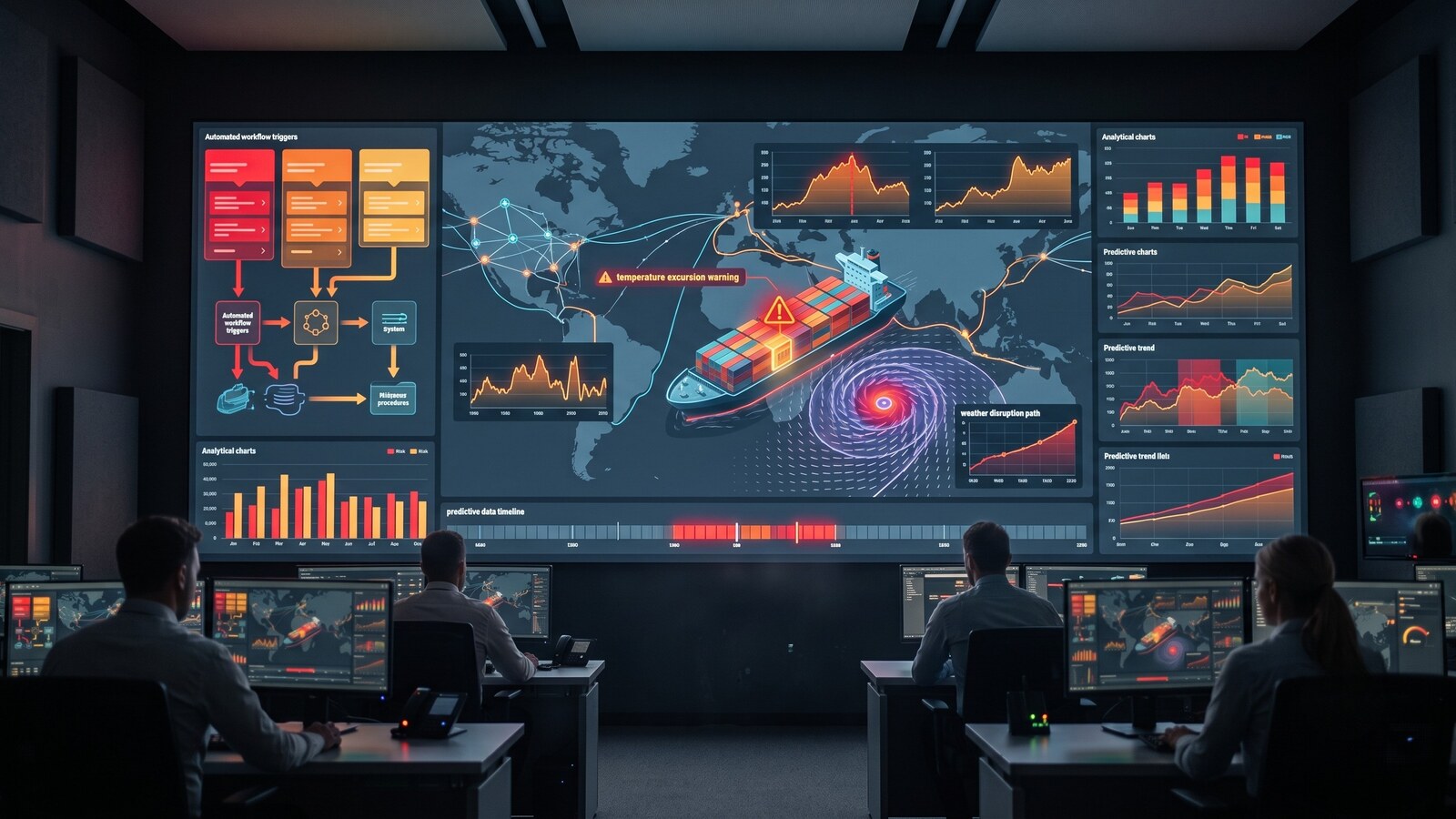
KEY TAKEAWAYS
Introduction
Risk intelligence platforms ingest operational data - location, temperature, customs status, carrier performance, and external signals like weather or port congestion - and convert it into alerts a team can act on before disruption becomes loss.
The value is not the data itself. It is how fast and how completely that data becomes something actionable.
Buying the wrong one, or bolting on a standalone tool that does not talk to anything else, often leaves teams with more dashboards and the same blind spots they started with.
01 — Why Risk Intelligence Is Board-Level
A missing container does not announce itself. Neither does a temperature excursion in a reefer, or a shipment quietly drifting days behind its ETA. By the time most teams find out, the problem has already had time to compound.
The scale of the issue is well documented. McKinsey’s 2025 supply chain risk pulse survey found that 82% of companies reported their supply chains were affected by new tariffs, with the same research showing that most organizations still have risk visibility only as far as their tier-one suppliers - a gap that has widened, not narrowed, as memory of pandemic-era disruption has faded.
Separate McKinsey analysis has found that companies can lose a substantial share of a year’s EBITDA to a single major disruption when they lack diversified sourcing or real-time visibility into where risk is building.
The practical question is no longer whether supply chain risk exists. It is whether your team sees it early enough to change the outcome.
02 — What Risk Intelligence Means
A risk intelligence platform is distinct from a basic tracking tool in one specific way: it does not just tell you where a shipment is. It tells you when something about that shipment’s status, environment, or trajectory has moved outside acceptable parameters, and does so fast enough to still act on it.
03 — Evaluation Criteria
1. Data coverage
Ask what the platform actually ingests, not what it claims to cover.
Location and ETA data is table stakes. Does it also pull temperature and humidity for cold chain, customs and documentation status, carrier performance history, and external signals like weather and port congestion?
Coverage gaps are where the “surprise” disruptions come from.
2. Alert latency
The gap between an event occurring and you being notified is the entire value proposition.
A platform that batches updates every few hours is functionally reactive, no matter how sophisticated its analytics look in a demo. Ask for real latency numbers, not marketing ranges.
3. Integration breadth
A risk tool that lives outside your TMS, ERP, and carrier systems requires someone to manually cross-reference it against operational reality, which reintroduces the exact delay the tool was supposed to eliminate.
Look for native integrations, not just an API you would have to build against yourself.
4. Multimodal scope
Risk does not stop at a mode boundary, and neither should visibility into it.
A tool that is strong on ocean tracking but blind on the trucking leg - or vice versa - leaves exactly the handoff points where risk concentrates unmonitored.
5. Actionability
Does an alert trigger a defined workflow - reassignment, escalation, customer notification - or does it just add another flag to a dashboard someone has to interpret manually?
The best platforms turn detection into a next step, not just a notification.
6. Predictive vs. reactive
Reactive tools tell you what already happened.
Predictive ones flag a shipment trending toward a delay while there is still time to intervene - before the ETA is missed, not after.
04 — Standalone vs. Connected Platform
| Criterion | Standalone Risk Tool | Connected Platform |
|---|---|---|
| Data coverage | Often single-source, such as GPS only | Aggregated across modes and systems |
| Alert latency | Frequently batch-based | Real-time, event-triggered |
| Integration | Requires custom build per system | Native to the operational data flow |
| Multimodal scope | Usually mode-specific | Road, maritime, air in one view |
| Actionability | Alert, then manual follow-up | Alert tied to workflow and ownership |
| Context at time of alert | Isolated event | Full shipment history and status |
A risk tool that already sits inside your shipment data has context a standalone add-on simply does not. It does not need to guess what is normal for that lane, that carrier, that product. It already knows.
05 — Where Risk Concentrates
Temperature-sensitive cargo is a useful stress test for any risk intelligence platform, because the standards are specific and well established.
IATA’s CEIV Pharma certification and Temperature Control Regulations, alongside EU Good Distribution Practice and WHO cold chain guidelines, define acceptable temperature ranges and documentation requirements across the full journey, not just the flight or sailing segment.
A platform that can only flag “cargo is moving” but not “cargo temperature has drifted outside the qualified range for 40 minutes” is not built for this risk category, regardless of how it is marketed.
We break down the specific alerts that matter most day to day - not just a general framework - in Temperature Excursions, ETA Deviations & Missing Containers: The Five Risk Alerts Every Shipper Needs.
Nearshoring and multi-region sourcing have made supply chains more resilient in theory and more complex to monitor in practice: more origins, more modes, more handoffs, more places for risk to enter undetected.
Morocco’s emergence as a nearshoring hub is a useful case study in that trade-off. Proximity and capacity gains are real, but they only pay off if risk visibility keeps pace. See Moroccan Logistics as a Global Nearshoring & Resilience Hub for more on this.
06 — Buyer Questions
- What is your actual alert latency, measured - not estimated?
- Which data sources are native versus require a separate integration?
- Does your platform cover road, maritime, and air, or primarily one mode?
- When an alert fires, what happens next inside your system?
- Can you show a real example of a predicted delay that was caught before the ETA was missed?
07 — See Your Own Risk Data Connected
The fastest way to know whether a connected risk intelligence platform will outperform your current setup is to test it against a real lane you already know well.
Request a risk intelligence demo using one of your active shipments, and see how quickly a genuine anomaly - a delay, a temperature drift, a missed customs step - actually surfaces.
Conclusion
The right risk intelligence platform is not the one with the most dashboards. It is the one that closes the gap between an event happening and your team knowing about it, with enough context to act.
Standalone tools can look capable in a sales demo. The real test is whether they are already connected to the data that makes an alert meaningful in the first place.
Connect your risk signals before disruption becomes loss.
Risk intelligence demo
Test FreshTrack against a real shipment lane
Use one of your active shipments to see how quickly delays, temperature drift, missing milestones and other anomalies surface when your risk data is connected.
FAQ — Frequently asked questions
What is a risk intelligence platform in logistics?
A risk intelligence platform ingests operational data - location, temperature, customs status, carrier performance, and external signals like weather - and converts it into real-time alerts a team can act on before a disruption becomes a loss, rather than after.
What is the difference between a visibility tool and a risk intelligence platform?
A visibility tool primarily shows where a shipment is. A risk intelligence platform goes further, flagging when a shipment's status, environment, or trajectory moves outside acceptable parameters, and ideally ties that alert to a defined next action.
How fast should risk alerts be to be useful?
As close to real time as possible. A platform that updates in batches every few hours is functionally reactive regardless of its analytics, since the value of a risk alert depends on how much time is left to act on it.
Do risk intelligence platforms cover temperature-sensitive cargo?
The strongest ones do, monitoring against established standards like IATA's CEIV Pharma and Temperature Control Regulations, EU Good Distribution Practice, and WHO cold chain guidelines - not just tracking location but flagging excursions outside qualified temperature ranges.
Why do standalone risk tools often underperform connected platforms?
A standalone tool sitting outside your TMS and ERP requires manual cross-referencing to become useful, which reintroduces the delay the tool was meant to eliminate. A connected platform already has shipment context, so an alert arrives with the history needed to act on it immediately.
References & Sources
- McKinsey & Company — Supply chain risk pulse 2025: Tariffs reshuffle global trade priorities. https://www.mckinsey.com/capabilities/operations/our-insights/supply-chain-risk-survey
- McKinsey & Company — How global disruption is reshaping manufacturing supply chains. https://www.mckinsey.com/capabilities/operations/our-insights/decoding-disruption-to-reshape-manufacturing-footprints
- IATA — CEIV Pharma Certification. https://www.iata.org/en/services/certification/special-cargo/ceiv-pharma/
- World Bank — Logistics Performance Indicators (LPI 2.0). https://lpi.worldbank.org/en/home
- Gartner Peer Insights — Real-Time Transportation Visibility Platforms. https://www.gartner.com/reviews/market/real-time-transportation-visibility-platforms
Related reading: Moroccan Logistics as a Global Nearshoring & Resilience Hub · Temperature Excursions, ETA Deviations & Missing Containers: The Five Risk Alerts Every Shipper Needs