
Road Transport in Morocco 2026
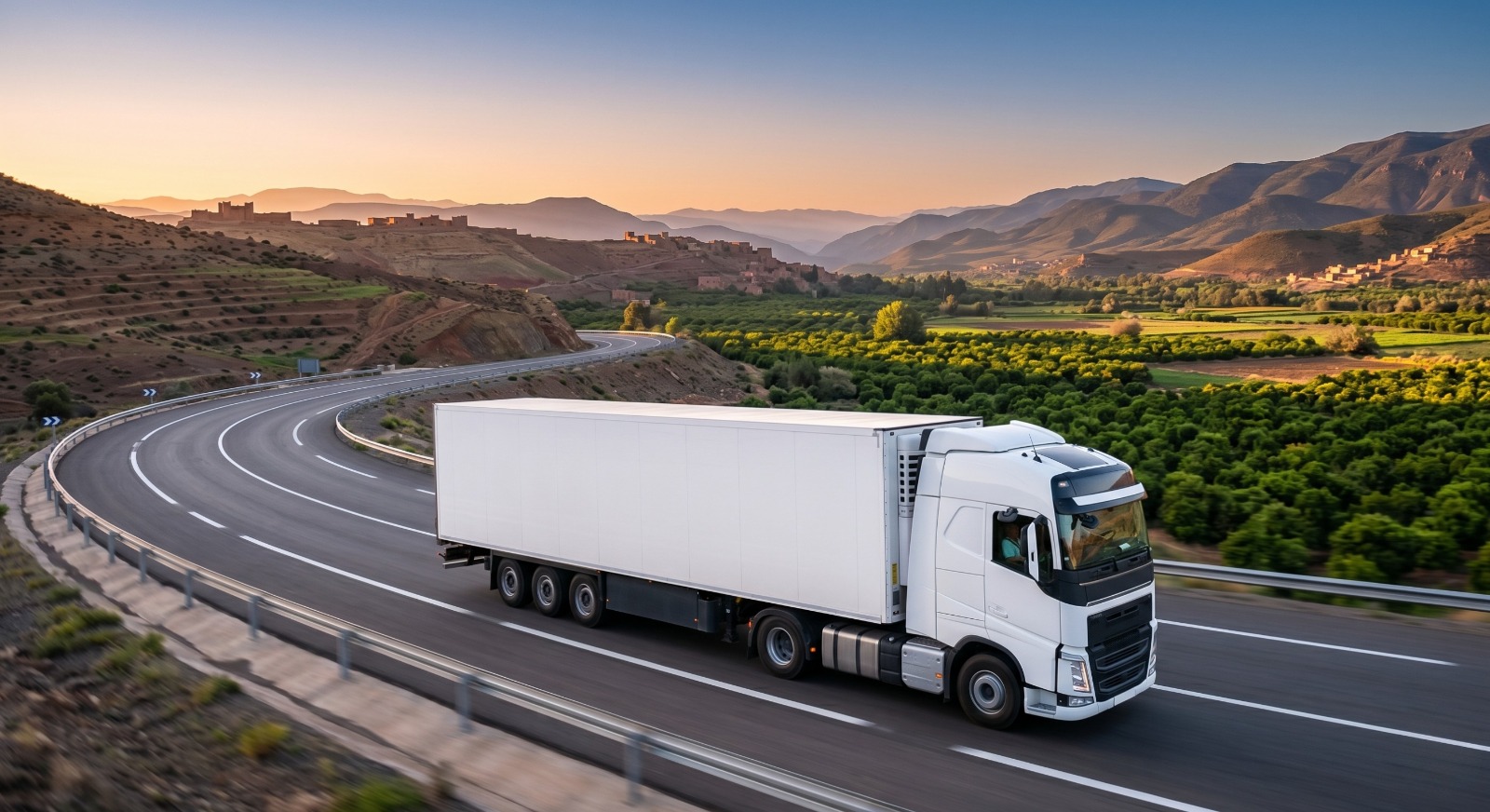
FRESHTRACK · ROAD TRANSPORT · MAY 2026
Road Transport in Morocco 2026
The Complete Referenced Guide for Freight Managers & Exporters
64.39% of non-phosphate freight moves by road. Diesel at 11.26 MAD/litre. 535,203 trucks crossed Tanger Med in 2025. Every figure sourced. 13 verified references.
FreshTrack · freshtrack.ma/en
KEY TAKEAWAYS — EVERY FIGURE SOURCED
Introduction
Road transport in Morocco is the engine of the country’s supply chain. It moves perishables from Souss-Massa packhouses to Tanger Med before dawn, delivers automotive components to Renault’s just-in-time assembly lines in Tangier, and connects Casablanca’s distribution hubs to retail shelves across Morocco’s 38 million consumers. Accounting for 64.39% of all non-phosphate freight by volume, road transport is the primary logistics infrastructure on which the country’s export competitiveness rests. [1]
This guide covers every operational dimension that matters to a freight manager, logistics director, or exporter managing road transport in Morocco: the network infrastructure, the carrier landscape, the primary freight corridors, the cost structure, documentation requirements, the challenges, and the digital tools that are transforming how road freight is booked, tracked, and managed.
Non-phosphate freight share by road
Mordor Intelligence, 2025
TIR trucks at Tanger Med in 2025
Tanger Med Port Authority, Feb 2026
Diesel price, June 2025
Mordor Intelligence, 2025
1. Morocco's Road Network: Infrastructure Behind the Freight
Morocco’s road network spans approximately 57,300 km of classified roads plus an 1,800 km motorway network managed by ADM (Autoroutes du Maroc). [2] The government has committed USD 1.3 billion in highway investment from 2025 to 2032 targeting 3,000 km of motorway by 2030. Key projects include the Continental Rabat-Casablanca Highway and the Tit Mellil-Berrechid Highway. [3]
The Four Primary Freight Corridors
| Corridor | Distance | Road Time | Primary Cargo | Indicative Reefer Rate (2026) |
|---|---|---|---|---|
| Agadir → Casablanca | ~600 km | 5–7 hours | Fresh produce, citrus (Souss-Massa) | MAD 4,500–7,500 |
| Casablanca → Tangier / Tanger Med | ~345 km | 3–4 hours | Automotive parts, FMCG, industrial goods | MAD 3,000–5,000 (ambient) |
| Agadir → Tanger Med (direct) | ~950 km | 8–10 hours | Long-haul fresh produce for EU export | MAD 7,000–11,000 |
| Casablanca → Marrakesh → Agadir | ~575 km | 4–6 hours | Consumer goods, retail distribution | MAD 3,500–6,000 (ambient) |
2. Morocco's Road Carrier Landscape: Fragmentation and What It Means
Mordor Intelligence’s 2025 Morocco Freight and Logistics Market report states explicitly: ‘Thousands of micro-fleets lack telematics, have limited access to bank financing, and operate older trucks that raise maintenance and fuel costs, translating into lower reliability and higher emissions. Such fragmentation complicates adoption of common digital platforms and weakens Morocco freight and logistics market efficiency.’ [1]
In practical terms, most of Morocco’s road carriers are owner-operators or small fleets of 1–10 trucks. They price by phone, track by WhatsApp call, and deliver proof of delivery on paper CMR returned by post. For a shipper managing 50–200 shipments per week across multiple corridors and temperature regimes, this model is structurally inadequate.
"Thousands of micro-fleets lack telematics, operate older trucks that raise maintenance and fuel costs, and have limited bank financing access — weakening Morocco freight and logistics market efficiency."
— Mordor Intelligence, Morocco Freight and Logistics Market Report, 2025
The fuel cost squeeze and its operational consequences
Diesel reached 11.26 MAD per litre in June 2025 following Morocco’s phase-out of government fuel subsidies. [1] Smaller carriers cannot hedge fuel costs and face immediate margin compression at each diesel price increase. This drives interest in digital load-matching platforms that reduce empty-running kilometres — the single biggest lever on per-kilometre fuel efficiency. On the Agadir–Casablanca corridor, an empty southbound return trip costs approximately MAD 2,700 in fuel alone — cost recouped through higher loaded-trip rates charged to northbound shippers.
SNTL (Societe Nationale de Transport et de Logistique) posted revenue of MAD 712.1 million in 2024 (+5% vs. 2023). [4] International 3PLs — DHL, DB Schenker, Kuehne+Nagel, CEVA — serve the multinational manufacturing sector.
3. Road Freight Costs in Morocco 2026: A Transparent Breakdown
| Route | Cargo Type | Indicative Rate (2026) | Key Variable |
|---|---|---|---|
| Agadir → Casablanca | Ambient (full truck, 24t) | MAD 4,000–6,500 | Return load availability; diesel price |
| Agadir → Casablanca | Refrigerated (reefer truck) | MAD 4,500–7,500 | Reefer fuel surcharge; citrus season peak (Oct–Mar) |
| Agadir → Tanger Med | Refrigerated (full truck) | MAD 7,000–11,000 | Truck availability at origin; peak season premium |
| Casablanca → Tangier | Ambient (full truck) | MAD 3,000–5,000 | High-frequency lane; good return load availability |
| Tanger Med → Spain (cross-border) | Any (TIR, full truck) | EUR 250–450 (ferry + Spain leg) | Ferry crossing; Spanish destination |
| Casablanca → Marrakesh | Ambient (full truck) | MAD 2,500–4,500 | Tourism peak (summer); FMCG demand |
| Spot broker margin | Any | 8–22% on base rate | Urgency; broker tier depth; relationship |
4. International Road Freight Documentation: Morocco to EU
DOCUMENTATION CHECKLIST — INTERNATIONAL ROAD FREIGHT MOROCCO TO EU
- → CMR Consignment Note: Legally required for all international road freight under the CMR Convention. Every field must be complete. A blank field is grounds for border refusal. [5]
- → e-CMR (Electronic CMR): Ratified by Spain and France — gives electronic consignment notes the same legal standing as paper CMR. Pre-lodging with border authorities reduces customs examination from hours to minutes. [5]
- → Form EUR.1 / REX Declaration: Certificate of Moroccan preferential origin for EU tariff. Without it, the EU importer pays full MFN duties. [6]
- → ONSSA Phytosanitary Certificate: Mandatory for fresh produce. Valid 48–72 hours. Lot number mismatch with physical pallets triggers border hold — the most common and costly error. [7]
- → EACCE Export Certificate: Required for commercially exported agri-food products. [8]
- → Customs Export Declaration (DAE): Submitted via ADII's BADR system before truck departure. Required by EU customs for import clearance.
5. Digital Road Freight Management: From Phone Calls to Real-Time Platforms
Traditional Moroccan road freight management runs on three tools: a phone, WhatsApp, and a paper CMR. A shipper with 30 active trucks calls each driver every 2–4 hours for a status update. For a logistics manager running 80 reefer trucks during peak citrus season, there is no reliable visibility on temperature, location, or ETA. In 2026, this model no longer meets EU buyer requirements.
FreshTrack (freshtrack.ma) provides continuous GPS tracking from packhouse dispatch to port gate, with IoT cold chain sensor integration that alerts when reefer temperature deviates before the excursion becomes irreversible. Load-matching connects shippers directly to available carriers — reducing broker layers and empty running. Digital CMR ensures documentation consistency across every document in the shipment record. Carrier performance data — verified on-time rates and temperature compliance scores — replaces word-of-mouth reputation with objective selection data.
The World Bank LPI 2023 found that end-to-end supply chain digitalisation can shorten port delays by up to 70% in emerging economies. [9] The same principle applies to road freight: visibility reduces exception handling time, data improves carrier selection accuracy, and electronic documentation eliminates the border delays that currently consume hours on every international crossing.
Structured for Google PAA and AI Mode. All figures sourced.
Frequently Asked Questions — Road Transport in Morocco
What percentage of Morocco's freight is transported by road?
Approximately 64.39% of all non-phosphate freight in Morocco, per Mordor Intelligence's Morocco Freight and Logistics Market Report (2025). [1]
How much does road freight cost in Morocco?
2026 indicative ranges: Agadir–Casablanca ambient MAD 4,000–6,500; Agadir–Casablanca refrigerated MAD 4,500–7,500; Agadir–Tanger Med refrigerated MAD 7,000–11,000; Casablanca–Tangier ambient MAD 3,000–5,000. Diesel at 11.26 MAD/litre (June 2025) is the primary cost driver. [1]
What is the main road network in Morocco for freight?
A 1,800 km motorway (autoroute) network, expanding to 3,000 km by 2030 with USD 1.3B investment. [3] Total classified roads: 57,300 km. [2] The Casablanca–Tangier motorway and Casablanca–Agadir axis are the two highest-volume freight corridors.
What documents are required for road freight from Morocco to Europe?
CMR consignment note (CMR Convention) [5]; commercial invoice and packing list; Form EUR.1 for EU preferential tariff [6]; ONSSA phytosanitary certificate for fresh produce [7]; EACCE export certificate [8]; customs export declaration (DAE) via ADII's BADR system; T1 transit document if passing through Spain/France in bond.
How long does road freight from Morocco to Spain take?
Tanger Med to Algeciras via RoRo ferry: 1.5–2 hours. Agadir to Tanger Med by motorway: 6–8 hours. Tanger Med to Madrid (after crossing): 6–8 hours; to Barcelona 12–14 hours; to Paris 18–22 hours. Door-to-door Agadir packhouse to Spanish DC: 18–26 hours with pre-lodged documentation.
References & Sources
All statistics traceable to primary or authoritative secondary sources.
- Mordor Intelligence. Morocco Freight and Logistics Market 2026–2030. Road share 64.39%; diesel 11.26 MAD/litre; carrier fragmentation. https://www.mordorintelligence.com/industry-reports/morocco-freight-and-logistics-market
- Worlddata.info / OpenStreetMap. Morocco transport infrastructure: 57,300 km classified roads; 13,322 km highways/expressways. https://www.worlddata.info/africa/morocco/transport.php
- U.S. ITA. Morocco Infrastructure Guide 2025. USD 1.3B highway investment 2025–2032; motorway to 3,000 km by 2030. https://www.trade.gov/country-commercial-guides/morocco-infrastructure
- Morocco World News. Morocco Reports Strong Growth in Transport. SNTL MAD 712.1M (+5%). October 2025. https://www.moroccoworldnews.com/2025/10/266004/morocco-reports-strong-growth-in-transport-logistics-sectors/
- UNECE. eCMR Additional Protocol to CMR Convention. Spain and France ratification. https://unece.org/DAM/trans/conventn/e-CMR-status.pdf
- European Commission — DG Trade. EU-Morocco Association Agreement — EUR.1 certificates. https://policy.trade.ec.europa.eu/eu-trade-relationships-country-and-region/countries-and-regions/morocco_en
- ONSSA. Phytosanitary certification requirements for Moroccan agricultural road freight exports. https://www.onssa.gov.ma/fr/
- EACCE. Export authorisations and agri-food export certification. https://www.eacce.org.ma/
- World Bank. LPI 2023. Digitalisation reduces port delays by up to 70%. https://www.worldbank.org/en/news/press-release/2023/04/21/world-bank-releases-logistics-performance-index-2023
- Rantasila & Ojala. OECD/ITF Discussion Paper 2012-4. Morocco logistics costs ~20% of GDP. https://www.itf-oecd.org/sites/default/files/docs/dp201204.pdf
- Tanger Med Port Authority. 2025 Annual Statistics: 535,203 TIR trucks (+3.6%). February 2026. https://www.maroc.ma/en/news/tanger-med-port-exceeds-11-mln-containers-2025-84-2024
- PortNet S.A. Morocco’s national single-window for logistics documentation. https://www.portnet.ma/
- ScienceDirect. Energy efficiency analysis of heavy goods vehicles in Morocco. July 2024. https://www.sciencedirect.com/science/article/abs/pii/S2213624X24001159
© 2026 FreshTrack · freshtrack.ma/en · All statistics verified as of May 2026.