From Tanger Med to the World: How Digital Platforms Are Powering Morocco's Port
FRESHTRACK · PORT DIGITIZATION · JULY 2026
From Tanger Med to the World: How Digital Platforms Are Powering Morocco's Port
How Tanger Med, PORTNET, and Nador West Med are turning Morocco's port growth into one coordinated digital network.
FreshTrack · freshtrack.ma/en
KEY TAKEAWAYS — READ IN 30 SECONDS
Introduction
A digital platform is the reason Morocco’s port expansion is scaling without the gridlock that usually comes with rapid growth. Tanger Med closed 2025 with record container volumes, Nador West Med is entering its final commissioning phase for a late-2026 launch, and a national single-window trade system was just relaunched in unified form.
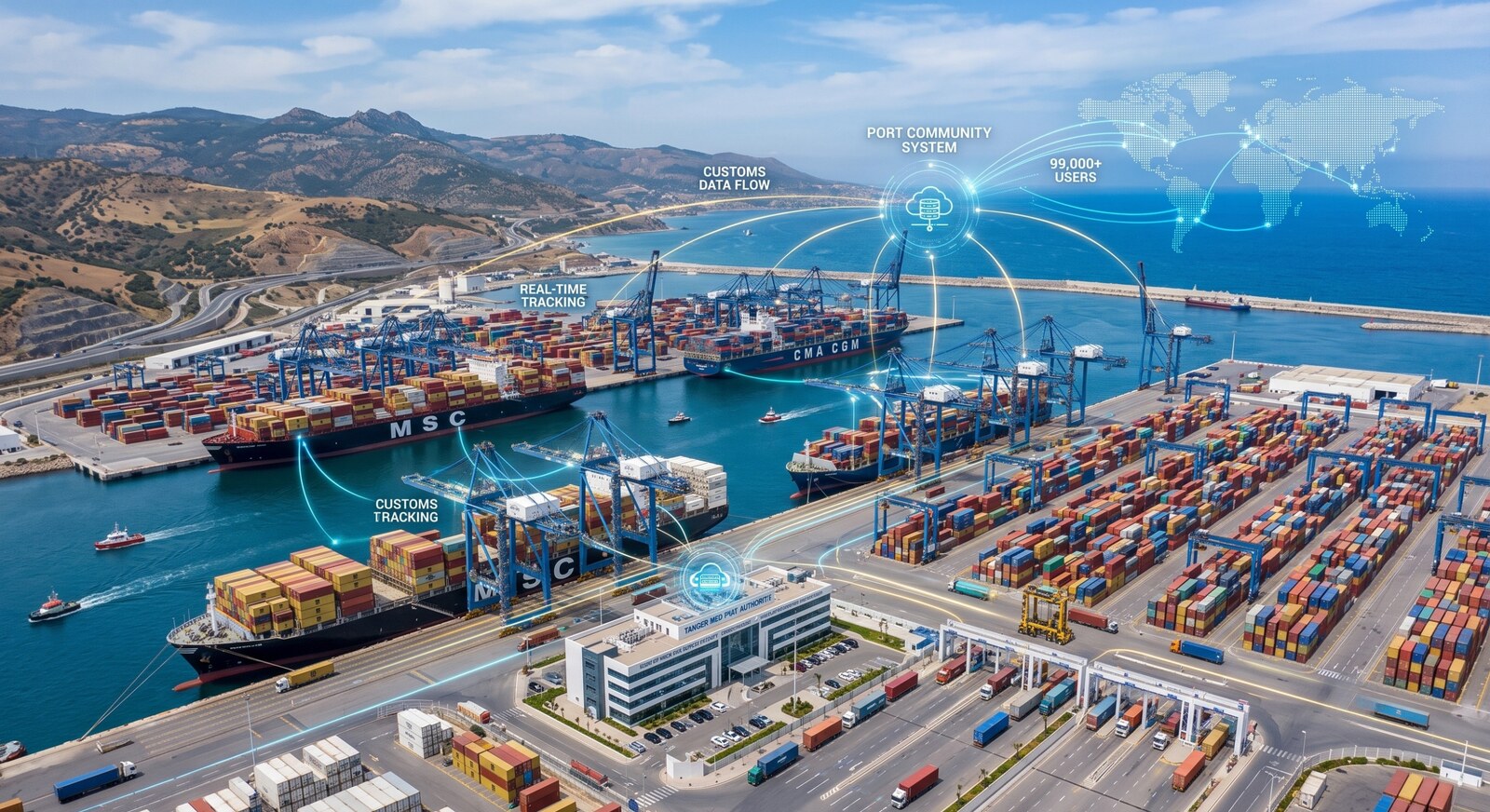
None of that growth is being coordinated on paper. It is running through Port Community Systems and a national trade platform that connect customs, terminal operators, shipping lines, and freight forwarders on shared, real-time data. That is the infrastructure story behind Morocco’s port boom that gets less attention than the concrete and cranes.
Containers handled by Tanger Med in 2025
Tanger Med / Maroc.ma
PORTNET users across Morocco's trade ecosystem
UNCTAD / PORTNET
Target later-phase capacity at Nador West Med
The Maritime Executive
Tanger Med's 2025 Numbers: A Port Running Near Its Digital Ceiling
Tanger Med closed 2025 having handled more than 11.1 million containers, an 8.4% increase over 2024, with direct connectivity to over 180 ports across 70 countries. That volume places Tanger Med as Africa’s largest port and, per recent comparative analysis, more than double the throughput of Algeciras, its main Mediterranean rival just across the Strait of Gibraltar.
Growth at that pace creates an obvious bottleneck risk: more vessels, more trucks, more customs declarations, and more terminal handoffs. Tanger Med has avoided that bottleneck largely because the surrounding data infrastructure scaled ahead of the physical volume. That is the part of the story that does not show up in tonnage figures.
For the full picture of how vessel, truck, and rail movement is being coordinated across the country, see Maritime Transport in Morocco.
The Digital Backbone: Tanger Med's Port Community System
Tanger Med operates its own Port Community System (TMPCS), a multi-service digital platform covering maritime, import, export, domestic, and financial procedures for the entire port community. Formalities for import and export port passage, for both containers and trucks, are now fully digitized, with operators submitting documents electronically rather than in person.
The system integrates the EU’s Entry Summary Declaration requirement directly into the platform, letting exporters forward pre-arrival customs data to the first EU customs office before goods even reach Europe.
Tanger Med’s Port Community System also became fully integrated with customs for import and export declarations, and Tanger Med Port Authority formally joined the International Port Community Systems Association (IPCSA) as its seventh African member. That is a signal that Morocco’s port digitization is now being benchmarked against, and contributing to, global standards rather than operating as a local workaround.
The operational shift is not simply from paper to screens. It is from sequential handoffs to shared data, where customs, terminals, shipping lines, and freight forwarders work from one coordinated record.
PORTNET: Morocco's Single Window, Now a UN-Recognized Model
Zoom out from Tanger Med specifically, and the same pattern repeats at the national level. UNCTAD’s 2025 Review of Maritime Transport singled out Morocco’s PORTNET system as a good practice to be shared with developing countries, dedicating a chapter to it as a model of successful public-private digital trade infrastructure.
The scale is substantial: PORTNET now serves more than 99,000 users, including roughly 80,000 economic operators and 1,800 freight forwarders, and in 95% of cases requires operators to submit their data only once rather than repeating it across multiple agencies.
Morocco extended that model further in May 2026 with the launch of PortNet Commerce Exterieur, a unified digital gateway that consolidates import and export procedures previously spread across customs, ports, banks, and various government departments into a single access point.
The stated goal is explicit: competitiveness increasingly comes down to speed, coordination, and digital efficiency across the supply chain, not production or port capacity in isolation.
Why the Next Port Needs the Platform Even More: Nador West Med
Morocco’s third deepwater port, Nador West Med, is entering its final phase before a late-2026 opening, potentially ahead of its original 2027 schedule, according to Equipment and Water Minister Nizar Baraka. The port’s core maritime infrastructure, including 5.4 kilometers of breakwaters and 4 kilometers of quays, is complete, backed by roughly MAD 51 billion, about $5.6 billion, in public and private investment.
Initial capacity is set at 1.8 million TEU, rising in later phases toward 5.5 million TEU, putting it in the same tier as Algeciras and Valencia. Terminal concessions have already been signed: Marsa Maroc has partnered with CMA Terminals, a CMA CGM subsidiary, for the West Terminal, while MSC Group’s Terminal Investment Limited holds the second container terminal concession.
Here is the operational risk that gets less attention than the ribbon-cutting: a second major container port, run on separate systems from Tanger Med, would recreate the exact problem a collaborative digital platform is meant to solve: two ports, two data silos, and shippers left reconciling both manually.
Nador West Med is being built on the same digital and institutional model that made Tanger Med work. The near-term test is not whether the new port has enough cranes. It is whether its Port Community System is interoperable with Tanger Med’s from day one.
WHAT THIS MEANS FOR SHIPPERS AND CARRIERS ROUTING THROUGH MOROCCO
- → Fewer manual touchpoints: Port passage formalities can be cleared electronically instead of in person.
- → Earlier customs readiness: Pre-arrival customs data can be submitted before a vessel docks.
- → More predictable multimodal planning: A second gateway should plug into the same digital ecosystem rather than requiring a separate integration.
- → Better network resilience: As Nador West Med comes online, shippers gain additional capacity without needing fragmented operating processes.
For the broader context of how this fits into Morocco’s logistics infrastructure strategy heading into 2026, see Logistics and Digital Platform in Morocco 2026.
See how a connected Moroccan gateway handles your own freight. Request a Morocco routing walkthrough and FreshTrack will map your current port touchpoints against what is now handled digitally end to end.
Conclusion
Morocco’s port boom is a physical infrastructure story on the surface: record container volumes, a new deepwater port, and billions in investment. Underneath it is a digital infrastructure story: a Port Community System that scaled ahead of volume, a UN-recognized single window now serving 99,000 users, and a national trade platform unifying customs, ports, and banks into one gateway.
As the country adds a second and eventually third major port, that digital layer, not additional concrete, is what will determine whether the network stays coordinated or fragments.
Frequently Asked Questions
How many containers did Tanger Med handle in 2025?
Tanger Med handled more than 11.1 million containers in 2025, an 8.4% increase over 2024, with connectivity to over 180 ports in 70 countries.
When will Nador West Med open?
Nador West Med, Morocco's third deepwater port, is scheduled to begin operations by late 2026, potentially ahead of its original 2027 timeline according to Morocco's Equipment and Water Minister.
What is PORTNET?
PORTNET is Morocco's national single-window digital trade platform, recognized by UNCTAD's 2025 Review of Maritime Transport as a global best-practice model. It serves more than 99,000 users and allows data submission only once in 95% of cases.
How does Tanger Med's digital platform benefit shippers?
Tanger Med's Port Community System digitizes import and export port passage formalities, integrates EU pre-arrival customs declarations directly into the platform, and provides real-time track-and-trace, reducing manual document handling and processing time.
Will Nador West Med use the same digital systems as Tanger Med?
Nador West Med is being developed on the same institutional and digital model that underpins Tanger Med's operations, though interoperability between the two ports' Port Community Systems is an operational detail shippers should confirm as the new port ramps up through 2026.
References & Sources
- Tanger Med Port Authority. Tanger Med Surpasses the 11 Million Container Mark. https://www.tangermedport.com/en/tanger-med-passes-the-10-million-container-mark/
- Maroc.ma, Kingdom of Morocco official portal. Tanger Med Port Exceeds 11 Mln Containers in 2025. https://www.maroc.ma/en/news/tanger-med-port-exceeds-11-mln-containers-2025-84-2024
- North Africa Post. UNCTAD Maritime Report: Morocco Cited as Success Model in Digitalization & Trade Facilitation. https://northafricapost.com/90954-unctad-maritime-report-morocco-cited-as-success-model-in-digitalization-trade-facilitation.html
- Morocco World News. Morocco Launches PortNet Platform to Accelerate and Unify Foreign Trade Procedures. https://www.moroccoworldnews.com/2026/05/303076/morocco-launches-portnet-platform-to-accelerate-and-unify-foreign-trade-procedures/
- The Maritime Executive. Morocco’s Nador West Med Port to Start Up Ahead of Schedule. https://maritime-executive.com/article/morocco-s-nador-west-med-port-to-start-up-ahead-of-schedule
- Tanger Med Port Community System. https://www.tangermedpcs.com/en
Related reading: Maritime Transport in Morocco · Logistics and Digital Platform in Morocco 2026