






What does global trade compliance mean for an exporter?
Global trade compliance is the set of legal, documentary and procedural obligations a shipper must meet to move goods across borders lawfully: describing the goods correctly, declaring their value and origin, holding any required licences, screening the parties involved, and keeping records that prove it afterward. It applies to exporters, importers and manufacturers alike, and it applies whether you ship one pallet a month or hundreds of containers.
This guide gives first-time and growing exporters a working map. It is general education, not legal advice, and it does not cover any single country’s rules in detail. FreshTrack takes no position on trade policy; the focus here is process and operational readiness.
Why is compliance an operations problem, not just a legal one?
Because missing or inconsistent data creates holds, inspections, storage charges and missed delivery windows, so compliance errors rarely stay inside the compliance team.
Border friction costs time and money, and governments have worked to reduce it. The WTO’s Trade Facilitation Agreement, which entered into force on 22 February 2017, commits members to modernize and simplify border procedures [1][3][4]. The WTO estimates that full implementation could reduce trade costs by an average of over 14 percent, based on a 2015 study [1]. That is a projection of benefits from reform, and implementation varies by country. For a shipper, the practical lesson is that clean, complete, consistent data is what lets you benefit from faster, more digital customs processes.
What are the seven obligations every exporter should manage?
The seven obligations are classification, valuation, origin, licensing and controls, party screening, documentation, and record-keeping.
| Obligation | What it means | Typical failure |
|---|---|---|
| 1. Classification | Assigning the correct Harmonized System (HS) code to each product | Guessing a code from a similar product |
| 2. Valuation | Declaring the transaction value and required adjustments consistently | Invoice value differs from payment records |
| 3. Origin | Determining where goods were made and whether preferential treatment applies | Claiming origin without supporting documents |
| 4. Licensing and controls | Checking whether the goods, destination or end use require a permit or are restricted | Assuming ordinary goods need no check |
| 5. Party screening | Checking buyers, consignees and intermediaries against applicable restricted-party lists | Screening only at onboarding, never again |
| 6. Documentation | Producing accurate commercial invoice, packing list, transport document and certificates | Descriptions that differ across documents |
| 7. Record-keeping | Retaining declarations and supporting evidence for the required period | Records scattered across inboxes and drives |
Classification: the obligation everything else depends on
The Harmonized System is the shared language of customs. Developed by the World Customs Organization, it is used by more than 200 countries and economies as the basis for customs tariffs and trade statistics, and over 98% of merchandise in international trade is classified under it [2]. It comprises about 5,000 commodity groups, each identified by a six-digit code. Individual countries add their own further digits for national tariffs.
The HS code influences the duty rate, whether a licence is needed, which statistical category the shipment lands in, and whether a trade agreement applies. Build a product-to-code master list, record who approved each classification and why, and review it whenever the product, its materials or the HS nomenclature changes.
Valuation and origin
Customs authorities generally expect the declared value to reflect what was actually paid or payable, with specified adjustments. Keep invoices, contracts and payment records aligned. For origin, document how a product qualifies: where it was wholly obtained or sufficiently transformed, and which rules apply under any agreement you rely on. Claiming origin you cannot support is a risk in any audit.
Licensing, controls and party screening
Some goods need a licence or special handling because of their nature, technology content, or intended use. Rules vary by exporting and destination country, so check them for each new product-destination pair rather than assuming last year’s answer still holds.
Party screening means checking the businesses and individuals in a transaction against the restricted-party lists that apply to you. Screen at onboarding and on a recurring schedule, and rescreen when a party’s details change. This guide does not interpret any specific sanctions or control regime; for those obligations, rely on the competent authority and qualified counsel.
Documentation and records
A typical export shipment needs a commercial invoice, packing list and transport document (bill of lading for sea, air waybill for air, road consignment note for road). Depending on goods and destination, add certificates of origin, licences, inspection or phytosanitary certificates, and dangerous-goods declarations. The goods description, quantities, values and party names should match across every document, because mismatches can cause avoidable holds.
Retention periods differ by jurisdiction. Set a policy at the longest period that applies to your trade lanes and store records somewhere searchable.
Who is responsible: the exporter, the forwarder or the broker?
Responsibility for the accuracy of the declared information generally stays with the exporter or importer of record, not with the forwarder or broker.
Forwarders and customs brokers prepare and submit filings, and good ones catch mistakes. They act on the information you provide. The contract terms matter too: which Incoterms rule applies determines who arranges and pays for export clearance, so confirm it before you ship. If you export from Morocco, our guide to Moroccan logistics for exporters puts these steps in a local context.
What does a practical compliance workflow look like?
A practical workflow has seven steps, and even a small business can run all of them.
- Map your flows. List products, origin countries, destinations, modes and counterparties.
- Appoint an owner. One named person is accountable, even in a small business.
- Build the classification master list and require approval for changes.
- Add controls to order intake. Check product-destination rules and screen parties before accepting an order.
- Standardize documents with templates that pull from the same product and party data.
- Keep a single record per shipment containing declarations, certificates and correspondence.
- Review quarterly. Sample recent shipments, fix gaps, and retrain.
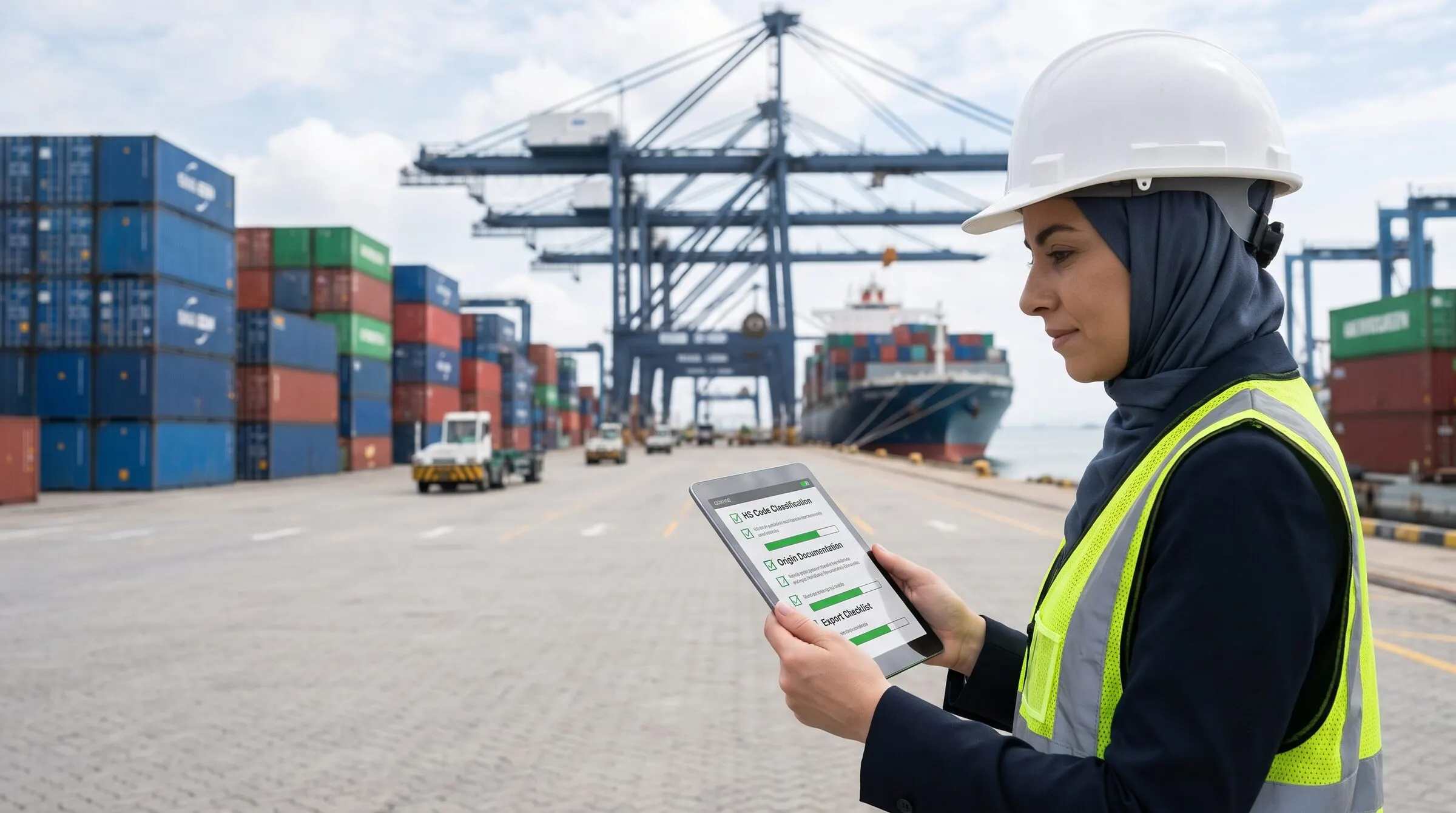
What should you check before every shipment?
Check that each item below is done and saved before the cargo leaves.
How do you keep compliance data connected to the shipment?
Keep product data, documents and shipment status in one record, so the people booking a shipment and the people checking it work from the same information. Compliance breaks down when product data lives in one place, documents in another, and shipment status in a third. FreshTrack brings planning, execution, visibility and risk intelligence together for exporters, importers and manufacturers across maritime, road and air freight, and its risk intelligence tools sit on the same record.
Where should you start?
Global trade compliance is manageable when you treat it as a repeatable process: classify carefully, document consistently, screen parties, and keep records. Start with the classification master list and the pre-shipment checklist; they remove the most common causes of delay. Then confirm country-specific rules with the relevant authority or a licensed professional.
Frequently asked questions
What is global trade compliance?
Global trade compliance is the process of following the laws, regulations and procedures that govern moving goods across borders. It covers classification, valuation, origin, licensing, party screening, documentation and record-keeping, for both exports and imports.
What documents do I need to export goods?
Most shipments need a commercial invoice, packing list and transport document. Depending on the goods and destination you may also need a certificate of origin, an export licence, inspection or health certificates, and dangerous-goods paperwork. Requirements vary by country, so check both the export and import sides.
What is an HS code and why does it matter?
An HS code is a standardized numeric code identifying a product category in international trade. The first six digits are shared worldwide. It determines duty treatment, licence requirements and statistical reporting, so a wrong code can cause delays, penalties or incorrect duties.
Who is responsible for compliance, the exporter or the freight forwarder?
The exporter or importer of record is generally responsible for the accuracy of the information declared, even when a forwarder or broker files on their behalf. The forwarder acts on your instructions and data. Confirm obligations in your contracts and with the relevant customs authority.
How long should I keep trade records?
Retention periods are set by each country's law and typically run for several years. Because they differ, adopt a policy based on the longest period that applies to your trade lanes and confirm it with a licensed customs professional.
Is this guide legal advice?
No. It is general educational content. Compliance rules differ by country and change over time, so consult the relevant customs authority or a qualified trade-compliance professional for decisions about your shipments.
References
- Global Affairs Canada, WTO Agreement on Trade Facilitation (summarizing entry into force and WTO cost-reduction estimates)
- World Customs Organization, What is the Harmonized System (HS)?
- European Commission, Taxation and Customs Union, Trade facilitation
- Congressional Research Service, WTO Trade Facilitation Agreement (R44777)