





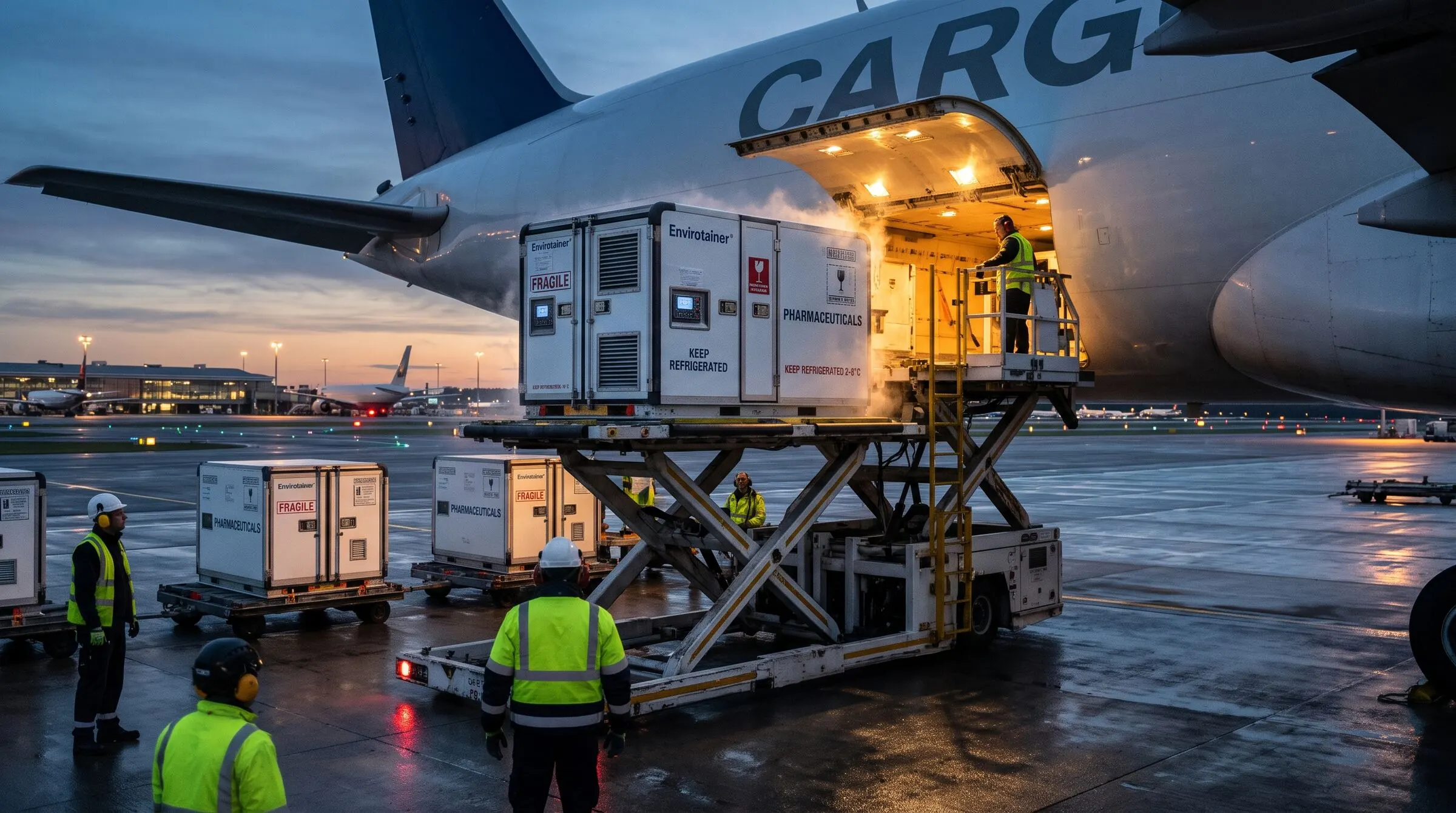
What is pharmaceutical cold chain logistics?
Pharmaceutical cold chain logistics is the controlled storage and transport of medicines within the temperature range stated by the manufacturer, from production through distribution to the point of care, supported by documented evidence that the range was maintained. It covers vaccines, biologics, insulin, many injectables and other temperature-sensitive products, and it spans air, ocean, road and last-mile delivery.
The labelled range is a hard limit. A medicine that has left its range may look unchanged and still be compromised, so the system relies on prevention and proof rather than inspection on arrival. This article explains the structure of that system for shippers, forwarders and pharma supply chain teams.
What temperature ranges do medicines need?
Storage and transport conditions come from the product’s registered label. Industry guidance on service-provider qualification lists the typical ranges as 2–8 °C, 15–25 °C, −20 °C and −70 °C [1], and every range drives different packaging, equipment and handling.
| Labelled range | Typical product examples | Logistics implication |
|---|---|---|
| 2–8 °C (refrigerated) | Many vaccines, biologics, insulin | Protection against both heat and freezing |
| Controlled room temperature | Many tablets and capsules | Seasonal heat and cold protection; often overlooked |
| −20 °C (frozen) | Certain biologics and vaccines | Specialized packaging or equipment, shorter hold times |
| −70 °C and below (ultra-cold) | Some advanced therapies and vaccines | Dry ice or cryogenic shippers, tight handling windows |
For refrigerated goods the danger runs in both directions. Freezing can damage some products as surely as heat can.
Who is accountable for temperature control in transport?
Under the EU’s Good Distribution Practice (GDP) guidelines, the supplying wholesale distributor is accountable. Chapter 9 places the responsibility on it to protect medicinal products against breakage, adulteration and theft and to ensure that temperature conditions are maintained within acceptable limits during transport [2]. The same guidance expects validated temperature-control systems, written procedures for seasonal variation, and a procedure for investigating excursions.
Regulators also expect risk-based thinking about the route itself. The UK’s MHRA GDP Inspectorate advises that an assessment of transport chains should identify which parts carry the greater risk [3], either by route or by grouping similar routes and modes into lanes. It lists risks such as high and low temperature excursions, security breaches, damage in transit and failure to deliver in full and on time.
For air freight, the industry reference is the IATA Temperature Control Regulations (TCR), which provide the requirements and standards for transporting and handling pharmaceutical products [4], including the compulsory use of the Time and Temperature Sensitive Label. IATA publishes a 14th edition for 2026 [5], and its CEIV Pharma programme certifies airlines, forwarders and handlers against pharmaceutical handling standards.
Where do temperature excursions happen?
Temperature failures cluster where control passes from one party to another or where goods wait.
- Origin handover: pre-conditioned packaging or vehicles not ready when cargo arrives.
- Airport and port dwell: time on the apron, in a non-controlled cargo area, or awaiting loading.
- Customs and inspection holds: unplanned delays that outlast packaging hold times.
- Transfers and cross-docks: doors open, loads staged outside controlled areas.
- Last mile: vehicle temperature, unattended deliveries, and missed delivery windows.
- Seasonal extremes: summer heat and winter freezing on routes designed for moderate weather.
Because the dangerous moments are transitions and delays, early awareness that a shipment is running late, before its packaging hold time runs out, is one of the most valuable capabilities a team can have.
What are the four layers of control?
Prevention rests on four layers: qualified packaging, qualified carriers and lanes, continuous monitoring, and a documented excursion procedure.
| Layer | What it does | Questions to ask |
|---|---|---|
| 1. Qualified packaging | Maintains range for a stated duration under stated conditions | Was it qualified for this lane, season and duration? What margin remains if the trip runs long? |
| 2. Qualified carriers and lanes | Ensures handlers, vehicles and facilities meet requirements | Do they hold relevant certifications? Have we audited them? |
| 3. Monitoring | Records temperature and location, with alerts | Logger or real-time sensor? Who receives alerts and who can act? |
| 4. Excursion procedure | Defines who does what when range is breached | Is there a written procedure with named owners and decision criteria? |
Layer 1: packaging
Passive systems (insulated shippers with coolant) and active systems (powered, temperature-controlled containers) are both used. The central question is duration: how long will the packaging hold range under the worst plausible conditions on this lane? Choose it for the delay you might face, not the transit time you hope for.
Layer 2: carriers and lanes
Qualify providers before using them and review them afterward. The same GDP guidance on service providers stresses that qualification is not a one-time exercise [1]. It should include performance monitoring such as excursion and delivery KPIs, and an effective corrective-and-preventive-action process.
Layer 3: monitoring and visibility
Data loggers record what happened; real-time sensors and shipment tracking tell you while it is still happening. Both are valuable, but they answer different questions. A logger can prove a shipment stayed in range or show where it did not. Live status and ETA tracking lets a team intervene, for example by arranging replacement ice, rerouting or escalating a customs hold. Whichever you use, define who receives alerts and what authority they have to act at 2 a.m.
Layer 4: the excursion procedure
See the next section for the steps.
What should you do when an excursion happens?
Treat an excursion as a quality decision: secure the product first, then let the responsible quality function assess it. Logistics staff should not decide to release or discard.
- Secure the product. Quarantine and label it so it cannot be released or used.
- Preserve the data. Retain logger or sensor data, packaging details and timelines.
- Notify the responsible quality function immediately.
- Assess impact. The quality unit judges the effect using the product’s stability data and the exposure profile.
- Document the decision and the root cause.
- Act on the cause. Update lane risk assessments, packaging or provider selection.
How can you see a delay before it becomes an excursion?
You can see it by tracking each shipment’s status and ETA across modes, so a missed connection, a customs hold or a rerouted flight is flagged while hold time remains. These problems quietly consume packaging hold time. FreshTrack is a supply chain platform that combines shipment visibility with risk intelligence across maritime, road and air freight, helping teams spot delays and disruption signals early. For the alert types worth setting up, see the five risk alerts every shipper needs.
It supports your process; it does not replace your validated quality system, packaging qualification or regulatory responsibilities. More on this sector is on our pharma page.
What should you check before each shipment?
Run through this checklist before cargo leaves:
- Product label temperature range confirmed with the quality unit.
- Packaging qualified for the lane, season and maximum expected duration.
- Carrier and handlers qualified and approved.
- Monitoring device selected, calibrated and activated; alert recipients named.
- Routing reviewed for dwell, transfer and customs risk points.
- Contingency plan ready for a delay: re-icing locations, alternate flights, customs contacts.
- Excursion procedure and quality contact reachable for the entire journey.
- Receiving site briefed on arrival time and acceptance steps.
Pharmaceutical cold chain logistics succeeds through layered prevention, early awareness and documented proof. Map the risky transitions on each lane, qualify packaging and providers for the worst plausible delay, monitor continuously, and treat any excursion as a quality decision.
Frequently asked questions
What is pharmaceutical cold chain logistics?
It is the transport and storage of medicines within their labelled temperature range from manufacturer to patient, with documented proof of control at every stage. It covers refrigerated, frozen and ultra-cold products across air, ocean, road and last-mile delivery.
What temperature must pharmaceuticals be shipped at?
It depends on the product label. Common ranges include 2–8 °C for refrigerated products, 15–25 °C for controlled room temperature products, and −20 °C or −70 °C for frozen and ultra-cold products. Always follow the manufacturer's labelled range and your quality unit's instructions.
What is a temperature excursion?
A temperature excursion is any time a product is exposed to conditions outside its labelled range during storage or transport. Whether the product remains usable is a quality assessment based on exposure and stability data; logistics teams should quarantine the product and escalate it rather than decide.
What does GDP mean in pharmaceutical logistics?
GDP stands for Good Distribution Practice, a quality standard for storing, transporting and distributing medicines. In the EU it is set out in the Commission's 2013 guidelines, which require that storage conditions be maintained during transport and that excursions be investigated.
What is IATA CEIV Pharma?
CEIV Pharma is an IATA certification programme for airlines, forwarders and ground handlers that handle pharmaceutical cargo. It certifies them against pharmaceutical handling standards.
Are data loggers enough, or do I need real-time tracking?
Loggers provide a record and proof after the fact. Real-time tracking and ETA monitoring give you time to intervene before the product leaves range. Many programmes use both, depending on product risk and lane.
References
This article is educational, not regulatory advice. Requirements differ between markets.
- ECA Academy (gmp-compliance.org), How Are Service Providers Qualified in a GDP Environment?
- ECA Academy (gmp-compliance.org), Checklist for Implementation of GDP Principles – Part 9: Transportation, referencing Chapter 9 of the EU GDP Guidelines (2013/C 343/01)
- MHRA GDP Inspectorate, A practical example of applying quality risk management in GDP transportation risks (blog post, 15 July 2020)
- IATA, Pharma and healthcare logistics
- IATA, Temperature Control Regulations