
Moroccan Logistics Partner: A Buyer's Checklist
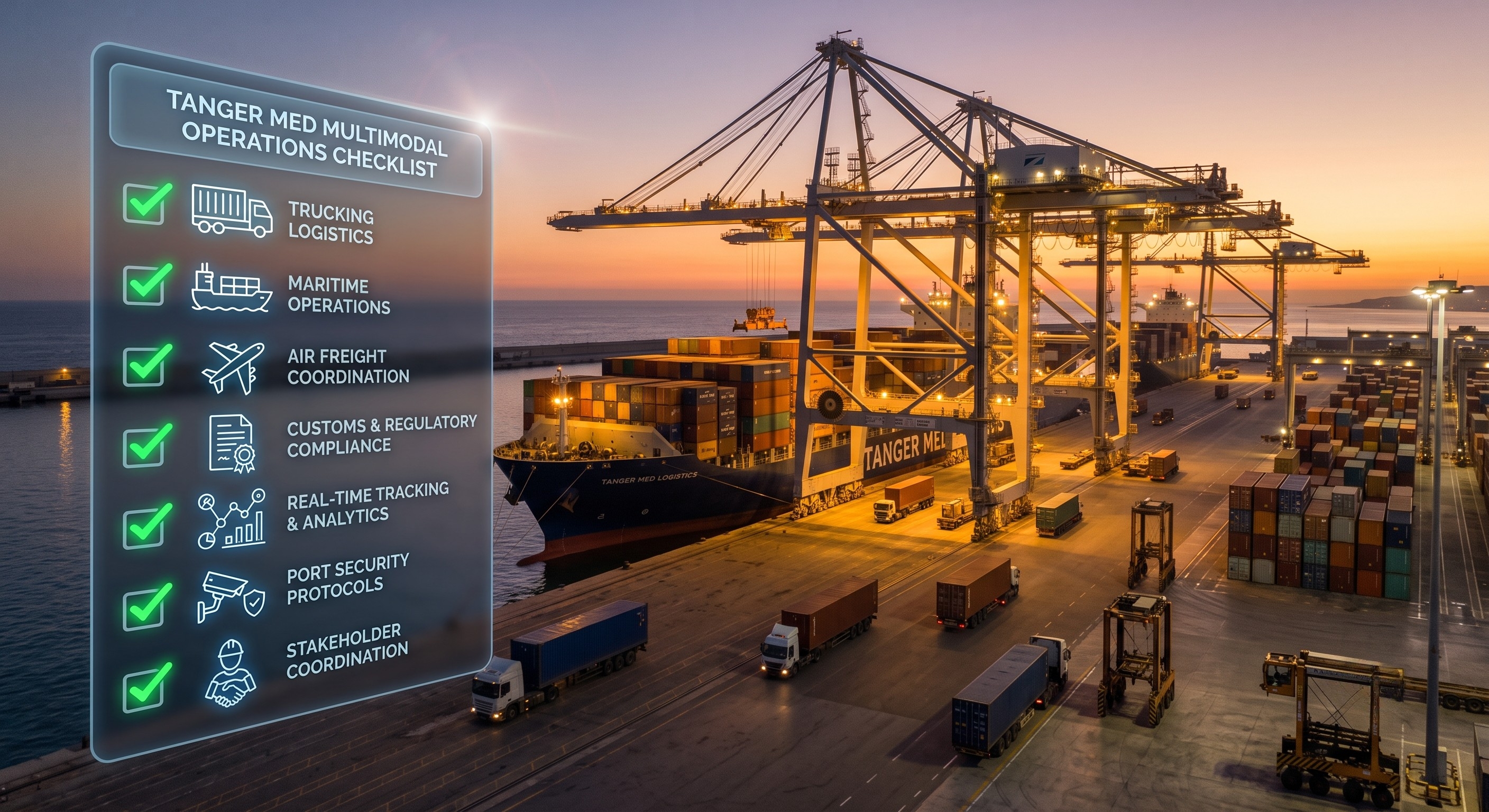
KEY TAKEAWAYS — READ IN 30 SECONDS
Introduction
A Moroccan logistics partner is the operator that turns Morocco’s geography — proximity to Europe, port capacity, and a growing multimodal network — into an actual result for your supply chain: on-time delivery, clean customs clearance, and predictable costs.
The country’s advantages are well documented, but they only reach your shipments through the specific partner you choose to operate them. This checklist walks through what to verify before you sign, organized by the questions that actually predict performance.
Containers handled by Tanger Med in 2025
Tanger Med Port Authority / Maroc.ma
Ports connected to Tanger Med
Tanger Med Port Authority
Countries covered by Moroccan preferential trade agreements
U.S. ITA / European Commission
Why Morocco Is a Strategic Logistics Decision Right Now
Morocco has become one of the more consequential logistics decisions on a global shipper’s map. Tanger Med, 45 kilometers from Tangier on the Strait of Gibraltar, is Africa’s largest port and handled more than 11.1 million containers in 2025, an 8.4% increase over 2024, with direct connectivity to over 180 ports in 70 countries.
On the World Bank’s Logistics Performance Indicators, which now draw on shipment-level tracking data rather than perception surveys alone, Morocco’s positioning reflects sustained investment in trade and transport infrastructure. Separately, the 2024 Agility Emerging Markets Logistics Index ranked Morocco 2nd in Africa and 12th globally on business fundamentals.
None of that is in question. What’s less certain, every time, is whether the specific partner in front of you can actually deliver on that geography.
Choosing wrong here is expensive in a specific way: it is not just one bad shipment, it is a bad shipment compounded across every lane that partner touches for the length of the contract.
A partner with a broker relationship at Tanger Med but no direct operational presence looks identical to one with real terminal relationships — right up until there is a delay and one of them can actually resolve it same-day.
The Buyer's Checklist
1. Network & Infrastructure Coverage
Start with geography. Does the partner have real operational presence at the corridors you actually use, or a broker relationship they are calling “coverage”?
- Which ports, airports, and inland hubs do they operate from directly?
- Do they have owned or controlled assets, or is everything subcontracted?
- What is their footprint outside the obvious hubs — do they reach secondary industrial zones?
2. Multimodal Capability
Very few shipments stay on a single mode end to end. A partner strong in one mode and weak in the others creates a handoff risk exactly where cargo is most vulnerable.
- Air: Can they handle time-critical or high-value freight with reliable customs clearance at Moroccan airports? See Air Transport in Morocco 2026 for current capacity and route coverage.
- Road: Is their road network resilient across the corridors linking Morocco to Europe and within-country industrial zones? Road Transport in Morocco 2026 covers infrastructure investment and regional reach.
- Maritime: How deep is their relationship with terminal operators at Tanger Med and other Moroccan ports? Maritime Transport in Morocco goes further into port capacity and vessel connectivity.
3. Technology & Visibility
Ask directly: is coordination happening on a shared system, or over email and phone calls? A partner that cannot give you live shipment status without a manual check-in is a liability the moment something goes wrong.
- Do they offer a live dashboard, or periodic manual updates?
- Can their system integrate with your TMS/ERP without a lengthy custom build?
- Is data shared with you in real time, or reconciled after the fact?
4. Compliance & Customs Expertise
Moroccan customs procedures and rules of origin under the EU and US free trade agreements are not optional knowledge — they are the difference between predictable clearance times and recurring delays.
- Do they have in-house customs brokerage, or do they outsource it?
- Can they demonstrate a track record with your product category: temperature-sensitive, hazardous, or high-value?
- Do they proactively flag documentation issues, or only react to holds?
5. Risk Management & Contingency
Ask what happens when something goes wrong — before it goes wrong.
- Do they have a defined process for delays, damage, or missing cargo, or is it improvised each time?
- What is their contingency plan for port congestion or weather disruption?
- Do they carry adequate, verifiable cargo insurance?
6. Sustainability & ESG
Increasingly a procurement requirement, not a nice-to-have, for shippers with their own ESG commitments.
- Do they report emissions data at the shipment or fleet level?
- What is their modal mix, and are they investing in lower-emission options?
7. References & Track Record
Can they provide references from shippers in your industry, not just their biggest logo? How long have they operated in Morocco specifically, versus just having a regional office?
8. Commercial Terms & SLAs
Are SLAs specific and measurable — on-time percentage, response time to exceptions — or vague language about “best effort”? How is pricing structured: all-in, or with accessorial fees that surface later? What is the exit clause if performance does not hold up?
| Category | Key question | Why it matters |
|---|---|---|
| Network coverage | Real presence or subcontracted? | Determines actual reliability at your corridors |
| Multimodal | Strong across air, road, sea? | Prevents handoff blind spots |
| Technology | Live dashboard or manual updates? | Determines how fast you learn about problems |
| Compliance | In-house customs expertise? | Predictable clearance times |
| Risk management | Defined contingency process? | Speed of recovery when disruption hits |
| Sustainability | Emissions data available? | Meets buyer-side ESG requirements |
| Track record | Vetted references in your sector? | Reduces evaluation guesswork |
| Commercial terms | Measurable SLAs? | Accountability built into the contract |
Trade Agreements Your Partner Should Know Cold
Morocco holds preferential trade agreements with more than 60 countries. Two matter most for international shippers:
- → EU-Morocco Association Agreement, in force since March 2000: created a free trade area for industrial goods, with duty-free access for limited quantities of agricultural products.
- → US-Morocco Free Trade Agreement, in force since January 2006: the only US FTA on the African continent, phasing out duties on qualifying goods and setting specific rules of origin, including accumulation and de minimis provisions.
A partner who can explain how your specific product qualifies under these rules — not just that the agreements exist — is showing you real customs expertise rather than a sales pitch.
Talk to a Partner Who Can Show, Not Just Tell
Before you sign anything, ask a candidate partner to walk you through one real shipment, end to end, on their own system — not a slide deck. Request a network and capability review for your specific lanes, and see how they answer the checklist questions above with actual data, not assurances.
Conclusion
Morocco’s advantage as a logistics hub is real — proximity to Europe, port capacity, and growing multimodal infrastructure. But that advantage only reaches your supply chain through the partner you choose to operate it.
Work through this checklist with specifics, not assurances, and you will catch the gaps before they show up in a delayed container or a missed customs deadline.
Choose the partner who can prove the operation, not just describe the market.
FAQ — Moroccan Logistics Partner Checklist
What should I look for in a Moroccan logistics partner?
Prioritize verifiable network coverage at your specific corridors, multimodal capability across air, road, and sea, real-time technology and visibility, in-house customs expertise, a defined risk and contingency process, and measurable SLAs rather than vague service commitments.
Why is Tanger Med important for choosing a logistics partner in Morocco?
Tanger Med is Africa's largest port and a major Mediterranean transshipment hub, connecting to over 180 ports in 70 countries. A partner with real operational relationships at Tanger Med's terminals — not just a broker arrangement — typically resolves delays faster and has better access to capacity during peak periods.
Does Morocco have a free trade agreement with the US and EU?
Yes. The EU-Morocco Association Agreement has been in force since March 2000, and the US-Morocco Free Trade Agreement has been in force since January 2006. Both include specific rules of origin that determine whether a given product qualifies for preferential tariff treatment.
How do I verify a Moroccan logistics partner's actual network coverage?
Ask which ports, airports, and inland hubs they operate from directly versus subcontract, request references from shippers in your industry, and ask for a live demonstration of their tracking system on a real shipment rather than a sales presentation.
What is the biggest risk in choosing the wrong logistics partner in Morocco?
The risk compounds: a partner with weak customs expertise, no shared visibility system, or no defined contingency process does not just cause one bad shipment — the same gaps recur across every lane they handle for the life of the contract.
References
- World Bank, Logistics Performance Indicators (LPI 2.0): https://lpi.worldbank.org/en/home
- Tanger Med Port Authority, Tanger Med Surpasses the 11 Million Container Mark: https://www.tangermedport.com/en/tanger-med-passes-the-10-million-container-mark/
- Maroc.ma, Tanger Med Port Exceeds 11 Mln Containers in 2025: https://www.maroc.ma/en/news/tanger-med-port-exceeds-11-mln-containers-2025-84-2024
- U.S. International Trade Administration, U.S.-Morocco Free Trade Agreement: https://www.trade.gov/us-morocco-free-trade-agreement
- European Commission, EU-Morocco Association Agreement: https://trade.ec.europa.eu/access-to-markets/en/content/eu-morocco-association-agreement
- Morocco World News, Morocco Ranks 2nd in Africa in 2024 Agility Emerging Markets Logistics Index: https://www.moroccoworldnews.com/2024/03/22028/morocco-ranks-2nd-in-africa-in-2024-agility-emerging-markets-logistics-index/
Related reading: Air Transport in Morocco 2026 · Road Transport in Morocco 2026 · Maritime Transport in Morocco