
Why Global Brands Are Quintupling Production in Morocco
FRESHTRACK · SUPPLY CHAIN CASE STUDY · JULY 2026
Why Global Brands Are Quintupling Production in Morocco
Moroccan supply chain data shows nearshoring has moved past pilots.
Decathlon has quintupled production, Asos and Boohoo expanded Morocco sourcing after Red Sea disruption, and QIMA audit data confirms order activity is rising.
FreshTrack · freshtrack.ma/en
KEY TAKEAWAYS — READ IN 30 SECONDS
Introduction
A Moroccan supply chain shift that started as a handful of pilot orders has become, for several major European retailers, a structural realignment of where production happens. Decathlon has quintupled its Moroccan output. Asos and Boohoo both redirected sourcing volume to Morocco after Red Sea shipping attacks disrupted their Asia routes. And independent sourcing-audit data — not brand press releases — confirms the trend is broad-based, not a handful of headline-grabbing exceptions.
This case study walks through what the numbers actually show, and why the shift looks durable rather than temporary.
Decathlon's increase in Moroccan production
K3 Fashion Solutions / Fashion-First ERP
Morocco inspection and audit demand, Q2 2025 YoY
QIMA Q2 2025 Barometer
Open water separating Morocco from Spain
Strait of Gibraltar proximity
The Numbers Behind the Shift
Brand announcements are easy to overstate. Inspection and audit demand is harder to fake, because it tracks what buyers are actually doing — commissioning factory audits and product inspections — rather than what they say in a press release.
QIMA, which draws on audit and inspection activity across more than 30,000 clients, has tracked this shift building for two years:
| Period | Morocco inspection/audit demand | Context |
|---|---|---|
| Q3 2024 | Mediterranean region >8% of EU procurement | Region establishing itself as a nearshoring hub |
| Q1 2025 | Morocco +45% YoY | Mediterranean sourcing at then-record share of EU portfolios |
| Q2 2025 | Morocco +53% YoY | Egypt +73%, Tunisia +35% — broad Mediterranean surge |
| Q3 2025 | Morocco +15% YoY | Growth continues, off a much larger 2025 base |
| Full-year 2025 | Morocco +38% YoY | Nearshoring hits record 14% of EU sourcing overall |
The pattern across every quarter is the same direction of travel, even as the growth rate moderates off an increasingly large base — which is itself a sign of a structural shift rather than a short-lived spike.
Case Study: Decathlon's Reversal
Decathlon, Europe’s largest sporting goods retailer, had spent roughly two decades reducing orders from Moroccan suppliers in favor of Southeast Asian manufacturing, building four proprietary factories, more than 500 suppliers, and four logistics hubs concentrated heavily in China.
That trend has now reversed. Decathlon has quintupled its production in Morocco, with approximately $100 million in annual orders now placed with Moroccan manufacturers — a shift driven by Europe’s position as Decathlon’s primary market and mounting pressure to address the environmental footprint of long-haul sourcing.
This is not a small supplementary order. Reversing two decades of sourcing strategy for a retailer of Decathlon’s scale signals a structural bet on Morocco’s proximity and reliability, not an opportunistic short-term hedge.
Asos and Boohoo After the Red Sea Crisis
Fast-fashion retailers Asos and Boohoo both increased Moroccan sourcing after attacks on container ships disrupted Red Sea and Suez Canal shipping routes. For fast fashion specifically, where the entire business model depends on short lead times, a disrupted six-to-eight-week Asia route is close to disqualifying — trend-driven collections that arrive late have already lost their commercial window.
Both retailers shifted trend-sensitive, quick-turn production toward Morocco, Turkey, and the UK, while continuing to use longer Asia routes for less time-sensitive product lines.
That is a telling detail: brands are not abandoning Asia sourcing wholesale, they are routing time-sensitive volume to nearshore suppliers and keeping cost-driven, less urgent volume further away — a deliberate bifurcation of the supply chain by lead-time sensitivity.
Why Morocco, Specifically?
Proximity and Transit Time
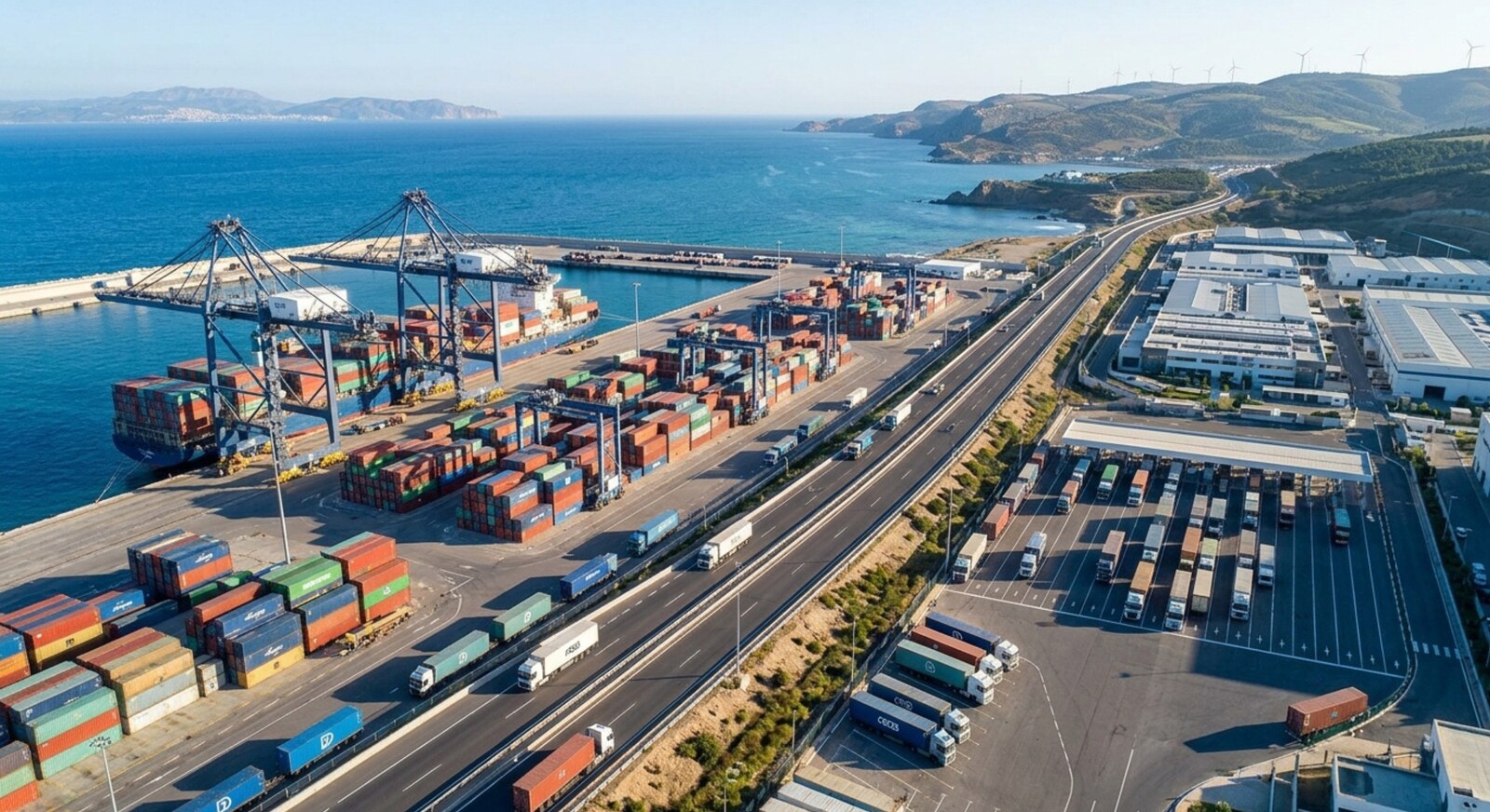
Morocco sits 14 kilometers from Spain across the Strait of Gibraltar, with Tanger Med providing a dedicated textile corridor and customs clearance in under an hour in some cases. That proximity converts directly into lead time: a European brand can turn around a Moroccan order in weeks, not the six-to-eight weeks typical of Asian ocean freight.
Getting goods from Moroccan factories to European distribution centers depends on a road network built for exactly this kind of time-sensitive movement — see Road Transport in Morocco 2026 for how that infrastructure is scaling alongside demand.
Duty-Free Market Access
The EU-Morocco Association Agreement, in force since March 2000, gives Moroccan industrial goods duty-free access to the EU market. The US-Morocco Free Trade Agreement, in force since 2006, extends preferential access to the US market — making Morocco the only African country with a free trade agreement with the United States.
For apparel specifically, that combination of proximity and tariff treatment is difficult for competing nearshore regions to match simultaneously.
Textile Ecosystem Scale
Morocco’s textile and apparel sector spans roughly 1,600 registered factories employing close to 200,000 workers, with the EU absorbing more than 90% of the sector’s textile and apparel exports, according to Morocco’s Association of Textile and Clothing Industries (AMITH).
That is not a boutique supplier base — it is an established industrial ecosystem with the depth to absorb structural order shifts from brands the size of Decathlon.
MOROCCO'S STRUCTURAL ADVANTAGE
- → Proximity: 14 kilometers from Spain, with road-ferry and short-sea options through Tanger Med.
- → Market access: Duty-free industrial goods access to the EU since 2000 and preferential US access since 2006.
- → Industrial depth: Around 1,600 registered textile and apparel factories employing close to 200,000 workers.
- → Operational fit: Fast enough for trend-sensitive European replenishment cycles that long Asia routes cannot reliably serve.
Trend or Pivot?
The clearest signal that this is a durable pivot rather than a passing trend: QIMA’s data shows Morocco outperforming Turkey, a longer-established nearshoring destination, as Turkey’s textile sector faces rising costs and labor shortages. When buyers redirect volume away from an established alternative toward Morocco specifically, that is a comparative decision based on current conditions, not just proximity to Europe in the abstract.
For a broader view of how this nearshoring shift fits into Morocco’s overall resilience story, see Moroccan Logistics as a Global Nearshoring & Resilience Hub.
MOROCCO SOURCING ASSESSMENT
See what nearshoring to Morocco looks like for your supply chain
If you are evaluating whether to shift production volume toward Morocco, the details that matter are specific to your product category, lead-time requirements, and current supplier base.
Conclusion
Decathlon, Asos, and Boohoo are not isolated case studies — they are visible examples of a shift that independent sourcing-audit data confirms is broad-based across European buyers. Morocco’s combination of proximity, duty-free market access, and established manufacturing scale means this looks less like a temporary hedge against Red Sea disruption and more like a durable reallocation of where European supply chains manufacture.
Frequently Asked Questions
Has Decathlon actually moved production to Morocco?
Yes. Decathlon has quintupled its Moroccan production, reversing roughly two decades of sourcing that had shifted heavily toward Southeast Asia, with approximately $100 million in annual orders now placed with Moroccan manufacturers.
Why did Asos and Boohoo increase sourcing in Morocco?
Both retailers increased Moroccan sourcing following 2024 attacks on container ships in the Red Sea and Suez Canal, which disrupted established Asia-to-Europe shipping routes. They shifted trend-sensitive, quick-turn production to Morocco while retaining longer Asia routes for less time-sensitive goods.
Is Morocco's nearshoring growth backed by data, or mostly brand announcements?
It is backed by independent sourcing-audit data. QIMA, drawing on inspection and audit activity across more than 30,000 clients, recorded Morocco inspection demand up 53% year-on-year in Q2 2025 and 38% for full-year 2025 — a measure of actual order activity rather than brand messaging.
What gives Morocco an advantage over other nearshoring destinations like Turkey?
Morocco combines 14-kilometer proximity to Spain, duty-free access to both the EU and US markets, and sub-one-hour customs clearance at Tanger Med. QIMA data shows Morocco outperforming Turkey specifically as Turkey's textile sector faces rising costs and labor shortages.
Is nearshoring to Morocco a temporary response to shipping disruptions, or a lasting shift?
The data suggests a lasting shift. Growth has continued across multiple quarters even as immediate shipping disruptions have evolved, and major buyers like Decathlon have reversed decades-long sourcing strategies rather than making short-term adjustments.
References
- QIMA. Nearshoring & Reshoring Trends: Recent Data. https://blog.qima.com/traceability/nearshoring-reshoring-trends
- QIMA. Q1 2026 Supply Chain Barometer: Global Sourcing Trends, Risks & Opportunities. https://www.qima.com/newsroom/news/news-q1-2026-barometer
- QIMA. 2025 Q2 Barometer. https://www.qima.com/newsroom/news/news-q2-2025-barometer
- K3 Fashion Solutions / Fashion-First ERP. The Moroccan Opportunity: How Nearshoring Is Poised to Ignite EU and Africa Trade. https://k3fashionsolutions.com/knowledge-hub/the-moroccan-opportunity-how-nearshoring-is-poised-to-ignite-eu-and-africa-trade/
- U.S. International Trade Administration. U.S.-Morocco Free Trade Agreement. https://www.trade.gov/us-morocco-free-trade-agreement
- European Commission. EU-Morocco Association Agreement. https://trade.ec.europa.eu/access-to-markets/en/content/eu-morocco-association-agreement
Related reading: Moroccan Logistics as a Global Nearshoring & Resilience Hub · Road Transport in Morocco 2026