
Morocco-to-Sub-Saharan Africa Logistics: The Next Growth Corridor
KEY TAKEAWAYS - READ IN 30 SECONDS
Introduction
Morocco-to-Sub-Saharan Africa logistics is being reshaped by one of the most ambitious infrastructure initiatives in the region: Morocco’s Atlantic Initiative, a state-led effort to connect landlocked Sahel economies to global maritime trade through Moroccan ports.
For shippers and carriers evaluating West and Central African market access, this corridor is worth understanding now, even though significant pieces of it are still years from completion.
01 - What the Atlantic Initiative Actually Is
Announced by King Mohammed VI in November 2023, Morocco’s Atlantic Initiative is a corridor strategy combining Atlantic port infrastructure, inland transit routes, and energy systems to connect landlocked Sahelian economies - specifically Mali, Burkina Faso, Niger, and Chad - to maritime access through Moroccan territory.
The strategy responds to a real structural problem: landlocked Sahel countries face high shipping costs and limited market access, and the initiative aims to substantially transform the economic position of these states by giving them a reliable Atlantic gateway.
02 - The Infrastructure: Dakhla Atlantic Port
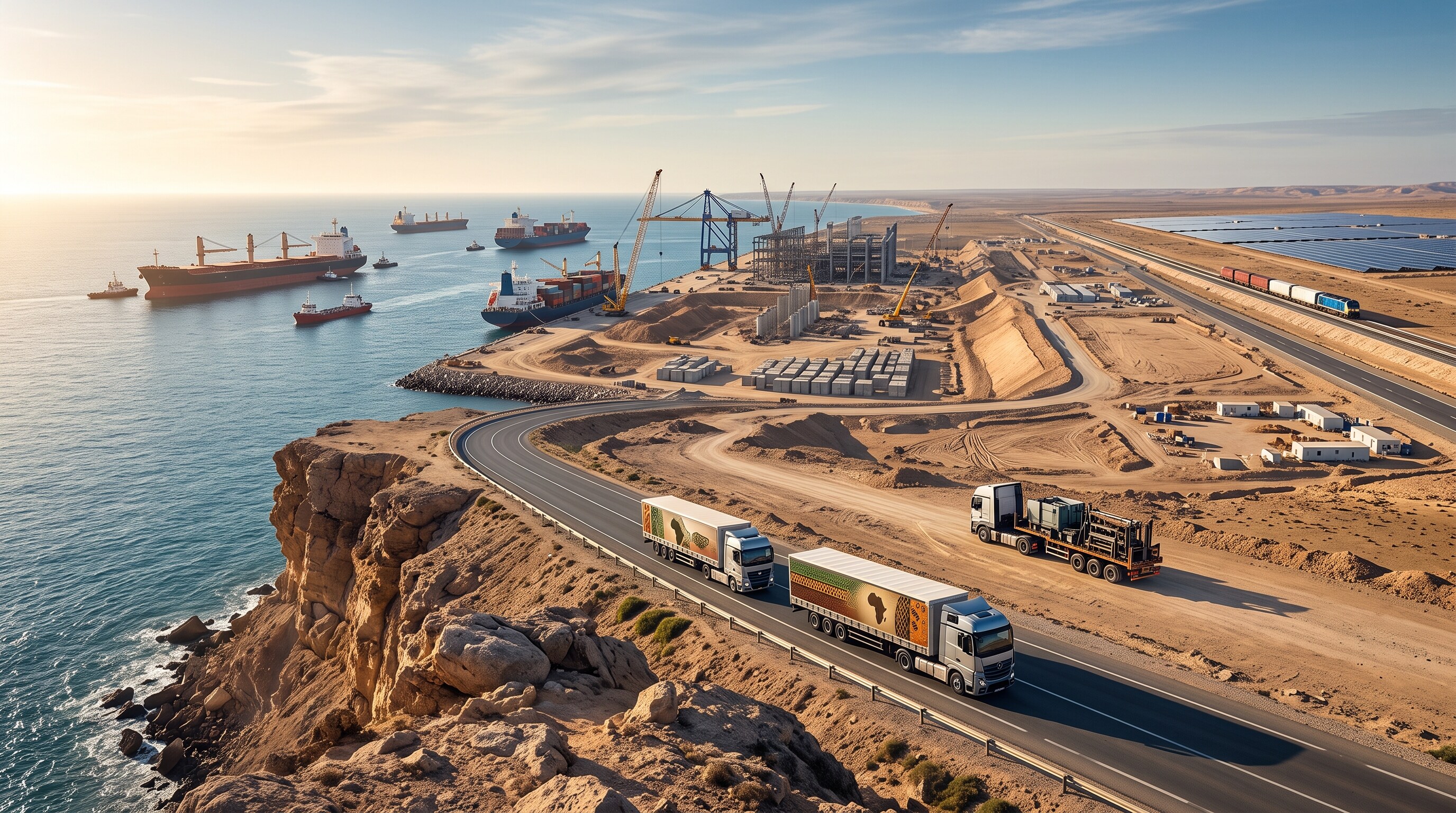
The centerpiece of the corridor is the Dakhla Atlantic Port at El Argoub, a roughly $1.2-$1.3 billion investment targeting 35 million tons of annual capacity by full completion in 2028, with partial operations potentially beginning in 2026.
This is not a standalone port project. It is paired with commitments to pave and secure the Moroccan coastal road to the Mauritanian border and a new, second Morocco-Mauritania border crossing east of Guerguerat, confirmed in February 2025, intended to relieve congestion on the existing single-axis route.
For shippers, the Atlantic Initiative is best understood as a corridor program, not just a port announcement.
03 - What Already Works vs. What Is Still Aspirational
It is worth being precise about the corridor’s current maturity, because the gap between announced ambition and built infrastructure is significant.
| Element | Current status |
|---|---|
| Existing coastal road: Morocco-Mauritania via Guerguerat | Functional today; a single paved axis facing rising congestion |
| Dakhla Atlantic Port | Under construction; targeting 2026 partial operations and 2028 full capacity |
| New second border crossing: Es-Smara route | Confirmed and in development as of early 2025 |
| Full road/rail network to Mali, Niger, Chad | Not yet built; experts describe this network as not currently existing |
| Total cost of full trans-Saharan corridor to Chad | Estimated at roughly $1 billion, per regional analysts |
Independent analysts, including researchers at Morocco’s own Policy Center for the New South, are candid about this gap: the corridor’s credibility currently rests on the port infrastructure and transit governance through Mauritania, while thousands of kilometers of the deeper Sahel road network remain to be built.
04 - Why This Corridor Matters Commercially, Already
Despite the infrastructure gap, the trade relationship this corridor is meant to formalize is already growing.
Moroccan exports to Africa increased from $300 million to more than $3 billion between 2004 and 2024, and Moroccan companies have invested more than $2.5 billion across the continent, with Mali ranking as the third-largest destination for Moroccan investment in Africa.
That existing commercial base - telecommunications, cement, banking, and services - gives the Atlantic Initiative a running start that a purely greenfield corridor would not have.
05 - What This Means for Shippers Right Now
For shippers evaluating this corridor today, the practical takeaway is a two-speed reality: the existing coastal route through Guerguerat to Nouadhibou and Nouakchott is a functional, if increasingly congested, option for Mauritania-bound and near-border trade now.
Deeper access into Mali, Burkina Faso, Niger, and Chad remains dependent on infrastructure that is confirmed and funded but not yet operational.
This is a corridor to build into a multi-year market-entry plan, not one to route time-sensitive freight through today.
For the broader Moroccan logistics infrastructure this corridor connects to, see Road Transport in Morocco 2026 and Moroccan Logistics as a Global Nearshoring & Resilience Hub.
Plan Ahead of the Infrastructure Curve
Corridors like this reward shippers who position early relationships and route knowledge before capacity is fully built out.
Request a Sub-Saharan corridor briefing and we will walk through what is realistic to plan for on a 2026-2028 timeline versus what remains aspirational.
Conclusion
Morocco’s Atlantic Initiative represents a genuinely significant long-term shift in West and Central African market access, backed by real investment, an already-growing trade relationship, and a specific 2028 infrastructure target.
But shippers should treat it as an emerging corridor to plan around, not a mature route to rely on today: the port is under construction, the deep-Sahel road network does not yet exist, and the existing coastal route is functional but increasingly congested.
Plan the corridor before the capacity arrives.
Corridor briefing
Map what is realistic on the 2026-2028 horizon
FreshTrack helps shippers separate usable routes from emerging infrastructure when evaluating Morocco-to-Sub-Saharan Africa logistics plans.
FAQ - Frequently asked questions
What is Morocco's Atlantic Initiative?
It is a corridor strategy launched in November 2023 to connect landlocked Sahel states - Mali, Burkina Faso, Niger, and Chad - to global maritime trade through Moroccan Atlantic ports, anchored by the Dakhla Atlantic Port and supporting road infrastructure.
When will the Dakhla Atlantic Port be operational?
Partial operations are targeted for as early as 2026, with full capacity of 35 million tons annually expected by 2028, backed by roughly $1.2-$1.3 billion in investment.
Is the Morocco-to-Sub-Saharan Africa corridor usable for shipping today?
Partially. The existing coastal road via Guerguerat to Nouadhibou and Nouakchott is functional for Mauritania-bound trade, but the deeper road and rail network into Mali, Niger, and Chad has not yet been built.
How much has Morocco's trade with Africa grown?
Moroccan exports to Africa grew from $300 million to more than $3 billion between 2004 and 2024, alongside more than $2.5 billion in Moroccan company investment across the continent.
What is the biggest risk to this corridor's timeline?
Infrastructure gaps and regional security conditions in parts of the Sahel remain significant challenges, and independent analysts note that the full trans-Saharan road network to landlocked states does not currently exist.
References
- Carnegie Endowment for International Peace, Morocco’s Atlantic Initiative and Potential Challenges to Regional Leadership - https://carnegieendowment.org/sada/2024/10/moroccos-atlantic-initiative-and-potential-challenges-to-regional-leadership?lang=en
- Policy Center for the New South, Unlocking the Sahel, Reconfiguring the Western Mediterranean: Morocco’s Atlantic Initiative as an Integration Corridor - https://www.policycenter.ma/publications/unlocking-sahel-reconfiguring-western-mediterranean-moroccos-atlantic-initiative
- France 24 / AFP, Morocco’s Atlantic Gambit: Linking Restive Sahel to Ocean - https://www.france24.com/en/live-news/20250629-morocco-s-atlantic-gambit-linking-restive-sahel-to-ocean
- New Lines Institute, A U.S. Sahel Strategy Anchored in Morocco and Mauritania - https://newlinesinstitute.org/global-security-mil-priorities/a-u-s-sahel-strategy-anchored-in-morocco-and-mauritania/
Related reading: Road Transport in Morocco 2026 - Moroccan Logistics as a Global Nearshoring & Resilience Hub