
Logistics Platform vs. Point Solutions: Why a Single Collaborative Interface Wins for Global Supply Chains
KEY TAKEAWAYS — READ IN 30 SECONDS
Introduction
A logistics platform is software that connects every party in a shipment — shipper, carrier, forwarder, customs broker, and consignee — to one shared, real-time record, replacing the separate tools each actor would otherwise use on their own.
That is the core distinction from a point solution, which is built to serve a single actor’s task, like booking freight or tracking GPS pings, in isolation from everyone else touching the shipment.
For global supply chains running multiple modes and multiple partners at once, that architectural difference determines how fast problems get caught — and how much manual work it takes to catch them.
01 — What Is a Logistics Platform, and How Is It Different From a Point Solution?
Point solutions: built for a task
A transportation management system (TMS) handles booking and freight audit. A visibility tool pings GPS and AIS data. A carrier portal manages documents.
Each does its one job well — for one actor. None of them was designed to represent the shipment as a whole, because none of them was built to be shared.
Logistics platforms: built for the shipment
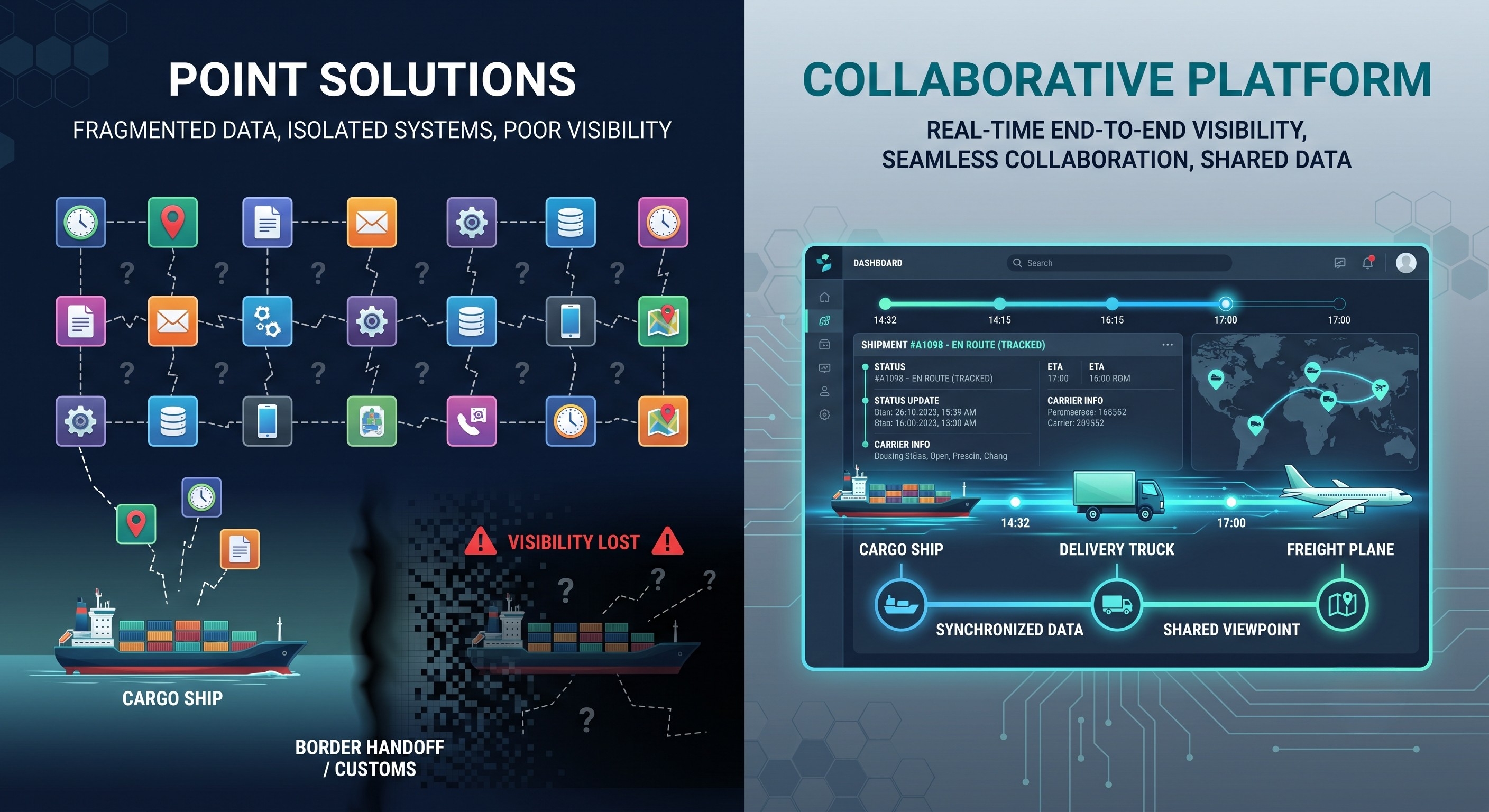
A digital logistics platform flips that design principle. Instead of software built around one actor’s task, it is built around the shipment itself, with every party working from the same live record — bookings, documents, exceptions, and status updates in one place, visible to everyone who needs them.
02 — The Real Cost of Running Logistics on Point Solutions
Fragmentation rarely happens on purpose. It accumulates, tool by tool, until three predictable failure points show up in every disrupted shipment:
- Data lives in silos. The forwarder’s system does not know what the carrier’s system knows. Connecting them means custom, point-to-point integrations that have to be rebuilt for every new partner.
- Visibility stops at the handoff. A tool built for ocean freight goes dark the moment cargo hits the road — right at the transfer points where risk concentrates.
- Collaboration happens over email. Without a shared system of record, coordination becomes a chain of forwarded messages and phone calls: slow, undocumented, and hard to audit after the fact.
McKinsey’s research on digital logistics adoption found that a large majority of logistics digital transformations fail to fully achieve their stated goals — a pattern consistent with tools being added piecemeal rather than built on a shared data foundation.
03 — Logistics Platform vs. Point Solutions: Side-by-Side Comparison
| Capability | Point Solutions (TMS / Visibility Tool) | Collaborative Platform |
|---|---|---|
| Data model | Siloed per system, per actor | Single shared record per shipment |
| Cross-actor visibility | Stops at each tool's boundary | Continuous, end-to-end |
| Multimodal coverage | Usually mode-specific | Road, maritime, air on one dashboard |
| Integration cost | New integration per partner | One connection, network effect scales |
| Exception handling | Manual, email-driven | Shared workflow, timestamped and auditable |
| Onboarding new partners | Slow, custom each time | Standardized, faster |
04 — Why a Collaborative Interface Wins at Scale
Gartner’s Market Guide for Supply Chain Visibility Software frames this directly: supply chain leaders reduce risk and improve performance by moving to multienterprise, collaborative software that gives real-time insight across the full value network — not by adding another single-function tool.
That is not a minor technical preference. When a delay happens on a multimodal shipment, a point-solution stack requires someone to manually reconcile two or three separate systems just to see the full picture. A collaborative platform already has that picture assembled, which is the difference between reacting to a problem after the fact and catching it while there is still time to act.
There is a relationship dimension here too. When every actor — shipper, carrier, forwarder — works from the same record, disputes over “what happened and when” mostly disappear, because the timeline is shared and timestamped rather than reconstructed from separate inboxes after something goes wrong.
The real test is not whether a vendor has a dashboard. It is whether every actor in the shipment can work from the same live record without rebuilding integrations partner by partner.
05 — Where This Matters Most: Multimodal Routes and Emerging Hubs
Nearshoring, dual-sourcing, and shorter lead times have made global supply chains more distributed, not less — more actors, more modes, more handoffs.
Morocco’s rise as a nearshoring and logistics gateway between Europe, Africa, and the Americas is a clear example of this shift in practice. See Logistics and Digital Platform in Morocco 2026 for how digital infrastructure is becoming a differentiator there.
The multimodal dimension is usually where point solutions break down hardest, since few shipments stay on a single mode end to end. We go deeper on how a unified dashboard handles road, sea, and air handoffs in Multimodal Orchestration: Managing Road, Maritime and Air on One Dashboard.
06 — How to Evaluate a Logistics Platform
- Does every actor see the same data, or a filtered version of it? If carriers and shippers look at different systems that sync periodically, it is still a point-solution problem with a platform label.
- Does coverage span modes, or just one? Strong ocean tracking with no road or air visibility is still a point solution.
- Can a new partner be onboarded in days, not months? Integration friction is the clearest sign of the underlying architecture.
- Is collaboration built into the workflow, or bolted on as messaging? Comments and exception resolution should live inside the shipment record, not a parallel inbox.
Ready to See a Collaborative Platform in Action?
If your current stack is a TMS here, a visibility tool there, and a lot of email in between, the fastest way to know whether a collaborative platform is worth the switch is to see your own shipment data on one shared interface.
Request a platform walkthrough and bring one real multimodal lane — we will show you exactly where the current handoffs are creating blind spots.
Conclusion
Point solutions optimize a task. A collaborative platform optimizes the shipment — and the relationship between everyone responsible for getting it there.
As supply chains add more actors and more modes, that architectural choice compounds: the stack that worked with three tools and one lane breaks down at scale, while the platform built for collaboration does not.
Optimize the shipment, not just the task.
Collaborative logistics platform
See your multimodal shipments on one shared interface
Bring one real lane and identify where fragmented tools are creating blind spots, manual reconciliation, and preventable exception costs.
FAQ — Frequently asked questions
What is the difference between a logistics platform and a TMS?
A TMS is a point solution focused on one actor's task — typically booking, rating, and freight audit. A logistics platform is broader: it connects shippers, carriers, forwarders, and other actors on one shared record, often including or integrating with a TMS rather than replacing its function entirely.
Is a collaborative logistics platform more expensive than point solutions?
Not necessarily. Point solutions often look cheaper individually, but the cost of custom integrations, manual reconciliation, and delayed exception handling adds up. A platform's total cost of ownership is frequently lower once integration and coordination overhead are counted.
Can a logistics platform replace my existing TMS?
Some platforms integrate with an existing TMS rather than replacing it, syncing booking and freight-audit data into the shared shipment record. Others offer native TMS functionality. Which approach fits depends on how embedded your current TMS is in other workflows.
Does a logistics platform work across road, sea, and air?
A true collaborative platform is built for multimodal coverage, since most global shipments cross more than one mode. A tool that only covers one mode is a point solution regardless of what it is called.
How long does it take to onboard a new carrier or partner onto a logistics platform?
On a well-built collaborative platform, onboarding typically takes days, since the architecture is standardized rather than custom-built per partner. If a vendor quotes weeks or months for onboarding a single partner, that is usually a sign of point-solution architecture underneath.
References
- Gartner, Market Guide for Supply Chain Visibility Software — https://www.gartner.com/en/documents/3183220
- McKinsey & Company, Digital logistics: Into the express lane? — https://www.mckinsey.com/capabilities/operations/our-insights/digital-logistics-into-the-express-lane
- McKinsey & Company, Overcoming barriers to multitier supplier collaboration — https://www.mckinsey.com/capabilities/operations/our-insights/overcoming-barriers-to-multitier-supplier-collaboration
- Gartner Peer Insights, Real-Time Transportation Visibility Platforms — https://www.gartner.com/reviews/market/real-time-transportation-visibility-platforms