
The Cost of a Missed Alert: Real-World Scenarios Where Risk Intelligence Saved (or Could Have Saved) a Shipment
KEY TAKEAWAYS
The scenarios below are composite illustrations built from documented industry claims data and public reporting, not confidential case files from a specific shipper - with one exception: the Strait of Hormuz section describes a real, ongoing 2026 event.
Introduction
Risk intelligence exists to close one specific gap: the time between something going wrong with a shipment and someone finding out about it.
That gap is where a manageable problem - a refrigeration unit drifting a few degrees, a customs document sitting unprocessed, a chokepoint growing more dangerous by the day - turns into a total loss, a demurrage bill, or a stranded vessel.
The three scenarios below walk through how that gap plays out in practice, using documented industry data rather than hypothetical numbers, to make the case concrete rather than abstract.
01 - Scenario One: The Spoiled Reefer Load
The pattern
A temperature-sensitive shipment - produce, seafood, pharmaceuticals - leaves origin with a refrigeration unit set correctly. Somewhere in transit, the unit’s compressor degrades, a door seal fails, or the container loses power during a transfer.
Without continuous monitoring, nobody notices until the container is opened at destination and the cargo is visibly compromised.
What this actually costs
Industry claims data shows this is not a rare event. Mechanical failures account for roughly 36% of reefer cargo claims and temperature variations another 29% - together the two largest causes of loss, at 65% combined.
A single mechanical failure can spoil $80,000 to $200,000 of cargo in a matter of hours, and documented claims for individual 40-foot reefer containers have ranged widely: unintentional thawing of a tuna shipment valued at $500,000, temperature abuse of a fruit consignment at $335,000, a frozen shrimp shipment at $228,000, and a cherry consignment at $92,000.
The average reported reefer claim runs around $38,000 - meaning even “typical” excursions, not just worst-case failures, represent a meaningful loss.
What changes with risk intelligence
A connected platform monitoring temperature via IoT sensors flags the deviation the moment it starts, not when the container is opened.
That turns a total-loss event into a response window - reroute to a nearer cold-storage facility, alert the receiver to arrange emergency processing, or in some cases recover the shipment before the excursion becomes irreversible.
For the specific alert thresholds and monitoring standards that matter for cold chain cargo, see Temperature Excursions, ETA Deviations & Missing Containers: The Five Risk Alerts Every Shipper Needs.
02 - Scenario Two: The Missed Customs Window
The pattern
A container arrives at port, but a documentation gap - a missing certificate, an HS code mismatch, an incomplete customs declaration - is not caught until the container is already sitting in the terminal.
By the time the paperwork clears, the free-time window has expired. Demurrage charges begin accruing daily. If the container is not picked up promptly once released, detention charges stack on top.
What this actually costs
This is not a marginal cost category. Nine major ocean carriers collectively billed approximately $15.4 billion in demurrage and detention fees between April 2020 and March 2025, according to data reported against Federal Maritime Commission filings - a structural cost center in international shipping, not an occasional surprise.
Demurrage typically runs $75-150 per container per day, with detention adding $100-300 per day on top once a container leaves the terminal.
Industry analysis attributes 42% of demurrage and detention incidents to port congestion, 28% to customs clearance delays, 18% to trucking capacity constraints, and 12% to warehouse operational issues - meaning the documentation and customs share alone is a large, and often preventable, slice of the total.
What changes with risk intelligence
A platform that flags documentation gaps before a vessel arrives - missing certificates, HS code mismatches, incomplete declarations - gives a team days, not hours, to resolve the issue before the free-time clock even starts.
Combined with an automated countdown to free-time expiry, the same visibility that catches the underlying documentation problem also prevents the accidental demurrage-into-detention stacking that turns one delay into two separate fee categories.
Note that U.S. billing practices for these charges are now governed by Federal Maritime Commission rules requiring itemized, timely invoices - which makes accurate tracking of your own free-time windows even more valuable when disputing charges.
03 - Scenario Three: The Chokepoint Nobody Was Watching
Strait of Hormuz, 2026
Unlike the two scenarios above, this one is not a composite - it is a real, ongoing disruption.
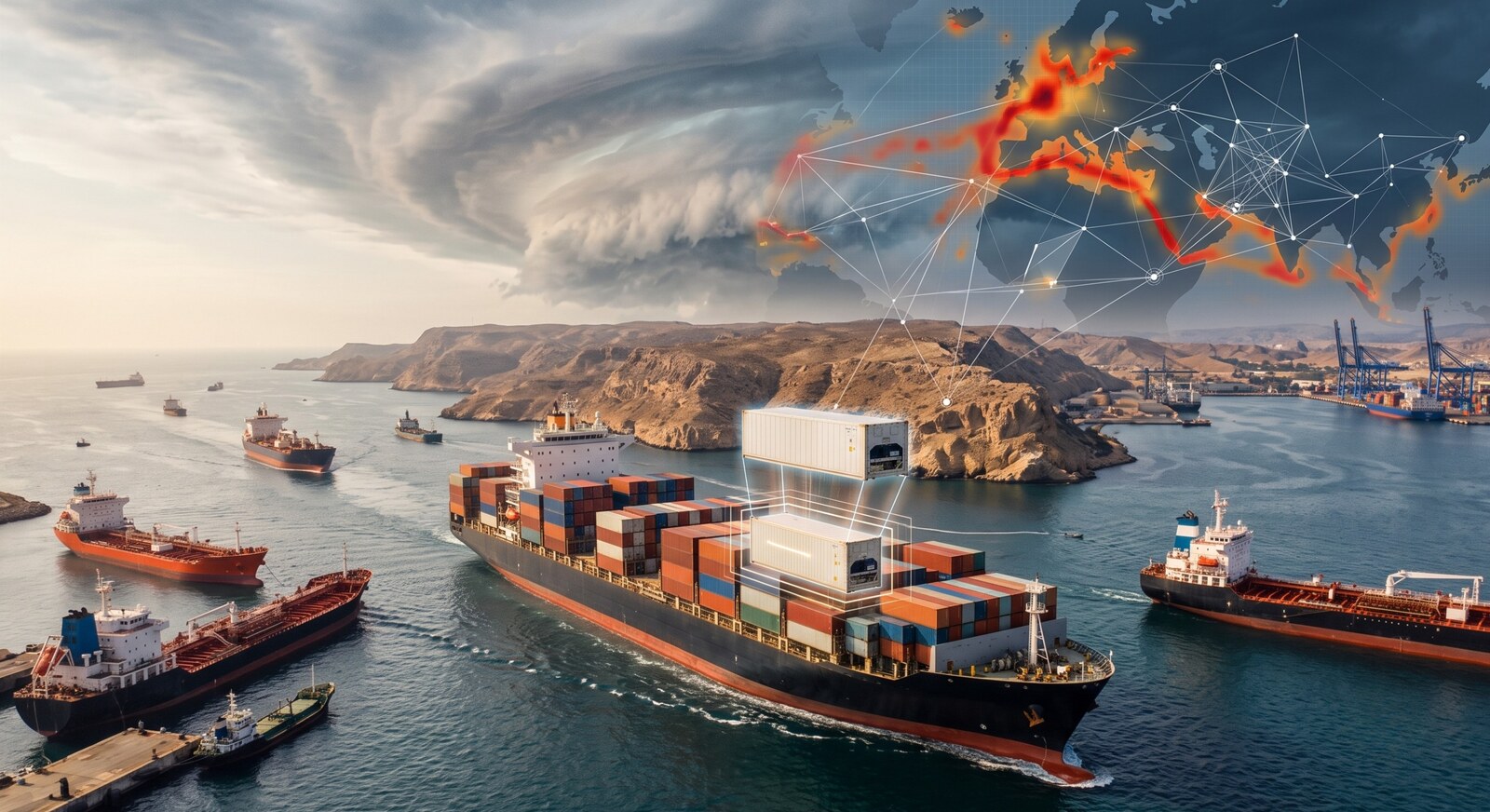
Since February 28, 2026, military escalation around the Strait of Hormuz has cut tanker traffic through one of the world’s most critical maritime chokepoints by an estimated 95% from its pre-crisis average of roughly 178 vessels a day.
More than 1,500 commercial vessels and over 20,000 mariners have been reported stranded in and around the strait. War-risk insurance premiums, which are normally repriced every 24 to 48 hours, rose sharply as insurers withdrew or repriced cover, with rates for some Gulf transits moving toward roughly 3% of vessel value.
The Red Sea route reopened to renewed attacks in the same window, meaning both of the region’s major maritime corridors were disrupted simultaneously - forcing carriers including Maersk, CMA CGM, MSC, and Hapag-Lloyd to suspend transits and reroute around the Cape of Good Hope, adding weeks to transit times.
What changes with risk intelligence
The US Navy-led Joint Maritime Information Center raised its Hormuz risk advisory from “substantial” to “severe” - a signal that was public before the situation deteriorated further.
A platform that ingests geopolitical and maritime advisory data alongside shipment tracking can flag a chokepoint’s rising risk level against cargo already committed to that route, giving a shipper time to reroute, renegotiate insurance terms, or adjust delivery commitments before the disruption fully materializes, rather than discovering the exposure only once transits have already stopped.
For the full picture of how this crisis is affecting global shippers, see our coverage of the ongoing Strait of Hormuz disruption.
The Pattern Across All Three
| Scenario | Missed-Alert Outcome | Connected Platform Outcome |
|---|---|---|
| Reefer temperature excursion | Total loss discovered at destination | Deviation flagged in transit, response window preserved |
| Customs documentation gap | Demurrage, then detention, stacking daily | Gap flagged pre-arrival, free-time clock never starts |
| Chokepoint escalation (Hormuz) | Exposure discovered only once transit halts | Rising risk advisory flagged against committed cargo in advance |
The common thread is not the type of disruption - it is the lag between the disruption starting and someone finding out.
For a full breakdown of what to evaluate when choosing a platform built to close that lag, see Risk Intelligence Platforms Compared: What to Look for Before You Buy.
See What a Missed Alert Would Have Cost You
If any of these scenarios sound familiar, the fastest way to understand the exposure in your own supply chain is to look at your actual shipment data.
Request a risk exposure review using your recent shipments, and we will show you where an alert would have fired - and how much earlier you would have known.
Conclusion
None of these scenarios require an exotic failure. A refrigeration unit degrades. A document gets flagged late. A shipping lane becomes dangerous faster than a static routing plan accounts for.
What separates a manageable disruption from an expensive one is almost always the same variable: how much time passes between the problem starting and someone finding out.
That is the entire case for risk intelligence - not predicting the unpredictable, but closing the gap on the disruptions that are, in hindsight, very well documented.
Close the gap between disruption and detection.
Risk exposure review
See where your missed alerts would have fired
Use recent shipment data to identify the points where earlier alerts could have reduced loss, fees, delays or exposure.
FAQ - Frequently asked questions
How much can a single reefer temperature excursion cost?
Documented cases range widely, from roughly $92,000 for a cherry consignment to $500,000 for an unintentional tuna thaw, with the average reported claim around $38,000. A mechanical refrigeration failure alone can spoil $80,000-$200,000 of cargo within hours.
How much do shippers pay in demurrage and detention fees?
Nine major ocean carriers collectively billed approximately $15.4 billion in demurrage and detention fees between April 2020 and March 2025. Demurrage typically runs $75-150 per container per day, with detention adding $100-300 per day once a container leaves the terminal.
Is the Strait of Hormuz still disrupted in 2026?
Yes, as of mid-2026 the Strait of Hormuz remains significantly disrupted following military escalation that began February 28, 2026. Tanker traffic has run at a small fraction of its pre-crisis average, with major carriers rerouting around the Cape of Good Hope.
What is the most common cause of demurrage and detention charges?
Industry analysis attributes 42% of incidents to port congestion, 28% to customs clearance delays, 18% to trucking capacity constraints, and 12% to warehouse operational issues.
Can a risk intelligence platform actually prevent a chokepoint disruption like the Hormuz crisis?
No platform can prevent a geopolitical or military disruption. What a connected risk intelligence platform can do is surface a rising risk advisory against cargo already committed to that route early enough to reroute, renegotiate insurance, or adjust delivery commitments before transits actually stop.
References & Sources
- Allianz Commercial, Safety and Shipping Review 2026. https://commercial.allianz.com/news-and-insights/news/safety-shipping-review-2026.html
- UN Trade and Development (UNCTAD), Strait of Hormuz Disruptions: Implications for Global Trade and Development. https://unctad.org/publication/strait-hormuz-disruptions-implications-global-trade-and-development
- Al Jazeera, When Will Strait of Hormuz Be “Safe” for Commercial Shipping Again? https://www.aljazeera.com/features/2026/4/28/when-will-strait-of-hormuz-be-safe-for-commercial-shipping-again
- Federal Maritime Commission, FMC Publishes Final Rule on Detention and Demurrage Billing Practices. https://www.fmc.gov/articles/fmc-publishes-final-rule-on-detention-and-demurrage-billing-practices/
- nVision Global, The Perils of Port Congestion: How to Mitigate Demurrage and Detention Fees. https://corporate.nvisionglobal.com/the-perils-of-port-congestion-how-to-mitigate-demurrage-and-detention-fees/
- RTE-USA, The ROI of Reefer Monitoring: Reducing Cargo Loss Claims. https://www.rte-usa.com/the-roi-of-automated-reefer-monitoring-part1/
Related reading: Temperature Excursions, ETA Deviations & Missing Containers: The Five Risk Alerts Every Shipper Needs · Risk Intelligence Platforms Compared: What to Look for Before You Buy · Strait of Hormuz coverage